to the editor: I was pleased that the article “The ‘Crashing Asthmatic’”1 included a differential diagnosis of vocal cord dysfunction (VCD). I would like to further discuss this puzzling condition.
VCD is a paradoxic adduction (closure) of the vocal cords during inspiration or expiration, when they should normally remain open. Unfortunately, misdiagnosis of VCD as asthma has led to several unnecessary intubations and iatrogenic side effects from unnecessary medications. The incidence of VCD is unknown and probably underreported, but an estimated 2 to 3 percent of the general population is affected. The majority of cases reported are in adolescent females. One study2 found that almost 10 percent of elite winter athletes had VCD.
The etiology of VCD is unknown, but there are several triggers, including exercise, gastro-esophageal reflux disease (GERD), postnasal drip, allergic rhinitis, and inhaled irritants.3 VCD is most commonly misdiagnosed as exercise-induced bronchospasm. There also seems to be a large psychologic component. A recent case report4 proposed focal dystonia as an etiology, suggesting that neurologic causes may at times need to be considered.4 The typical clinical presentation is acute onset of an inability to catch one's breath, inspiratory stridor, and choking or full sensation in the throat. The “so-called” classic history is an adolescent female who appears with inspiratory stridor just before a major sporting competition. The attack usually abates as quickly as it began. Most patients will appear very anxious, but are almost never hypoxemic, which differentiates VCD from an acute asthma attack. Patients also will have poor to no response from bronchodilators, except for the 30 percent of patients who have VCD and coexistent asthma and may be suffering from a simultaneous attack.
Microscopic Hematuria
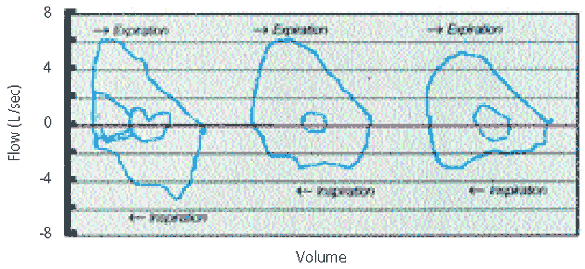
FIGURE. Spirometry flow-volume loops reveal the blunt or flattened inspiratory curves of a patient who has symptomatic vocal cord dysfunction.
Diagnosis rests with a high clinical suspicion and direct observation of paradoxic vocal cord function. The diagnosis can be strongly suggested by abnormal flow volume loops during an acute or provoked attack showing truncation or irregularity of the inspiratory or expiratory limbs of the flow volume loop (see the accompanying figure).5 VCD may be either an inspiratory (most common), expiratory, or combined phenomenon. During pulmonary function testing (PFT), methacholine can be used to induce reactive airway disease, and negative results almost certainly rule out any asthmatic component. Unfortunately, methacholine can act as an irritant and provoke VCD, but the flow volume loops will not reveal the characteristic obstructive pattern. If VCD is considered during PFT, direct laryngoscopy should be available to visually confirm the paradoxic vocal cord motion if induced. The real role of PFT is determining if there is a reversible bronchoconstrictive process. Fluoroscopy has been demonstrated as a reliable and noninvasive technique to confirm the diagnosis of VCD.6
Initial management depends on the severity of the attack. For mild episodes, coughing or panting may break the cycle. Acute, severe episodes of VCD can be managed with oxygen, Heliox (80 percent helium/20 percent oxygen), or sedation. Intermittent, positive pressure also can resolve an attack. Topical lidocaine applied to the larynx and discontinuing unnecessary asthma medication may be useful. Treatment of patients with GERD, allergic rhinitis, or postnasal drip are contributory; treatment of these conditions can greatly decrease the number of attacks. Behavior modification and speech therapy also are necessary. Anxiolytics have a role in the chronic management, because there is a large psychologic component to VCD.