Constipation in children usually is functional and the result of stool retention. However, family physicians must be alert for red flags that may indicate the presence of an uncommon but serious organic cause of constipation, such as Hirschsprung’s disease (congenital aganglionic megacolon), pseudoobstruction, spinal cord abnormality, hypothyroidism, diabetes insipidus, cystic fibrosis, gluten enteropathy, or congenital anorectal malformation. Treatment of functional constipation involves disimpaction using oral or rectal medication. Polyethylene glycol is effective and well tolerated, but a number of alternatives are available. After disimpaction, a maintenance program may be required for months to years because relapse of functional constipation is common. Maintenance medications include mineral oil, lactulose, milk of magnesia, polyethylene glycol powder, and sorbitol. Education of the family and, when possible, the child is instrumental in improving functional constipation. Behavioral education improves response to treatment; biofeedback training does not. Because cow’s milk may promote constipation in some children, a trial of withholding milk may be considered. Adding fiber to the diet may improve constipation. Despite treatment, only 50 to 70 percent of children with functional constipation demonstrate long-term improvement.
Constipation has been defined as “a delay or difficulty in defecation, present for two or more weeks, sufficient to cause significant distress to the patient.”1 This condition is responsible for an estimated 3 to 5 percent of physician visits by children.2 Constipation often causes more distress to parents and other caregivers than to the affected child. Many caregivers worry that a child’s constipation is the sign of a serious medical problem.
SORT: KEY RECOMMENDATIONS FOR PRACTICE
| Clinical recommendation | Evidence rating | References |
|---|---|---|
| If a rectal examination cannot be performed, an abdominal radiograph can be used to diagnose rectal impactions in children. | C | 8 |
| Orally administered polyethylene glycol is recommended for disimpaction in children with functional constipation. This agent has been shown to be more effective than lactulose. | B | 11 |
| Behavioral treatment is recommended as an adjunct to medical therapy in children with functional constipation. | A | 14, 15 |
| Biofeedback is not recommended because it does not improve outcomes when it is combined with medical therapy for functional constipation in children. | B | 16 |
A = consistent, good-quality patient-oriented evidence; B = inconsistent or limited-quality patient-oriented evidence; C = consensus, disease-oriented evidence, usual practice, expert opinion, or case series. For information about the SORT evidence rating system, see page 374 orhttps://www.aafp.org/afpsort.xml.
As children age, normal physiologic changes occur in the intestines and colon that decrease the daily number of stools from a mean of 2.2 in infants younger than one year to a mean of 1.4 in one- to three-year-old children (Table 1).1,3 Thus, less frequent stooling may not be constipation. If, however, constipation is defined as “failure to evacuate the lower colon completely,”4 even children who stool daily in small amounts may be considered to have constipation. Encopresis, which is the involuntary leakage of feces into the undergarments, may be an indication of constipation.
TABLE 1 Normal Frequency of Bowel Movements in Infants and Children
| Age | Mean number of bowel movements per week | Mean number of bowel movements per day |
|---|---|---|
| 0 to 3 months: breastfed | 5 to 40 | 2.9 |
| 0 to 3 months: formula-fed | 5 to 28 | 2.0 |
| 6 to 12 months | 5 to 28 | 1.8 |
| 1 to 3 years | 4 to 21 | 1.4 |
| > 3 years | 3 to 14 | 1.0 |
Adapted with permission from Fontana M, Bianchi C, Cataldo F, Conti Nibali S, Cucchiara S, Gobio Casali L, et al. Bowel frequency in healthy children. Acta Paediatr Scand 1989;78:682–4, with information from reference 1.
This article reviews the differentiation of organic and functional constipation in infants and children. The treatment of functional constipation also is reviewed.
Epidemiology
Up to one third of children ages six to 12 years report constipation during any given year.5 Constipation generally first appears between the ages of two and four years.6
Encopresis is reported by 35 percent of girls and 55 percent of boys who have constipation.7 In toddlers (ages two to four years), the distribution of constipation and soiling is equal in boys and girls. However, by school age (five years), encopresis is three times more common in boys than in girls.4 At the age of 10 years, approximately 1.6 percent of children still have some encopresis.4
Etiology and Pathophysiology
Continence is maintained by involuntary and voluntary muscle contractions. The internal anal sphincter has an involuntary resting tone that decreases when stool enters the rectum. The external anal sphincter is under voluntary control. The urge to defecate is triggered when stool comes into contact with the mucosa of the lower rectum.
If a child does not wish to defecate, he or she tightens the external anal sphincter and squeezes the gluteal muscles. These actions can push feces higher in the rectal vault and reduce the urge to defecate. If a child frequently avoids defecating, the rectum eventually stretches to accommodate the retained fecal mass, and the propulsive power of the rectum is diminished.
The longer that feces remains in the rectum, the harder it becomes. Passage of a hard or large stool may cause a painful anal fissure. The cycle of avoiding bowel movements because of a fear of painful defecation may progress to stool retention and infrequent bowel movements, a condition that is termed functional constipation.
Most children who present with constipation have functional constipation. Rarely, however, constipation has a serious organic cause. For confident diagnosis of functional constipation, family physicians should be alert for warning signs that may indicate the presence of a pathologic condition (Table 2).5
TABLE 2 Warning Signs for Organic Causes of Constipation in Infants and Children
| Warning signs or symptoms | Suggested diagnosis |
|---|---|
| Passage of meconium more than 48 hours after delivery, small-caliber stools, failure to thrive, fever, bloody diarrhea, bilious vomiting, tight anal sphincter, and empty rectum with palpable abdominal fecal mass | Hirschsprung’s disease |
| Abdominal distention, bilious vomiting, ileus | Pseudo-obstruction |
| Decrease in lower extremity reflexes or muscular tone, absence of anal wink, presence of pilonidal dimple or hair tuft | Spinal cord abnormalities: tethered cord, spinal cord tumor, myelomeningocele |
| Fatigue, cold intolerance, bradycardia, poor growth | Hypothyroidism |
| Polyuria, polydipsia | Diabetes insipidus |
| Diarrhea, rash, failure to thrive, fever, recurrent pneumonia | Cystic fibrosis |
| Diarrhea after wheat is introduced into diet | Gluten enteropathy |
| Abnormal position or appearance of anus on physical examination | Congenital anorectal malformations: imperforate anus, anal stenosis, anteriorly displaced anus |
Adapted with permission from Felt B, Brown P, Coran A, Kochhar P, Opipari-Arrigan L. Functional constipation and soiling in children. University of Michigan Health System guidelines for clinical care 2003. Accessed online February 2, 2005, at:http://cme.med.umich.edu/pdf/guideline/peds03.pdf.
Differential Diagnosis: Functional vs. Organic Constipation
NEONATES
Organic causes of constipation most commonly are found in neonates (Table 3).1 Failure to pass a meconium stool within 48 hours of birth should raise suspicion for Hirschsprung’s disease (congenital aganglionic megacolon). Hirschsprung’s disease occurs in one of 5,000 children and usually is diagnosed in infancy.1
TABLE 3 Differential Diagnosis of Constipation by Age*
Infants
|
*—Diagnoses listed by frequency
Information from reference 1.
In neonates, it is important to confirm the anatomic position and patency of the anus. The absence of an anal wink or a cremasteric reflex, the presence of a pilonidal dimple or hair tuft, or a decrease in lower extremity tone, strength, or reflexes may suggest a spinal cord abnormality such as tethered cord, myelomeningocele, or spinal cord tumor.
INFANTS
If Hirschsprung’s disease is not recognized in the neonatal period, the affected infant may present with symptoms such as abdominal distension, pencilthin stools, failure to thrive, and bilious vomiting. If an infant has any of these symptoms, and the physical examination shows an empty rectum, Hirschsprung’s disease should be suspected. A delay in diagnosing this disease places the infant at risk for enterocolitis, with fever, explosive bloody diarrhea, and abdominal distension, in the second or third month of life.
Hypothyroidism is suggested in an infant with bradycardia, poor growth, and large fontanels. Cystic fibrosis may present with constipation and should be considered in an infant with constipation and concomitant rash, failure to thrive, fever, or pneumonia.
CHILDREN
Functional constipation is the cause of symptoms of constipation in more than 95 percent of children older than one year.5 However, when warning signs are present, organic causes must be considered (Table 2).5
Short-segment Hirschsprung’s disease may remain undiagnosed until a child is older than three years. Metabolic causes of constipation include hypercalcemia; hypothyroidism; and, more rarely, diabetes insipidus. Other causes include gluten enteropathy, cystic fibrosis, and lead toxicity.
Children with developmental or behavioral issues (e.g., mental retardation, autism, oppositional defiant disorder, depression) may be taking constipating medications such as opiates, phenobarbital, and tricyclic antidepressants.1
Clinical Diagnosis
The findings of the history and physical examination are instrumental in differentiating functional from organic constipation in all children. Because the causes of constipation differ according to age, algorithms for the differential diagnosis are different for neonates and infants (Figure 1)5 and for children older than one year (Figure 2).5
Figure 1. Functional Constipation in Infants
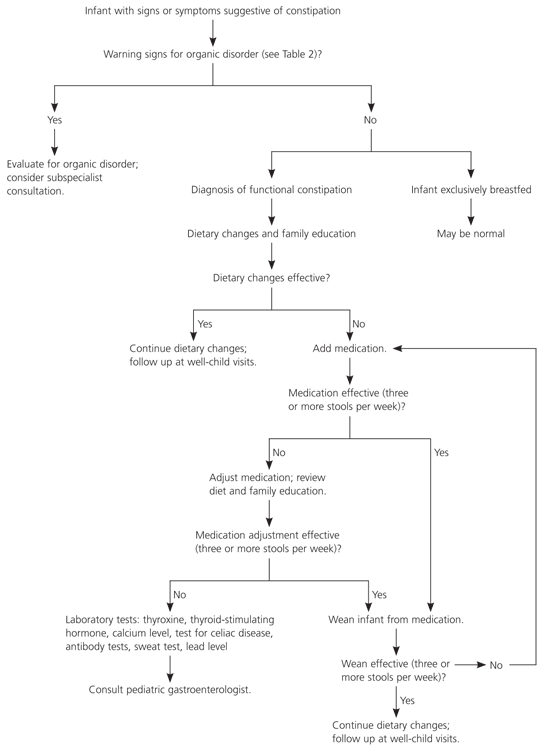
Diagnosis and management of functional constipation and encopresis in infants (age less than one year).
Adapted with permission from Felt B, Brown P, Coran A, Kochhar P, Opipari-Arrigan L. Functional constipation and soiling in children. University of Michigan Health System guidelines for clinical care 2003. Accessed online February 2, 2005, at:http://cme.med.umich.edu/pdf/guideline/peds03.pdf.
Figure 2. Functional Constipation in Children
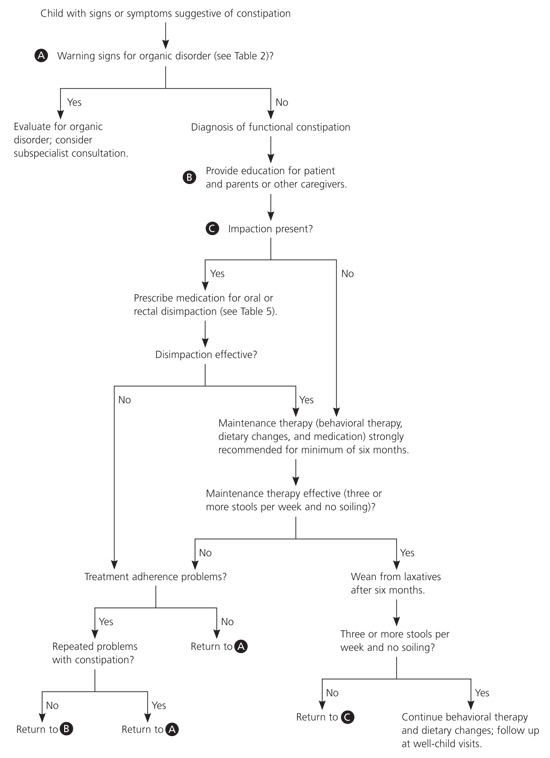
Diagnosis and management of functional constipation and encopresis in children (age older than one year).
Adapted with permission from Felt B, Brown P, Coran A, Kochhar P, Opipari-Arrigan L. Functional constipation and soiling in children. University of Michigan Health System guidelines for clinical care 2003. Accessed online February 2, 2005, at:http://cme.med.umich.edu/pdf/guideline/peds03.pdf.
MEDICAL HISTORY
A careful history should be obtained to identify possible organic causes of constipation (Table 4).5 Functional constipation is almost always the diagnosis in children older than one year. The medical history generally confirms this diagnosis.
The passage of infrequent, large-caliber stools is highly suggestive of functional constipation. Fecal soiling, especially after a child has been toilet trained for some time, suggests rectal impaction from functional constipation. One study8 found that 78 percent of children with encopresis had fecal impaction. Approximately three of every four children with constipation have pain with defecation.2 The history may indicate that a child with constipation has a low-fiber diet containing few fruits and vegetables.
TABLE 4 Findings Consistent with Functional Constipation
| History |
| Stool passed within 48 hours of birth |
| Extremely hard stools, large-caliber stools |
| Fecal soiling (encopresis) |
| Pain or discomfort with stool passage; withholding of stool |
| Blood on stools; perianal fissures |
| Decreased appetite, waxing and waning of abdominal pain with stool passage |
| Diet low in fiber or fluids, high in dairy products |
| Hiding while defecating before toilet training is completed; avoiding the toilet |
| Physical examination |
| Mild abdominal distention; palpable stool in left lower quadrant |
| Normal placement of anus; normal anal sphincter tone |
| Rectum packed with stool; rectum distended |
| Presence of anal wink and cremasteric reflex |
Adapted with permission from Felt B, Brown P, Coran A, Kochhar P, Opipari-Arrigan L. Functional constipation and soiling in children. University of Michigan Health System guidelines for clinical care 2003. Accessed online February 2, 2005, at:http://cme.med.umich.edu/pdf/guideline/peds03.pdf.
When evaluating children with constipation, family physicians should ask about toileting behavior, such as the timing of bowel movements, postures suggestive of stool retention (e.g., standing with legs crossed, rocking, squeezing the gluteal muscles), restricted access to toilets, and toilet avoidance or refusal.1
PHYSICAL EXAMINATION
A digital rectal examination should be performed to assess rectal tone and determine the presence of rectal distention or impaction (Table 4).5 The finding of rectal impaction may confirm the diagnosis of functional constipation. The presence of anal fissures (or papillae indicative of chronic anal fissures) also suggests functional constipation.
DIAGNOSTIC TESTING
If the rectal examination reveals fecal impaction, no confirmatory imaging studies are needed. If a rectal examination is not possible or is too traumatic for the child, abdominal radiography may be considered. One study8 found that a plain-film abdominal radiograph showing fecal impaction was highly predictive of the finding of fecal impaction on digital rectal examination. If stool is present in the rectum, a barium enema is no more useful than a plain-film radiograph. Computerized tomography is not indicated.
In the child with infrequent bowel movements and no signs of constipation, colonic transit time can be evaluated with radiopaque markers. When Hirschsprung’s disease is suspected, anal manometry is useful. Appropriate relaxation of the anal sphincter reliably excludes this disease.1
Treatment of Functional Constipation
Early intervention may improve the chance for complete resolution of functional constipation.7 Treatment goals include disimpacting the rectum and then maintaining a regular bowel-movement routine. Months of treatment may be necessary before maintenance medications can be weaned.
FAMILY EDUCATION
Education for parents and caregivers is an important component of treatment for functional constipation. The affected child also should be educated if old enough to understand this medical problem and its treatment.
By explaining the pathophysiology of functional constipation, family physicians can help parents and caregivers understand why the child is unable to have bowel movements of normal caliber and frequency. The child’s fear of a painful bowel movement is the most common motivating factor for fecal retention. The fecal retention seldom is an oppositional behavior. Furthermore, encopresis in a child usually is involuntary.
Dietary modifications commonly are recommended for children with functional constipation. One randomized controlled trial9 showed that fiber supplementation improved constipation better than placebo, especially in children with encopresis. A double-blind crossover study10 found that constipation may be a manifestation of cow’s milk intolerance in some children. Therefore, a trial of withholding milk for a brief period may be considered.
DISIMPACTION
Disimpaction can be accomplished with enemas, rectal suppositories, and oral agents (Table 5).5 No randomized controlled studies have compared methods of disimpaction. Rectal disimpaction with enemas is rapid, but it is also invasive and possibly traumatic for the child. A common protocol in children older than two years is to administer a mineral oil enema followed by a phosphate enema.
TABLE 5 Suggested Agents for Disimpaction in Infants and Children with Functional Constipation
| Medications | Treatment side effects and comments | ||
|---|---|---|---|
| Infants (younger than 1 year) | |||
| Glycerin suppositories | No side effects | ||
| Enema: 6 mL (0.2 oz) per kg (maximum: 135 mL [4.5 oz]) | If needed, administer the first enema in the physician’s office. | ||
| Children (1 year and older) | |||
| Rapid disimpaction | |||
| Enemas: 6 mL per kg (maximum: 135 mL) every 12 to 24 hours one to three times | Invasive, risk of mechanical trauma | ||
| Mineral oil | Feces may not return after administration. | ||
| Lubricates hard impaction | |||
| For large impaction, administer a normal saline or phosphate enema one to three hours after the mineral oil enema. | |||
| Normal saline | Abdominal cramping | ||
| May not be as effective as hypertonic phosphate enema | |||
| Hypertonic phosphate | Abdominal cramping | ||
| Risk of hyperphosphatemia, hypokalemia, and hypocalcemia, especially in children with Hirschsprung’s disease or renal insufficiency, or if the hypertonic phosphate solution is retained | |||
| Some experts do not recommend phosphate enemas for children younger than 4 years; others do not recommend the enemas for children younger than 2 years. | |||
| Milk and molasses (1:1) | Used for impactions that are difficult to clear | ||
| Combination treatment: enema, suppository, and oral laxative | |||
| Day 1: enema every 12 to 24 hours | See enema section above | ||
| Day 2: bisacodyl suppository (10 mg) every 12 to 24 hours | Abdominal cramping, diarrhea, hypokalemia | ||
| Day 3: bisacodyl tablet (5 mg) every 12 to 24 hours | Abdominal cramping, diarrhea, hypokalemia | ||
| Repeat three-day cycle one or two times if necessary. | |||
| Oral or nasogastric polyethylene glycol electrolyte solution: 25 mL (0.8 oz) per kg per hour (maximum: 1,000 mL [33.3 oz] per hour) for four hours | Nausea, cramping, vomiting, bloating, aspiration | ||
| Large volume of solution to be given | |||
| Administration usually requires hospitalization and use of nasogastric tube. | |||
| Slower disimpaction | |||
| Oral high-dose mineral oil: 15 to 30 mL (0.5 to 1.0 oz) per year of child’s age per day (maximum: 240 mL [8 oz]) for three or four days | Risk of lipoid pneumonia | ||
| Give chilled. | |||
| Oral senna: 15 mL every 12 hours for three doses | Abdominal cramping | ||
| May not see output until dose two or three | |||
| Oral magnesium citrate: 1 oz per year of child’s age per day (maximum: 300 mL [10 oz]) for two or three days | Hypermagnesemia | ||
| Maintenance medications (see Table 6) | Maintenance medications also may be used for disimpaction. | ||
Adapted with permission from Felt B, Brown P, Coran A, Kochhar P, Opipari-Arrigan L. Functional constipation and soiling in children. University of Michigan Health System guidelines for clinical care 2003. Accessed online February 2, 2005, at:http://cme.med.umich.edu/pdf/guideline/peds03.pdf.
Few studies have compared oral medications for disimpaction. In one study of children with chronic constipation,11 the osmotic laxative polyethylene glycol (PEG 3350) was significantly more effective than lactulose during a two-week treatment period, and its use was preferred by 73 percent of caregivers. Randomized trials12,13 have found several different doses of polyethylene glycol to be effective for disimpacting children, with reasonable acceptance by parents and children. Other oral medications for rectal disimpaction include mineral oil, senna, polyethylene glycol electrolyte solution (GoLYTELY, NuLYTELY), and magnesium citrate.
MAINTENANCE
The goal is to maintain soft bowel movements once or twice a day. Ensuring regularity is important because rectal impaction can recur, restarting the constipation cycle.
Maintenance medications include mineral oil, lactulose, milk of magnesia, polyethylene glycol powder (MiraLax), and sorbitol. These and other maintenance medications vary in acceptance of use (Table 6).5
TABLE 6 Suggested Maintenance Medications for Use After Disimpaction in Children Older Than One Year with Functional Constipation*
| Medications | Treatment side effects and comments | ||
|---|---|---|---|
| Oral administration | |||
| Lubricant | Softens stool and eases passage | ||
| Mineral oil: 1 to 3 mL per kg per day given once daily or in divided doses twice daily | Chill or give with juice. | ||
| Risk of lipoid pneumonia | |||
| Adherence problems | |||
| Leakage may occur if dose is too high or impaction is present. | |||
| Osmotic laxatives | Retain water in stool, which adds bulk and softness | ||
| Lactulose (concentration: 10 g per 15 mL): 1 to 3 mL per kg per day given in divided doses twice daily | Abdominal cramping, flatus | ||
| Lactulose is a synthetic disaccharide. | |||
| Magnesium hydroxide (milk of magnesia; concentration: 400 mg per 5 mL): 1 to 3 mL per kg per day given in divided doses twice daily | With overdose or renal insufficiency: risk of hypermagnesemia, hypophosphatemia, or secondary hypocalcemia | ||
| Magnesium hydroxide (concentration: 800 mg per 5 mL): 0.5 mL per kg per day given in divided doses twice daily | |||
| Polyethylene glycol powder (17 g per 240 mL of water or juice): 1 g per kg per day given in divided doses twice daily (approximately 15 mL per kg per day) | Titrate dosage at three-day intervals to achieve mushy stool consistency. | ||
| Solution may be prepared in advance for administration over one to two days. | |||
| Excellent adherence | |||
| Sorbitol: 1 to 3 mL per kg per day given in divided doses twice daily | Less costly than lactulose | ||
| Stimulants | Short-term use only; improves effectiveness of colonic and rectal muscle contractions | ||
| Senna syrup (8.8 g sennoside per 5 mL) | Risk of idiosyncratic hepatitis, melanosis coli, hypertropic osteoarthropathy, analgesic nephropathy, abdominal cramping | ||
| Age two to six years: 2.5 to 7.5 mL per day given in divided doses twice daily | |||
| Age six to 12 years: 5 to 15 mL per day given in divided doses twice daily | Melanosis coli improves after medication is stopped. | ||
| Tablets and granules are available. | |||
| Bisacodyl (5-mg tablets): one to three tablets given once or twice daily | Abdominal cramping, diarrhea, hypokalemia | ||
| Rectal administration | |||
| Glycerine suppository | No side effects | ||
| Bisacodyl suppository (10 mg): one-half to one suppository administered once or twice daily | Abdominal cramping, diarrhea, hypokalemia | ||
*—A single agent may be sufficient to achieve daily, comfortable defecation.
Adapted with permission from Felt B, Brown P, Coran A, Kochhar P, Opipari-Arrigan L. Functional constipation and soiling in children. University of Michigan Health System guidelines for clinical care 2003. Accessed online February 2, 2005, at:http://cme.med.umich.edu/pdf/guideline/peds03.pdf.
Adjuncts to maintenance medications have been studied. In two randomized trials,14,15 more children who received behavioral treatment plus medications achieved remission of encopresis after three and six months than children who received medical treatment alone. (A behavioral treatment plan is described in one of the patient information handouts that accompany this article.)
A Cochrane review16 of data from eight studies found higher rates of persisting (up to 12 months) defecation problems when biofeedback training was added to conventional medical treatment. Therefore, biofeedback training is not recommended for children with functional constipation.
Long-Term Prognosis
Functional constipation is difficult to treat, and the relapse rate is high. In one study,17 52 percent of children with constipation and encopresis still had symptoms after five years of treatment. A second study18 found that 30 percent of children who had been treated medically for constipation for a mean of 6.8 years continued to have intermittent constipation.
If a child’s symptoms do not improve after six months of good adherence to a treatment regimen, referral to a pediatric gastroenterologist may be warranted.7