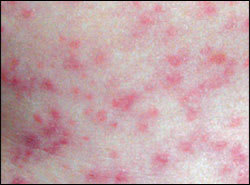
A 29-year-old woman presented to the office with a pruritic rash. She had just returned from a three-day Caribbean vacation. On day 3 of her vacation, she took a swim in the ocean, returned to her room for a shower and, within minutes, became aware of an itching sensation on her skin. Over the next 24 hours she developed the rash. She was not taking any medications and said she had no known allergies. Examination revealed an eruption of discrete, erythematous papules confined to the area that had been covered by her bathing suit. The papules were especially numerous on the buttocks, breasts, and abdomen (Figures 1 and 2).
Figure 1.
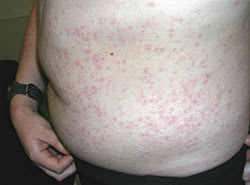
Figure 2.
Question
Based on the patient's history and physical examination, which one of the following is the most likely diagnosis?
A. Cercarial dermatitis.
B. Cutaneous reaction to arthropod bites.
C. Seabather's eruption (marine dermatitis).
D. Secondary syphilis.
E. Varicella.
Discussion
The answer is C: seabather's eruption. Seabather's eruption (marine dermatitis) is a benign clinical syndrome caused by the stings of cnidarian larvae. The phylum Cnidaria includes jellyfish, corals, and sea anemones.1 The diagnosis is clinical and is based on the development of a skin eruption on areas of the body covered by a swimsuit four to 24 hours after ocean exposure.2 It is predominantly reported in south Florida and the Caribbean; however, cases also have been reported in other areas along the eastern coast of the United States.2
The characteristic lesion defining seabather's eruption is an intensely pruritic, vesicular, or macropapular eruption, primarily affecting skin surfaces covered by swimwear or where friction occurs (e.g., armpits).2 Systemic symptoms such as fever and headache can accompany the skin lesions.2 Symptoms usually begin within 24 hours of ocean exposure, last three to five days, and resolve spontaneously. There are, however, a few documented cases involving severe symptoms and long-term sequelae.1,2 Several patients have reported local or vesicular eruptions that periodically recur up to one year after initial exposure.2 Treatment is symptomatic using antihistamines, antipruritic agents, and topical steroids.2 In severe or unremitting cases, systemic steroids may be needed.2
One observation that may be perplexing to clinicians, especially when considering the diagnosis, is that some persons develop symptoms whereas others who swim in the same area do not. Some physicians have proposed that host factors, varying levels of exposure among persons because of different styles of swimwear, and variable length of ocean activity may contribute to this.2
Another dermatitis caused by seawater exposure is cercarial dermatitis. This is caused by cercarial parasites that elicit an allergic response after burrowing into the skin.3,4 The key factor that differentiates cercarial dermatitis from seabather's eruption is that the lesions of cercarial dermatitis occur on the exposed areas of the skin as opposed to the areas covered by the bathing suit.3,4
Cutaneous reactions to arthropod bites (e.g., chiggers) may present as intensely pruritic papules and urticarial lesions that generally are localized to the ankles or legs. Typically, the affected patient has recently spent time outdoors.
The dermal manifestations of secondary syphilis in adults are polymorphous, generalized lesions that appear as scaling, pink to copper-colored macules and papules that often involve the palms and soles. Unlike the lesions of seabather's eruption, those of secondary syphilis are neither vesicular nor monomorphous.5
Varicella is a systemic febrile illness characterized by the gradual appearance of a diffuse vesicular eruption that starts on the trunk and moves centrifugally to the face and extremities. Any correlation with outdoor activity or swimming would be coincidental.
Selected Differential Diagnosis
| Condition | Characteristics |
|---|---|
| Cercarial dermatitis | Papular urticaria appears following exposure to fresh or saltwater; spares areas covered by swimwear |
| Cutaneous reaction to arthropod bites | Intensely pruritic papules and urticaria; generally confined to exposed areas of the ankles and legs |
| Seabather's eruption (marine dermatitis) | Inflammatory, erythematous papular or papulovesicular eruption that occurs during or shortly after wading or swimming in saltwater; monomorphous; affects areas covered by swimsuit |
| Secondary syphilis | Widespread eruption of pink to copper-colored papules, often involving the palms and soles; polymorphous; lesions may be annular or ellipsoid |
| Varicella | Diffuse papulovesicular, moderately pruritic eruption; lesions evolve from papular to vesicular stage with subsequent crusting; centrifugal spread |