

Advertisement

Practice Guideline Briefs

Am Fam Physician. 2007 Aug 1;76(3):444-447.

Cesarean Delivery Rate Hits All-time High

Source: Centers for Disease Control and Prevention

Published source: Morbidity and Mortality Weekly Report, April 20, 2007

Available at: http://www.cdc.gov/mmwr/preview/mmwrhtml/mm5615a8.htm

Nearly one in three live births in the United States in 2005 was a cesarean delivery, marking the highest U.S. total cesarean rate ever reported. Since 1996, the total cesarean rate has increased by 46 percent, driven by an increase in the percentage of women having a first cesarean delivery and a decrease in the percentage of women delivering vaginally after a previous cesarean delivery. Cesarean rates vary considerably among states but tend to be lower in the Western mountain states and upper Midwest, and higher in the Southeast and East (Figure 1).


Cesarean Delivery Rates by State, 2005
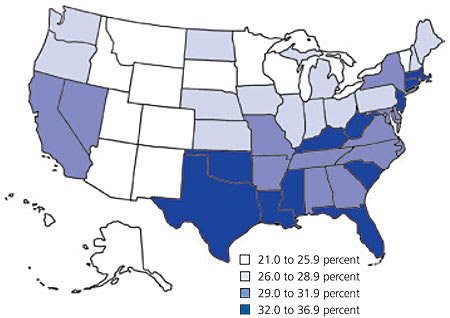

Figure 1.

Cesarean deliveries as a percentage of all live births in 2005.

Reprinted from Centers for Disease Control and Prevention. Quickstats: percentage of all live births by cesarean delivery—National Vital Statistics System, United States, 2005. MMWR Morb Mortal Wkly Rep 2007;56(RR-15):373.

AGA Releases Position Statement on CT Colonography

Guideline source: American Gastroenterological Association

Literature search described? No

Evidence rating system used? No

Published source: Gastroenterology, November 2006

Although computed tomographic (CT) colonography is considered investigational for colorectal screening, the American Gastroenterological Association (AGA) suggests that it could significantly influence patient care and how the field of gastroenterology is defined. CT colonography has the potential to provide a relatively noninvasive diagnostic evaluation of the colon with good patient acceptability. However, published data have suggested that CT colonography should be used only as a diagnostic tool for patients who have had incomplete colonoscopies for limited indications. Therefore, the AGA has released a position statement on CT colonography, which appears in the November 2006 issue of Gastroenterology.

Guided by its position that physicians should be able to use and manage any technology that will allow them to provide better care to patients, the AGA is monitoring the development of CT colonography and is creating training standards for the performance of the test.

Many physicians have the relevant expertise to correctly interpret CT colonography. However, issues such as relative sensitivity, standardization of test performance, cost and reimbursement, and technologic challenges need to be addressed before CT colonography is widely accepted as an alternative to conventional colonoscopy for colorectal cancer screening.

Physicians trained to interpret CT colonography should be able to detect neoplasms of the colon during CT colonography. They also should be encouraged to consult with radiologists when interpreting studies, correlate findings with clinical presentation, and make appropriate management decisions based on the findings. Additionally, the AGA has convened a task force to develop training standards and criteria for CT colonography training.

Article Tools

Printer-friendly

Share this page

AFP CME Quiz

Get Permissions

Search AFP


AFP at a Glance
INDUSTRY INFORMATION
Advertisement
Advertisement