
Pharmacy subscription program, days’ supply, and out-of-pocket costs

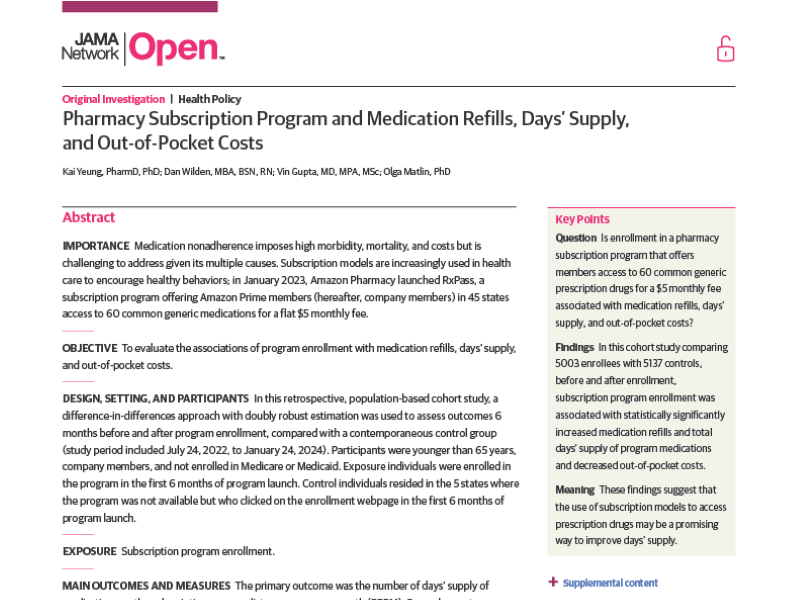
Research objective and design
Medication nonadherence remains a significant challenge in healthcare, contributing to high morbidity, mortality, and costs. Subscription programs have emerged as a promising approach to encourage healthy behaviors. RxPass, from Amazon Pharmacy, is a leading model, offering Amazon Prime members access to more than 60 common generic medications for a flat $5 monthly fee.
This retrospective, population-based cohort study evaluated the associations between program enrollment and medication refills, days' supply, and out-of-pocket costs. Using a difference-in-differences approach with doubly robust estimation, researchers assessed outcomes 6 months before and after program enrollment compared with a contemporaneous control group. The study period spanned from July 24, 2022, to January 24, 2024.
Participants were under 65 years old, Amazon Prime members, and not enrolled in Medicare or Medicaid. The exposure group enrolled in RxPass during the first 6 months of launch, while the control group resided in the 5 states where the program was unavailable but had clicked on the enrollment webpage during the same period. RxPass is now available in all states except CA and WA.
Key findings
After propensity score weighting, the study included 5,003 enrollees (mean age 45.9 years; 41.5% female) and 5,137 controls (mean age 45.8 years; 41.2% female). The results demonstrated significant improvements across all measured outcomes:
- Days' supply increased by 10.39 days per person per month (27% increase)
- Prescription refills increased by 0.19 per person per month (29% increase)
- Out-of-pocket spending decreased by $2.35 per person per month (30% decrease)
Conclusions
Program enrollment was associated with increased medication refills and total days' supply alongside reduced out-of-pocket costs. The findings suggest that subscription-based pharmacy models may effectively address medication adherence challenges. Future research should explore the cognitive and behavioral mechanisms driving these improvements and assess whether similar results can be replicated across other pharmacies and patient populations.
Disclaimer:
The posting of information and content on this page should not be considered an AAFP endorsement or recommendation of the partner or sponsor organization’s products, services, policies or procedures. The information and opinions expressed are those of partners and paid sponsors and do not necessarily reflect the views of the AAFP. The AAFP is not responsible for the content of third-party websites linked from this page. Any links on this page to third-party websites where goods and services are advertised are not endorsements or recommendations by the AAFP of the third-party sites, goods or services.