Birth Through Age 18 Immunization Schedule
This version of the child and adolescent immunization schedule has been adopted by the American Academy of Family Physicians.
The CDC's 2026 immunization schedules, which are not endorsed by the AAFP, can be found here.
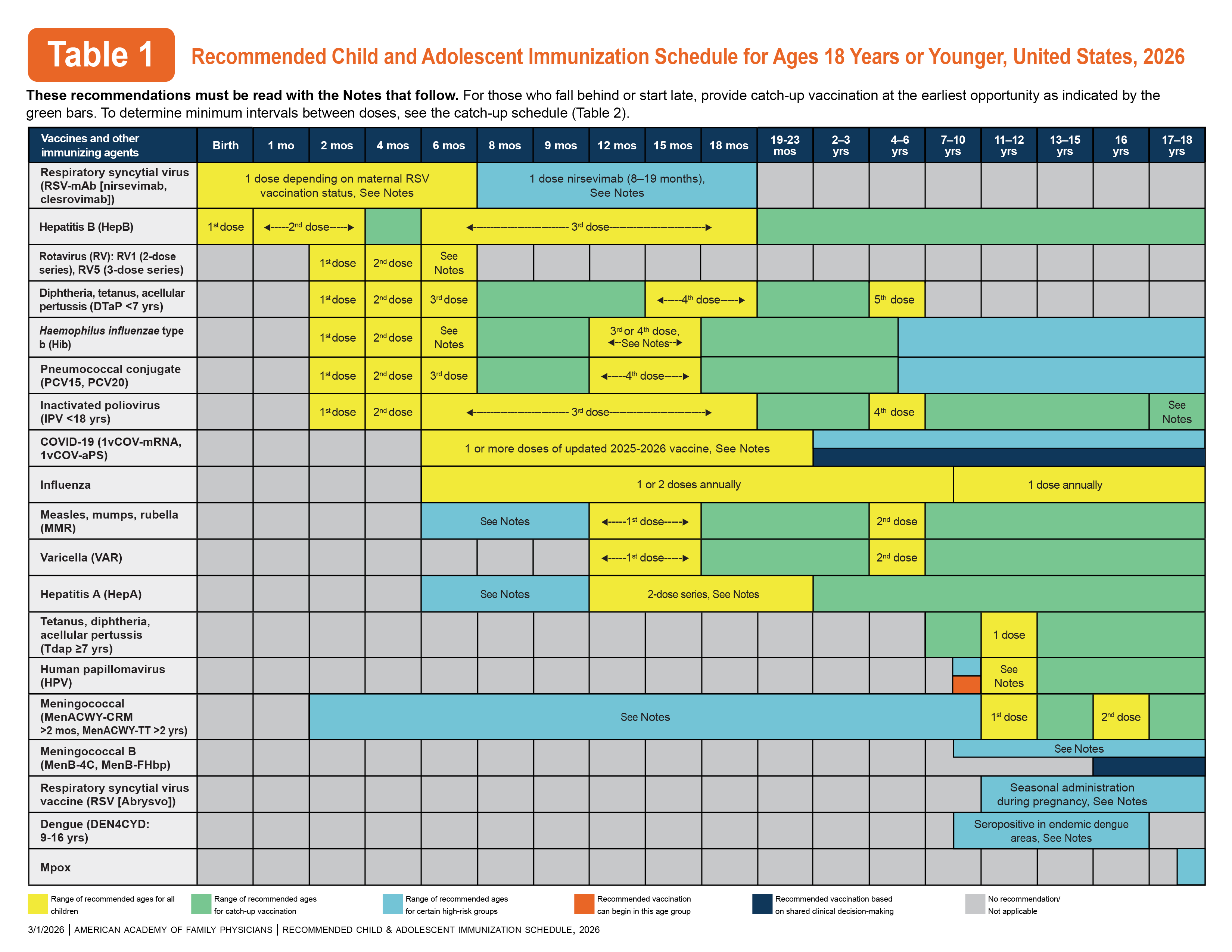
Schedule Based on Age Group
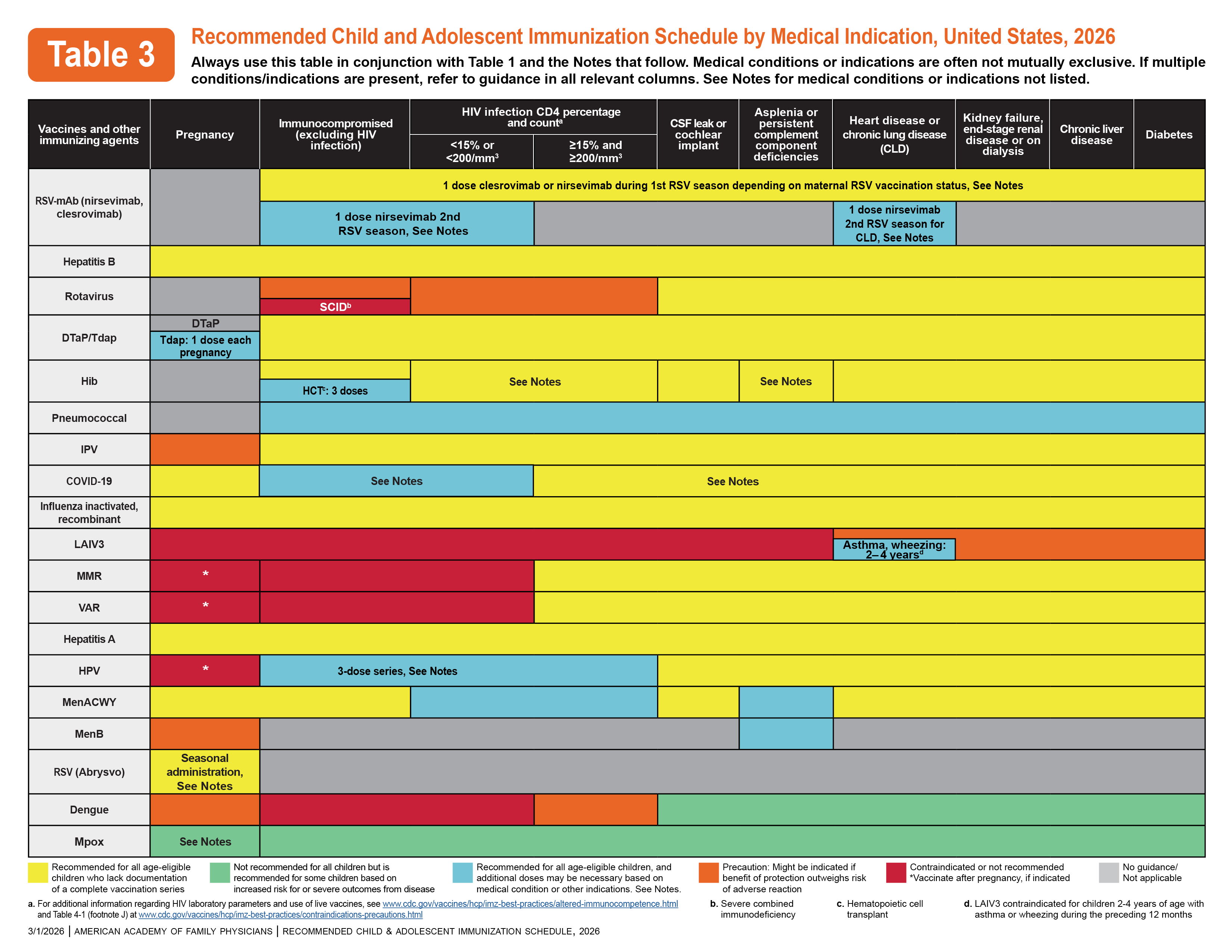
Schedule Based on Medical Indication
Notes
Minimum age: 6 months
Universal vaccination for ages 6-23 months; Risk-based single-dose for 2-18 years (with access upon request for families seeking protection
Routine Vaccination
Age 6 months–23 months
- Unvaccinated (i.e., never received any COVID-19 vaccine doses)
- 2 doses Moderna Spikevax 0, 4–8 weeks
- Incomplete initial vaccination series:
- 1 dose Moderna: complete initial series with 1 dose 4–8 weeks after most recent dose of Spikevax
- 1 dose Pfizer-BioNTech: complete initial series with 2 doses Moderna Spikevax 8 weeks apart (administer dose 1 4–8 weeks after most recent dose)
- 2 doses Pfizer-BioNTech: complete initial series with 1 dose Moderna Spikevax at least 8 weeks after the most recent dose
- Completed initial vaccination series:
- 1 dose Moderna Spikevax at least 8 weeks after the most recent dose
Special situations
Age 2–18 years in the following risk groups*: persons at high risk of severe COVID-19, residents of long-term care facilities or other congregate settings, persons who have never been vaccinated against COVID-19, persons whose household contacts are at high risk for severe COVID-19:
- Ages 2–4 years: 1 dose of Moderna Spikevax regardless of previous vaccination status at least 8 weeks after the most recent dose
- Ages 5-11 years: 1 dose of Moderna Spikevax or Pfizer-BioNTech Comirnaty regardless of previous vaccination status at least 8 weeks after the most recent dose
- Ages 12–18 years:
- 1 dose of Moderna Spikevax, Pfizer-BioNTech Comirnaty, or Novavax Nuvaxovid regardless of previous vaccination status at least 8 weeks after the most recent dose
- 1 dose of Moderna mNexspike regardless of previous vaccination status at least 12 weeks after the last dose was received.
Children 2 through 18 years of age not included in the risk groups above whose parent or guardian desires their protection from COVID-19 should be offered a single dose of age-appropriate COVID-19 vaccine.
Use any available COVID-19 vaccine appropriate by age and health status that is approved by the FDA through a biologics license application. The most updated version of the COVID-19 vaccine that is available should be used. *Refer to the AAFPs 2025-26 COVID-19 Vaccinations Clinical Guidance for more information on risk groups, https://www.aafp.org/family-physician/patient-care/prevention-wellness/immunizations-vaccines.html.
Persons who are moderately or severely immunocompromised. People eligible for additional doses include those who are receiving active cancer treatment for tumors or cancers of the blood, those who received an organ transplant and are taking medicine to suppress the immune system, those who received a hematopoietic cell transplant within the last 2 years or are taking medicine to suppress the immune system, those with moderate or severe primary immunodeficiency (such as DiGeorge syndrome, Wiskott-Aldrich syndrome), those with advanced or untreated HIV infection, and those with active treatment with high-dose corticosteroids or other drugs that may suppress an immune response. For revaccination guidance for children with hematologic malignancy post-hematopoietic cell transplant or CAR T-cell therapy, refer to: https://doi.org/10.1111/tid.14109.
Age 6 months–4 years moderately or severely immunocompromised
- Unvaccinated:
- 4 doses (3-dose initial series Moderna Spikevax at 0, 4 weeks, and at least 4 weeks after dose 2, followed by 1 dose Moderna Spikevax 6 months later [minimum interval 2 months]). May administer additional doses.*
- Incomplete initial 3-dose vaccination series:
- Previous vaccination with Moderna
- 1 dose Moderna: complete initial series with 2 doses Moderna Spikevax at least 4 weeks apart (administer dose 1 Moderna Spikevax 4 weeks after most recent dose), followed by 1 dose Moderna Spikevax 6 months later (minimum interval 2 months). May administer additional doses of Moderna Spikevax.**
- 2 doses Moderna: complete initial series with 1 dose Moderna Spikevax at least 4 weeks after most recent dose, followed by 1 dose Moderna Spikevax 6 months later (minimum interval 2 months). May administer additional doses of Moderna Spikevax.*
- Previous vaccination with Pfizer-BioNTech
- 1 dose Pfizer-BioNTech: complete initial series with 2 doses Moderna Spikevax at least 8 weeks apart (administer dose 1 Moderna Spikevax 4 weeks after most recent dose), followed by 1 dose Moderna Spikevax 6 months later (minimum interval 2 months). May administer additional doses of Moderna Spikevax.*
- 2 doses Pfizer-BioNTech: complete initial series with 1 dose Moderna Spikevax at least 8 weeks after most recent dose, followed by 1 dose Moderna Spikevax 6 months later (minimum interval 2 months).
- Previously completed initial 3-dose vaccination series with:
- 3 or more doses Moderna: 2 doses Moderna Spikevax 6 months apart (minimum interval 2 months). Administer dose 1 at least 8 weeks after the most recent dose. May administer additional doses of Moderna Spikevax.*
- 3 or more doses Pfizer-BioNTech: 2 doses Moderna Spikevax 6 months apart (minimum interval 2 months). Administer dose 1 at least 8 weeks after the most recent dose. May administer additional doses of Moderna Spikevax.*
- Previous vaccination with Moderna
Age 5–11 years moderately or severely immunocompromised
Use vaccine from the same manufacturer for all doses in the initial vaccination series.
- Unvaccinated:
- 4 doses (3-dose initial series Moderna Spikevax at 0, 4 weeks, and at least 4 weeks after dose 2, followed by 1 dose Moderna Spikevax or Pfizer-BioNTech 6 months later [minimum interval 2 months]). May administer additional doses.*
- 4 doses (3-dose initial series Pfizer-BioNTech at 0, 3 weeks, and at least 4 weeks after dose 2, followed by 1 dose Moderna Spikevax or Pfizer-BioNTech 6 months later [minimum interval 2 months]). May administer additional doses.*
- Incomplete initial 3-dose vaccination series:
- Previous vaccination with Moderna
- 1 dose Moderna Spikevax: complete initial series with 2 doses Moderna a Spikevax t least 4 weeks apart (administer dose 1 Moderna Spikevax 4 weeks after most recent dose), followed by 1 dose Moderna Spikevax or Pfizer-BioNTech 6 months later (minimum interval 2 months). May administer additional doses of Moderna Spikevax or Pfizer-BioNTech.*
- 2 doses Moderna Spikevax: complete initial series with 1 dose Moderna Spikevax at least 4 weeks after most recent dose, followed by 1 dose Moderna Spikevax or Pfizer BioNTech 6 months later (minimum interval 2 months). May administer additional doses of Moderna Spikevax or Pfizer-BioNTech.*
- Previous vaccination with Pfizer-BioNTech
- 1 dose Pfizer-BioNTech: complete initial series with 2 doses Pfizer-BioNTech at least 4 weeks apart (administer dose 1 Pfizer-BioNTech 3 weeks after most recent dose), followed by 1 dose Moderna Spikevax or Pfizer-BioNTech 6 months later (minimum interval 2 months). May administer additional doses of Moderna or PfizerBioNTech.*
- 2 doses Pfizer-BioNTech: complete initial series with 1 dose Pfizer-BioNTech at least 4 weeks after most recent dose, followed by 1 dose Moderna Spikevax or Pfizer-BioNTech 6 months later (minimum interval 2 months). May administer additional doses of Moderna Spikevax or Pfizer-BioNTech.*
- Completed initial 3-dose vaccination series with:
- 3 or more doses Moderna or 3 or more doses PfizerBioNTech: 2 doses Moderna or Pfizer-BioNTech 6 months apart (minimum interval 2 months). Administer dose 1 at least 8 weeks after the most recent dose. May administer additional doses of Moderna or Pfizer-BioNTech.*
Age 12–18 years moderately or severely immunocompromised
Use vaccine from the same manufacturer for all doses in the initial vaccination series. Either Moderna product (Spikevax or mNEXSPIKE) can be used unless otherwise specified.
- Unvaccinated:
- 4 doses (3-dose initial series Moderna at 0, 4 weeks, and at least 4 weeks after dose 2, followed by 1 dose Moderna or Novavax or Pfizer-BioNTech 6 months later [minimum interval 2 months]). May administer additional doses of Moderna or Novavax or Pfizer-BioNTech.*
- 4 doses (3-dose initial series Pfizer-BioNTech at 0, 3 weeks, and at least 4 weeks after dose 2, followed by 1 dose Moderna or Novavax or Pfizer-BioNTech 6 months later [minimum interval 2 months]). May administer additional doses of Moderna or Novavax or Pfizer-BioNTech.*
- 3 doses (2-dose initial series Novavax at 0, 3 weeks, followed by 1 dose Moderna or Novavax or Pfizer-BioNTech 6 months later [minimum interval 2 months]). May administer additional doses of Moderna or Novavax or Pfizer-BioNTech.*
- Incomplete initial vaccination series:
- Previous vaccination with Moderna
- 1 dose Moderna: complete initial series with 2 doses Moderna at least 4 weeks apart (administer dose 1 Moderna 4 weeks after most recent dose), followed by 1 dose Moderna or Novavax or Pfizer-BioNTech 6 months later (minimum interval 2 months). May administer additional doses of Moderna or Novavax or PfizerBioNTech.*
- 2 doses Moderna: complete initial series with 1 dose Moderna at least 4 weeks after most recent dose, followed by 1 dose Moderna or Novavax or Pfizer-BioNTech 6 months later (minimum interval 2 months). May administer additional doses of Moderna or Novavax or Pfizer-BioNTech.*
- Previous vaccination with Pfizer-BioNTech
- 1 dose Pfizer-BioNTech: complete initial series with 2 doses Pfizer-BioNTech at least 4 weeks apart (administer dose 1 Pfizer-BioNTech 3 weeks after most recent dose), followed by 1 dose Moderna or Novavax or PfizerBioNTech 6 months later (minimum interval 2 months). May administer additional doses of Moderna or Novavax or Pfizer-BioNTech.*
- 2 doses Pfizer-BioNTech: complete initial series with 1 dose Pfizer-BioNTech at least 4 weeks after most recent dose, followed by 1 dose Moderna or Novavax or Pfizer-BioNTech 6 months later (minimum interval 2 months). May administer additional doses of Moderna or Novavax or Pfizer-BioNTech.*
- Previous vaccination with Novavax
- 1 dose Novavax: complete initial series with 1 dose Novavax at least 3 weeks after most recent dose, followed by 1 dose Moderna or Novavax or Pfizer-BioNTech 6 months later (minimum interval 2 months). May administer additional doses of Moderna or Novavax or Pfizer-BioNTech.*
- Completed initial 3-dose vaccination series with:
- 3 or more doses Moderna or 3 or more doses PfizerBioNTech: 2 doses Moderna or Novavax or Pfizer-BioNTech 6 months apart (minimum interval 2 months). Administer dose 1 at least 8 weeks after the most recent dose. May administer additional doses of Moderna or Novavax or Pfizer-BioNTech.*
- 2 or more doses Novavax: 2 doses Moderna or Novavax or Pfizer-BioNTech 6 months apart (minimum interval 2 months). Administer dose 1 at least 8 weeks after the most recent dose. May administer additional doses of Moderna or Novavax or Pfizer-BioNTech.*
- Previous vaccination with Moderna
*Additional doses of COVID-19 vaccine for moderately or severely immunocompromised: based on shared clinical decision making and administered at least 2 months after the most recent dose.
Minimum Age: 9 years
Routine Vaccination
- Age 9-16 years living in areas with endemic dengue AND have laboratory confirmation of previous dengue infection
- 3-dose series administered at 0, 6, and 12 months
- Endemic areas include Puerto Rico, American Samoa, US Virgin Islands, Federated States of Micronesia, Republic of Marshall Islands, and the Republic of Palau.
- Dengue vaccine should not be administered to children traveling to or visiting endemic dengue areas.
Minimum Age: 6 weeks [4 years for Kinrix or Quadracel]
Routine vaccination
5-dose series (3-dose primary series at age 2, 4, and 6 months, followed by booster doses at ages 15–18 months and 4–6 years
- Prospectively: Dose 4 may be administered as early as age 12 months if at least 6 months have elapsed since dose 3.
- Retrospectively: A 4th dose that was inadvertently administered as early as age 12 months may be counted if at least 4 months have elapsed since dose 3.
Catch-up vaccination
- Dose 5 is not necessary if dose 4 was administered at age 4 years or older and at least 6 months after dose 3.
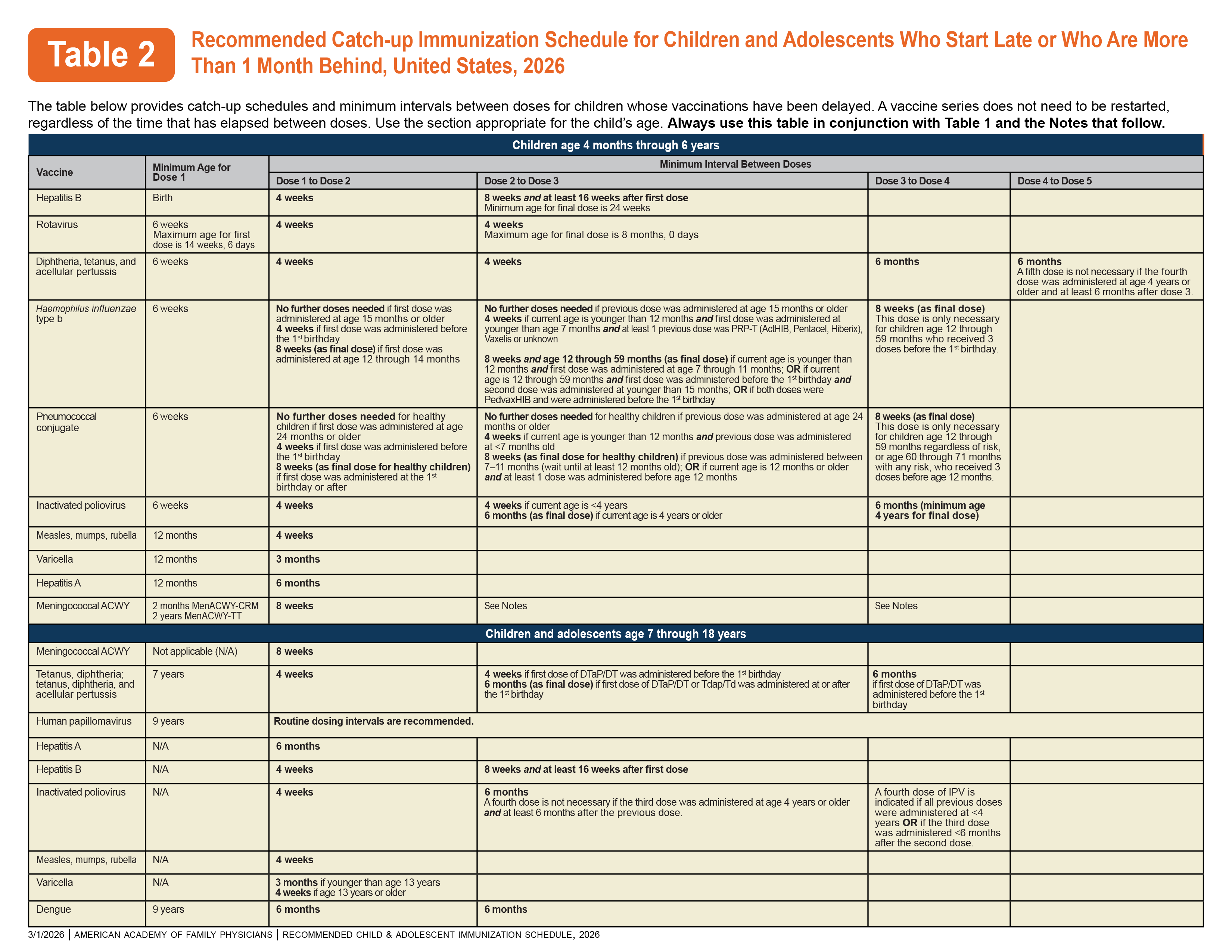
- For other catch-up guidance, see Catch Up Schedule
Special Situations
- Children younger than age 7 years with a contraindication specific to the pertussis component of DTaP: May administer Td for all recommended remaining doses in place of DTaP. Encephalopathy within 7 days of vaccination when not attributable to another identifiable cause is the only contraindication specific to the pertussis component of DTaP. For additional information, see www.cdc.gov/pertussis/hcp/vaccine-recommendations/td-offlabel.html.
- Wound management in children younger than age 7 years with history of 3 or more doses of tetanus-toxoid containing vaccine: For all wounds except clean and minor wounds, administer DTaP if more than 5 years since last dose of tetanus-toxoid-containing vaccine. For detailed information, see www.cdc.gov/mmwr/volumes/67/rr/rr6702a1.htm.
Minimum Age: 6 weeks
Routine vaccination
- ActHIB, Hiberix, Pentacel, or Vaxelis: 4-dose series (3-dose primary series at age 2, 4, and 6 months, followed by a booster dose* at age 12–15 months)
- *Vaxelis is not recommended for use as a booster dose. A different Hib-containing vaccine should be used for the booster dose.
- PedvaxHIB: 3-dose series (2-dose primary series at age 2 and 4 months, followed by a booster dose at age 12–15months)
Catch-up Vaccination
- Dose 1 at age 7–11 months: Administer dose 2 at least 4 weeks later and dose 3 (final dose) at age 12–15 months or 8 weeks after dose 2 (whichever is later).
- Dose 1 at age 12–14 months: Administer dose 2 (final dose) at least 8 weeks after dose 1.
- Dose 1 before age 12 months and dose 2 before age15 months: Administer dose 3 (final dose) at least 8 weeks after dose 2.
- 2 doses of PedvaxHIB before age 12 months: Administer dose 3 (final dose) at age 12–59 months and at least 8 weeks after dose 2.
- 1 dose administered at age 15 months or older: No further doses needed
- Unvaccinated at age 15–59 months: Administer 1 dose
- Previously unvaccinated children age 60 months or older who are not considered high risk: Do not require catch-up vaccination
- For other catch-up guidance, see Catch Up Schedule. Vaxelis can be used for catch-up vaccination in children less than age 5 years. Follow the catch-up schedule even if Vaxelis is used for one or more doses. For detailed information on use of Vaxelis® see www.cdc.gov/mmwr/volumes/69/wr/mm6905a5.htm.
Special Situations
- Chemotherapy or radiation treatment:
- Unvaccinated or only 1 dose before age 12 months: 2 doses, 8 weeks apart
- 2 or more doses before age 12 months: 1 dose at least 8 weeks after previous dose
Doses administered within 14 days of starting therapy or during therapy should be repeated at least 3 months after therapy completion.
Age 12–59 months
- Hematopoietic stem cell transplant (HSCT):
- 3-dose series 4 weeks apart starting 6 to 12 months after successful transplant, regardless of Hib vaccination history
- Anatomic or functional asplenia (including sickle cell disease):
- Unvaccinated or only 1 dose before age 12 months: 2 doses, 8 weeks apart
- 2 or more doses before age 12 months:1 dose at least 8 weeks after previous dose
Persons age 5 years or older
- Unvaccinated*
- 1 dose
Persons age 15 months or older
- Elective splenectomy:
- Unvaccinated*
- 1 dose (preferably at least 14 days before procedure)
- Unvaccinated*
- HIV infection:
- Unvaccinated or only 1 dose before age 12 months: 2 doses, 8 weeks apart
- 2 or more doses before age 12 months:1 dose at least 8 weeks after previous dose
Persons age 5–18 years
- Unvaccinated*
- 1 dose
- Immunoglobulin deficiency, early component complement deficiency:
- Unvaccinated or only 1 dose before age 12 months: 2 doses, 8 weeks apart
- 2 or more doses before age 12 months: 1 dose at least 8 weeks after previous dose
*Unvaccinated = Less than routine series (through age 14 months) OR no doses (age 15 months or older)
Minimum age: 12 months for routine vaccination
Routine vaccination
2-dose series (minimum interval: 6 months) at age 12–23 months
Catch-up vaccination
- Unvaccinated persons through age 18 years should complete a 2-dose series (minimum interval: 6 months).
- Persons who previously received 1 dose at age 12 months or older should receive dose 2 at least 6 months after dose 1.
- Adolescents age 18 years or older may receive HepA-HepB (Twinrix) as a 3-dose series (0, 1, and 6 months) or 4-dose series (3 doses at 0, 7, and 21–30 days, followed by a booster dose at 12 months).
International travel
- Persons traveling to or working in countries with high or intermediate endemic hepatitis A (www.cdc.gov/travel/):
- Infants age 6–11 months: 1 dose before departure; revaccinate with 2 doses (separated by at least 6 months) between age 12–23 months.
- Unvaccinated age 12 months or older: Administer dose 1 as soon as travel is considered.
Minimum age: birth
Routine Vaccination
- Mother is HBsAg-negative
- 3-dose series at age 0, 1–2, 6–18 months (use monovalent HepB vaccine for doses administered before age 6 weeks)
- Birth weight ≥2,000 grams: 1 dose within 24 hours of birth if medically stable
- Birth weight <2,000 grams: 1 dose at chronological age 1 month or hospital discharge (whichever is earlier and even if weight is still <2,000 grams
- Infants who did not receive a birth dose should begin the series as soon as possible (see Table 2 for minimum intervals).
- Administration of 4 doses is permitted when a combination vaccine containing HepB is used after the birth dose.
- Minimum intervals (see Table 2): when 4 doses are administered, substitute “dose 4” for “dose 3” in these calculations.
- Final (3rd or 4th) dose: age 6–18 months (minimum age 24 weeks)
- 3-dose series at age 0, 1–2, 6–18 months (use monovalent HepB vaccine for doses administered before age 6 weeks)
- Mother is HBsAg-positive
- Birth dose (monovalent HepB vaccine only): administer HepB vaccine and hepatitis B immune globulin (HBIG) (in separate limbs) within 12 hours of birth, regardless of birth weight.
- Birth weight <2000 grams: administer 3 additional dosesof HepB vaccine beginning at age 1 month (total of 4 doses).
- Final (3rd or 4th) dose: administer at age 6 months (minimum age 24 weeks)
- Test for HBsAg and anti-HBs at age 9–12 months. If HepB series is delayed, test 1–2 months after final dose. Do not test before age 9 months.
- Mother is HBsAg-unknown If other evidence suggestive of maternal hepatitis B infection exists (e.g., presence of HBV DNA, HBeAg-positive, or mother known to have chronic hepatitis B infection), manage infant as if mother is HBsAg-positive.
- Birth dose (monovalent HepB vaccine only):
- Birth weight ≥2,000 grams: administer HepB vaccine within 12 hours of birth. Determine mother’s HBsAg status as soon as possible. If mother is determined to be HBsAg-positive, administer HBIG as soon as possible (in separatelimb), but no later than 7 days of age.
- Birth weight <2,000 grams: administer HepB vaccine and HBIG (in separate limbs) within 12 hours of birth. Administer 3 additional doses of HepB vaccine beginning at age 1 month (total of 4 doses).
- Final (3rd or 4th) dose: administer at age 6 months (minimum age 24 weeks)
- If mother is determined to be HBsAg-positive or if status remains unknown, test for HBsAg and anti-HBs at age 9–12 months. If HepB series is delayed, test 1–2 months after final dose. Do not test before age 9 months.
- Birth dose (monovalent HepB vaccine only):
Catch-up Vaccination
- Unvaccinated persons should complete a 3-dose series at 0, 1–2, 6 months. See Catch Up Schedule for minimum intervals.
- Adolescents age 11–15 years may use an alternative 2-dose schedule with at least 4 months between doses (adult formulation Recombivax HB only).
- Adolescents age 18 years may receive:
- Heplisav-B: 2-dose series at least 4 weeks apart
- PreHevbrio: 3-dose series at 0, 1, and 6 months
- HepA-HepB (Twinrix): 3-dose series (0, 1, and 6 months) or 4-dose series (3 doses at 0, 7, and 21–30 days, followed by a booster dose at 12 months).
Special Situations
Revaccination is not generally recommended for persons with a normal immune status who were vaccinated as infants, children, adolescents, or adults.
Post-vaccination serology testing and revaccination (if anti-HBs <10mlU/mL) is recommended for certain populations, including:
- Infants born to HBsAg-positive mothers
- Persons who are predialysis or on maintenance dialysis
- Other immunocompromised persons
- For detailed revaccination recommendations, see www.cdc.gov/vaccines/hcp/acip-recs/vacc-specific/hepb.html.
Note: PreHevbrio is not recommended in pregnancy due to lack of safety data in pregnant persons.
Minimum Age: 9 years
Routine and catch-up vaccination
HPV vaccination routinely recommended at age 11–12 years (can start at age 9 years) and catch-up HPV vaccination recommended for all persons through age 18 years if not adequately vaccinated
- 2- or 3-dose series depending on age at initial vaccination:
- Age 9–14 years at initial vaccination: 2-dose series at 0, 6–12 months (minimum interval: 5 months; repeat dose if administered too soon)
- Age 15 years or older at initial vaccination: 3-dose series at 0, 1–2 months, 6 months (minimum intervals: dose 1 to dose 2: 4 weeks / dose 2 to dose 3: 12 weeks / dose 1 to dose3: 5 months; repeat dose if administered too soon)
- No additional dose recommended when any HPV vaccine series of any valency has been completed using recommended dosing intervals.
Special situations
- Immunocompromising conditions, including HIV infection: 3-dose series, even for those who initiate vaccination at age 9 through 14 years.
- History of sexual abuse or assault: Start at age 9 years
- Pregnancy: Pregnancy testing not needed before vaccination; HPV vaccination not recommended until after pregnancy; no intervention needed if vaccinated while pregnant.
Minimum Age:
- 6 months [IIV3],
- 2 years [LAIV3]
- 9 years [recombinant influenza vaccine, Flublok RIV3]
Routine Vaccination
- Use any influenza vaccine appropriate for age and health status annually. All marketed U.S. vaccines are trivalent this season (2025-26).
- Age 6 months–8 years who have received fewer than 2 influenza vaccine doses before July 1, or whose influenza vaccination history is unknown: 2 doses, separated by at least 4 weeks. Administer dose 2 even if the child turns 9 years between receipt of dose 1 and dose 2.
- Age 6 months–8 years who have received at least 2 influenza vaccine doses before July 1: 1 dose
- Age 9 years or older: 1 dose
- Age 18 years solid organ transplant recipients receiving immunosuppressive medications: high-dose inactivated (HD-IIV3) and adjuvanted inactivated (aIIV3) influenza vaccines are acceptable options. No preference over other age-appropriate IIV3 or RIV3.
- For the 2025-2026 season, see www.cdc.gov/mmwr/volumes/74/wr/mm7432a2.htm.
Special Situations
Close contacts (e.g., household contacts) of severely immunosuppressed persons who require a protected environment: should not receive LAIV3. If LAIV3 is given, they should avoid contact with or caring for such immunosuppressed persons for 7 days after vaccination.
Note: Persons with an egg allergy can receive any influenza vaccine (egg-based and non-egg-based) appropriate for age and health status.
Minimum Age: 12 Months for routine vaccination
Routine Vaccination
- 2-dose series at age 12–15 months, age 4–6 years
- MMR or MMRV* may be administered
Note: For dose 1 in children age 12–47 months, it is recommended to administer MMR and varicella vaccines separately. MMRV may be used if parents or caregivers express a preference.
Catch-up Vaccination
- Unvaccinated children and adolescents: 2-dose series at least 4 weeks apart
- The maximum age for use of MMRV* is 12 years.
- Minimum interval between MMRV* doses: 3 month
Special Situations
- International travel
- Infants age 6–11 months: 1 dose before departure; revaccinate with 2-dose series at age 12–15 months (12 months for children in high-risk areas) and dose 2 as early as 4 weeks later.
- - Unvaccinated children age 12 months or older: 2-dose series at least 4 weeks apart before departure
In mumps outbreak settings, for information about additional doses of MMR (including 3rd dose of MMR), see www.cdc.gov/mmwr/volumes/67/wr/mm6701a7.htm
*Note: If MMRV is used, the minimum interval between MMRV doses is 3 months.
Minimum Age:
- 2 months [MenACWY-CRM, Menveo]
- 2 years [MenACWY-TT, MenQuadfi],
- 10 years [MenACWY-TT/MenB-FHbp, Penbraya]
Routine Vaccination
2-dose series at age 11–12 years; 16 years
Catch-up Vaccination
- Age 13–15 years: 1 dose now and booster at age 16–18 years (minimum interval: 8 weeks)
- Age 16–18 years: 1 dose
Special situations
Anatomic or functional asplenia (including sickle cell disease), HIV infection, persistent complement component deficiency, complement inhibitor (e.g., eculizumab, ravulizumab) use:
- Menveo*
- Dose 1 at age 2 months: 4-dose series (additional 3 doses at age 4, 6, and 12 months)
- Dose 1 at age 3–6 months: 3- or 4-dose series (dose 2 [and dose 3 if applicable] at least 8 weeks after previous dose until a dose is received at age 7 months or older, followed by an additional dose at least 12 weeks later and after age 12 months)
- Dose 1 at age 7–23 months: 2-dose series (dose 2 at least 12 weeks after dose 1 and after age 12 months)
- Dose 1 at age 24 months or older: 2-dose series at least 8 weeks apart
- MenQuadfi
- Dose 1 at age 24 months or older: 2-dose series at least 8 weeks apart
Travel to countries with hyperendemic or epidemic meningococcal disease, including countries in the African meningitis belt or during the Hajj:
- Children less than age 24 months:
- Menveo* (age 2-23 months)
- Dose 1 at age 2 months: 4-dose series (additional 3 doses at age 4, 6, and 12 months)
- Dose 1 at age 3–6 months: 3- or 4-dose series (dose 2 [and dose 3 if applicable] at least 8 weeks after previous dose until a dose is received at age 7 months or older, followed by an additional dose at least 12 weeks later and after age 12 months)
- Dose 1 at age 7–23 months: 2-dose series (dose 2 at least 12 weeks after dose 1 and after age 12 months)
- Menveo* (age 2-23 months)
Children age 2 years or older: 1 dose Menveo* or MenQuadfi
First-year college students who live in residential housing (if not previously vaccinated at age 16 years or older) or military recruits:
- 1 dose Menveo* or MenQuadfi®
Adolescent vaccination of children who received MenACWY prior to age 10 years:
- Children for whom boosters are recommended because of an ongoing increased risk of meningococcal disease (e.g., those with complement component deficiency, HIV, or asplenia): Follow the booster schedule for persons at increased risk.
- Children for whom boosters are not recommended (e.g., a healthy child who received a single dose for travel to a country where meningococcal disease is endemic): Administer MenACWY according to the recommended adolescent schedule with dose 1 at age 11–12 years and dose 2 at age 16 years.
*Menveo has two formulations: lyophilized and liquid. The liquid formulation should not be used before age 10 years. See www.cdc.gov/vaccines/vpd/mening/downloads/menveo-single-vial-presentation.pdf.
Note: For MenACWY booster dose recommendations for groups listed under “Special situations” and in an outbreak setting and additional meningococcal vaccination information, see www.cdc.gov/mmwr/volumes/69/rr/rr6909a1.htm.
Children age 10 years or older may receive a single dose of Penbraya as an alternative to separate administration of MenACWY and MenB when both vaccines would be given on the same clinic day and a single injection with Penbraya is preferred (see “Meningococcal serogroup B vaccination” section below for more information).
Minimum Age: 10 years [MenB-4C, Bexsero; MenBF-Hbp, Trumenba; MenACWY-TT/MenB-FHbp, Penbraya])
Shared clinical decision-making
Adolescents not at increased risk age 16–23 years (preferred age 16–18 years)* based on shared clinical decision-making.
- Bexsero or Trumenba (use same brand for all doses): 2-dose series at least 6 months apart (if dose 2 is administered earlier than 6 months, administer dose 3 at least 4 months after dose 2)
- To optimize rapid protection (e.g., for students starting college in less than 6 months), a 3-dose series (0, 1–2, 6 months) may be administered.
For additional information on shared clinical decision-making for MenB, see www.cdc.gov/vaccines/media/pdfs/2025/03/2024-isd-job-aid-scdm-menb-508-remediated.pdf
Special situations
Anatomic or functional asplenia (including sickle cell disease), persistent complement component deficiency, complement inhibitor (e.g., eculizumab, ravulizumab) use:
- Bexsero or Trumenba (use same brand for all doses including booster doses): 3-dose series at 0, 1–2, 6 months (if dose 2 was administered at least 6 months after dose 1, dose 3 not needed; if dose 3 is administered earlier than 4 months after dose 2, a 4th dose should be administered at least 4 months after dose 3)
For MenB booster dose recommendations for groups listed under “Special situations” and in an outbreak setting and additional meningococcal vaccination information, see www.cdc.gov/mmwr/volumes/69/rr/rr6909a1.htm.
Note: MenB vaccines may be administered simultaneously with MenACWY vaccines if indicated, but at a different anatomic site, if feasible.
Children age 10 years or older may receive a dose of Penbraya (MenACWY–TT/MenB–FHbp) as an alternative to separate administration of MenACWY and MenB when both vaccines would be given on the same clinic day. For age-eligible children not at increased risk, if Penbraya is used for dose 1 MenB, MenB-FHbp (Trumenba) should be administered for dose 2 MenB. For age-eligible children at increased risk of meningococcal disease, Penbraya may be used for additional MenACWY and MenB doses (including booster doses) if both would be given on the same clinic day and at least 6 months have elapsed since most recent Penbraya dose.
Minimum Age: 18 years
Special Situations
- Age 18 years and at risk for mpox infection: complete 2-dose series, 28 days apart.
- Persons who are gay, bisexual, and other MSM, transgender or nonbinary people who in the past 6 months have had:
- A new diagnosis of at least 1 sexually transmitted disease
- More than 1 sex partner
- Sex at a commercial sex venue
- Sex in association with a large public event in a geographic area where mpox transmission is occurring
- Persons who are sexual partners of the persons described above
- Persons who anticipate experiencing any of the situations described above
- Persons who are gay, bisexual, and other MSM, transgender or nonbinary people who in the past 6 months have had:
- Pregnancy: There is currently no ACIP recommendation for Jynneos use in pregnancy due to lack of safety data in pregnant persons. Pregnant persons with any risk factor described above may receive Jynneos.
For detailed information, visit https://publications.aap.org/ redbook/book/755/chapter/14079669/Mpox
Minimum Age:
6 weeks [PCV15], [PCV 20]
- 2 years [PPSV23])
Routine Vaccination with PCV
4-dose series at 2, 4, 6, 12-15 months
Catch-up vaccination
- Healthy children ages 2-4 years with any incomplete* PCV series: 1 dose PCV
- For other catch-up guidance, see Catch-up Schedule.
Note: For children without risk conditions, PCV20 is not indicated if they have received 4 doses of PCV13 or PCV15 or another age appropriate complete PCV series.
Special situations
Children and adolescents with cerebrospinal fluid leak; chronic heart disease; chronic kidney disease (excluding maintenance dialysis and nephrotic syndrome); chronic liver disease; chronic lung disease (including moderate persistent or severe persistent asthma); cochlear implant; or diabetes mellitus:
Age 2-5 years
- Any incomplete* PCV series with:
- 3 PCV doses: 1 dose PCV (at least 8 weeks after the most recent PCV dose)
- Less than 3 PCV doses: 2 doses PCV (at least 8 weeks after the most recent dose and administered at least 8 weeks apart)
- Completed recommended PCV series but have not received PPSV23
- Previously received at least 1 dose of PCV20: no further PCV or PPSV23 doses needed
- Not previously received PCV20: administer 1 dose PCV20 OR 1 dose PPSV23 at least 8 weeks after the most recent PCV dose.
Age 6–18 years
- Not previously received any dose of PCV13, PCV15, or PCV20: administer 1 dose of PCV15 or PCV20. If PCV15 is used and no previous receipt of PPSV23, administer 1 dose of PPSV23 at least 8 weeks after the PCV15 dose.**
- Received PCV before age 6 years but have not received PPSV23
- Not previously received PCV20: administer 1 dose PCV20 OR 1 dose PPSV23 at least 8 weeks after the most recent PCV dose.
- Received PCV13 only at or after age 6 years: administer 1 dose PCV20 OR 1 dose PPSV23 at least 8 weeks after the most recent PCV13 dose
- Received 1 dose PCV13 and 1 dose PPSV23 at or after age 6 years: no further doses of any PCV or PPSV23 indicated.
Children and adolescents on maintenance dialysis, or with immunocompromising conditions such as nephrotic syndrome; congenital or acquired asplenia or splenic dysfunction; congenital or acquired immunodeficiencies; diseases and conditions treated with immunosuppressive drugs or radiation therapy, including malignant neoplasms, leukemias, lymphomas, Hodgkin disease, and solid organ transplant; HIV infection; or sickle cell disease or other hemoglobinopathies:
Age 2–5 years
- Any incomplete* PCV series:
- 3 PCV doses: 1 dose PCV (at least 8 weeks after the most recent PCV dose)
- Less than 3 PCV doses: 2 doses PCV (at least 8 weeks after the most recent dose and administered at least 8 weeks apart)
- Completed recommended PCV series but have not received PPSV23
- Previously received at least 1 dose of PCV20: no further PCV or PPSV23 doses needed
- Not previously received PCV20: administer 1 dose PCV20 OR 1 dose PPSV23 at least 8 weeks after the most recent PCV dose. If PPSV23 is used, administer 1 dose of PCV20 or dose 2 PPSV23 at least 5 years after dose 1 PPSV23.
Age 6–18 years
- Not previously received any dose of PCV13, PCV15, or PCV20: administer 1 dose of PCV15 or 1 dose of PCV20. If PCV15 is used and no previous receipt of PPSV23, administer 1 dose of PPSV23 at least 8 weeks after the PCV15 dose.**
- Received PCV before age 6 years but have not received PPSV23
- Previously received at least 1 dose of PCV20: no additional dose of PCV or PPSV23
- Not previously received PCV20: administer 1 dose PCV20 OR 1 dose PPSV23 at least 8 weeks after the most recent PCV dose. If PPSV23 is used, administer either PCV20 or dose 2 PPSV23 at least 5 years after dose 1 PPSV23.
- Received PCV13 only at or after age 6 years: administer 1 dose PCV20 OR 1 dose PPSV23 at least 8 weeks after the most recent PCV13 dose. If PPSV23 is used, administer 1 dose of PCV20 or dose 2 PPSV23 at least 5 years after dose 1 PPSV23.
- Received 1 dose PCV13 and 1 dose PPSV23 at or after age 6 years: administer 1 dose PCV20 OR 1 dose PPSV23 at least 8 weeks after the most recent PCV13 dose and at least 5 years after dose 1 PPSV23.
- Pregnancy: no recommendation for PCV or PPSV23 due to limited data. Summary of existing data on pneumococcal vaccination during pregnancy can be found at www.cdc.gov/mmwr/volumes/72/rr/rr7203a1.htm
For guidance on determining which pneumococcal vaccines a patient needs and when, please refer to the mobile app, which can be downloaded here: www.cdc.gov/pneumococcal/hcp/vaccine-recommendations/app.html
*Incomplete series = Not having received all doses in either the recommended series or an age-appropriate catch-up series. See Table 2 in ACIP pneumococcal recommendations at stacks.cdc.gov/view/cdc/133252
**When both PCV15 and PPSV23 are indicated, administer all doses of PCV15 first. PCV15 and PPSV23 should not be administered during the same visit.
Minimum Age: 6 weeks
Routine Vaccination
- 4-dose series at ages 2, 4, 6-18 months, 4-6 years; administer the final dose on or after age 4 years and at least 6 months after the previous dose.
- 4 or more doses of IPV can be administered before age 4 years when a combination vaccine containing IPV is used. However, a dose is still recommended on or after age 4 years and at least 6 months after the previous dose.
Catch-up Vaccination
In the first 6 months of life, use minimum ages and intervals only for travel to a polio-endemic region or during an outbreak.
Adolescents age 18 years known or suspected to be unvaccinated or incompletely vaccinated: administer remaining doses (1, 2, or 3 IPV doses) to complete a 3-dose primary series.* Unless there are specific reasons to believe they were not vaccinated, most persons aged 18 years or older born and raised in the United States can assume they were vaccinated against polio as children.
Series containing oral poliovirus vaccine (OPV), either mixed OPV-IPV or OPV-only series:
- Total number of doses needed to complete the series is the same as that recommended for the U.S. IPV schedule. See www.cdc.gov/mmwr/volumes/66/wr/mm6601a6.htm?s_%20cid=mm6601a6_w.
- Only trivalent OPV (tOPV) counts toward the U.S. vaccination requirements.
- Doses of OPV administered before April 1, 2016, should be counted (unless specifically noted as administered during a campaign).
- Doses of OPV administered on or after April 1, 2016, should not be counted.
- For guidance to assess doses documented as “OPV,” see www.cdc.gov/mmwr/volumes/66/wr/mm6606a7.htm?s_cid=mm6606a7_w.
- For other catch-up guidance, see Catch up schedule.
Special Situations
Adolescents aged 18 years at increased risk of exposure to poliovirus and completed primary series*: may administer one lifetime IPV booster
*Note: Complete primary series consist of at least 3 doses of IPV or trivalent oral poliovirus vaccine (tOPV) in any combination.
For detailed information, see www.cdc.gov/vaccines/vpd/polio/hcp/recommendations.html
Routine Immunization
- Pregnant at 32 weeks 0 days through 36 weeks and 6 days gestation from September through January in most of the continental United States*: 1 dose Abrysvo. Administer RSV vaccine regardless of previous RSV infection.
- Either maternal RSV vaccination with Abrysvo or infant immunization with nirsevimab or clesrovimab (RSV monoclonal antibody) is recommended to prevent severe respiratory syncytial virus disease in infants.
- All other pregnant persons: RSV vaccine not recommended
- Subsequent pregnancies: additional doses not recommended. No data are available to inform whether additional doses are needed in subsequent pregnancies. If vaccine was not provided during the current pregnancy, the infant should receive nirsevimab or clesrovimab.
*Note: Providers in jurisdictions with RSV seasonality that differs from most of the continental United States (e.g., Alaska, jurisdictions with tropical climate) should follow guidance from public health authorities (e.g., CDC, health departments) or regional medical centers on timing of administration based on local RSV seasonality.
Minimum age: birth (monoclonal antibody) *Note: “RSV monoclonol antibody” refers to either Nirsevimab or Clesrovimab.
Routine Immunization
- Infants born October - March in most of the continental United States*
- Mother did not receive RSV vaccine OR mother’s RSV vaccination status is unknown: administer 1 dose RSV monoclonol antibody within 1 week of birth in hospital or outpatient setting
- Mother received RSV vaccine less than 14 days prior to delivery: administer 1 dose RSV monoclonol antibody within 1 week of birth in hospital or outpatient setting
- Mother received RSV vaccine at least 14 days prior to delivery: RSV monoclonol antibody not needed but can be considered in rare circumstances at the discretion of health care providers (see special populations and situations at www.cdc.gov/vaccines/vpd/rsv/hcp/child-faqs.html)
- Infants born April–September in most of the continental United States*
- Mother did not receive RSV vaccine OR mother’s RSV vaccination status is unknown: administer 1 dose RSV monoclonol antibody shortly before start of RSV season*
- Mother received RSV vaccine less than 14 days prior to delivery: administer 1 dose RSV monoclonol antibody shortly before start of RSV season*
- Mother received RSV vaccine at least 14 days prior to delivery: RSV monoclonol antibody not needed but can be considered in rare circumstances at the discretion of health care providers (see special populations and situations at www.cdc.gov/vaccines/vpd/rsv/hcp/child-faqs.html)
- Infants with prolonged birth hospitalization** (e.g., for prematurity) discharged October through March should be immunized shortly before or promptly after discharge.
Special Situations
- Infants <8 months entering first season without maternal protection should receive nirsevimab or clesrovimab (new product in 2025-26). Any licensed product may be used where indicated.
- Ages 8–19 months with chronic lung disease of prematurity requiring medical support (e.g., chronic corticosteroid therapy, diuretic therapy, or supplemental oxygen) any time during the 6-month period before the start of the second RSV season; severe immunocompromise; cystic fibrosis with either weight for length <10th percentile or manifestation of severe lung disease (e.g., previous hospitalization for pulmonary exacerbation in the first year of life or abnormalities on chest imaging that persist when stable)**:
- 1 dose RSV monoclonol antibody shortly before start of second RSV season*
- Ages 8–19 months who are American Indian or Alaska Native:
- 1 dose nirsevimab shortly before start of second RSV season*
- Age-eligible and undergoing cardiac surgery with cardiopulmonary bypass**: 1 additional dose of RSV monoclonol antibody after surgery. For additional details, see special populations and situations at www.cdc.gov/vaccines/vpd/rsv/hcp/child-faqs.html
*Note: While the timing of the onset and duration of RSV season may vary, administration of RSV monoclonol antibody is recommended October through March in most of the continental United States (optimally October through November or within 1 week of birth). Providers in jurisdictions with RSV seasonality that differs from most of the continental United States (e.g., Alaska, jurisdiction with tropical climate) should follow guidance from public health authorities (e.g., CDC, health departments) or regional medical centers on timing of administration based on local RSV seasonality
Minimum age: 6 weeks
Routine Vaccination
- Rotarix: 2-dose series at age 2 and 4 months
- RotaTeq®: 3-dose series at age 2, 4, and 6 months
- If any dose in the series is either RotaTeq® or unknown, default to 3-dose series.
Catch-up Vaccination
- Do not start the series on or after age 15 weeks, 0 days.
- The maximum age for the final dose is 8 months, 0 days.
- For other catch-up guidance, see Catch Up Schedule.
Minimum Age: 11 years for routine vaccination, 7 years for |catch-up vaccination
Routine Vaccination
- Age 11–12 years: 1 dose Tdap (adolescent booster)
- Pregnancy: 1 dose Tdap during each pregnancy, preferably in early part of gestational weeks 27–36.
Note: Tdap may be administered regardless of the interval since the last tetanus- and diphtheria-toxoid-containing vaccine.
Catch-up vaccination
- Age 13–18 years who have not received Tdap: 1 dose Tdap (adolescent booster)
- Age 7–18 years not fully vaccinated* with DTaP: 1 dose Tdap as part of the catch-up series (preferably the first dose); if additional doses are needed, use Td or Tdap.
- Tdap administered at age 7–10 years:
- Age 7–9 years who receive Tdap should receive the adolescent Tdap booster dose at age 11–12 years.
- Age 10 years who receive Tdap do not need the adolescent Tdap booster dose at age 11–12 years.
- DTaP inadvertently administered on or after age 7 years:
- Age 7–9 years: DTaP may count as part of catch-up series. Administer adolescent Tdap booster dose at age 11–12 years.
- Age 10–18 years: Count dose of DTaP as the adolescent Tdap booster dose.
- For other catch-up guidance, see Catch Up Schedule.
Special situations
Wound management in persons age 7 years or older with history of 3 or more doses of tetanus-toxoid-containing vaccine: For clean and minor wounds, administer Tdap or Td if more than 10 years since last dose of tetanus-toxoid-containing vaccine; for all other wounds, administer Tdap or Td if more than 5 years since last dose of tetanus-toxoid-containing vaccine. Tdap is preferred for persons age 11 years or older who have not previously received Tdap or whose Tdap history is unknown. If a tetanus-toxoid-containing vaccine is indicated for a pregnant adolescent, use Tdap.
• For detailed information, see www.cdc.gov/mmwr/volumes/69/wr/mm6903a5.htm.
*Fully vaccinated = 5 valid doses of DTaP OR 4 valid doses of DTaP if dose 4 was administered at age 4 years or older
Minimum Age: 12 months
Routine Vaccination
- 2-dose series at age 12-15 months, 4-6 years
- VAR or MMRV may be administered*
- Dose 2 may be administered as early as 3 months after dose 1 (a dose inadvertently administered after at least 4 weeks may be counted as valid).
*Note: For dose 1 in children age 12-47 months, it is recommended to administer MMR and varicella vaccines separately. MMRV may be used if parents or caregivers express a preference.
Catch-up vaccination
- Ensure persons age 7–18 years without evidence of immunity (see MMWR at www.cdc.gov/mmwr/pdf/rr/rr5604.pdf) have a 2-dose series:
- Age 7–12 years: Routine interval: 3 months (a dose inadvertently administered after at least 4 weeks may be counted as valid)
- Age 13 years and older: Routine interval: 4–8 weeks (minimum interval: 4 weeks)
- The maximum age for use of MMRV is 12 years.
Appendix: Contraindications and Precautions to Commonly Used Vaccines
When a contraindication is present, a vaccine should NOT be administered. Vaccination providers should check FDA-approved prescribing information for the most complete and updated information, including contraindications, warnings, and precautions.
| Vaccines and other Immunizing Agents | Contraindicated or Not Recommended | Precautions |
| COVID-19 mRNA vaccines [Pfizer-BioNTech, Moderna] |
Severe allergic reaction (e.g., anaphylaxis) after a previous dose or to a component of an mRNA COVID-19 vaccine
|
|
| COVID-19 protein subunit vaccines [Novavax] | Severe allergic reaction (e.g., anaphylaxis) after a previous dose or to a component of a Novavax COVID-19 vaccine
|
|
| Influenza, egg-based, inactivated injectable (IIV3) | Severe allergic reaction (e.g., anaphylaxis) after previous dose of any influenza vaccine (i.e., any egg-based IIV, ccIIV, RIV, or LAIV of any valency) Severe allergic reaction (e.g., anaphylaxis) to any vaccine component (excluding egg) |
|
| Influenza, cell culture-based inactivated injectable (ccIIV3) [Flucelvax] | Severe allergic reaction (e.g., anaphylaxis) to any ccIIV of any valency, or to any component of ccIIV3 |
|
| Influenza, recombinant injectable (RIV3) [Flublok] | Severe allergic reaction (e.g., anaphylaxis) to any RIV of any valency, or to any component of RIV3 |
|
| Influenza, live attenuated (LAIV3) [Flumist] |
|
|
| Dengue (DEN4CYD) |
|
|
| Diphtheria, tetanus, pertussis (DTaP) |
|
|
| Haemophilus influenzae type b (Hib) |
|
Moderate or severe acute illness with or without fever |
| Hepatitis A (HepA) | Severe allergic reaction (e.g., anaphylaxis) after a previous dose or to a vaccine component including neomycin | Moderate or severe acute illness with or without fever |
| Hepatitis B (HepB) |
|
Moderate or severe acute illness with or without fever |
| Hepatitis A-Hepatitis B vaccine (HepA-HepB) [Twinrix] | Severe allergic reaction (e.g., anaphylaxis) after a previous dose or to a vaccine component including neomycin and yeast | Moderate or severe acute illness with or without fever |
| HPV |
|
Moderate or severe acute illness with or without fever |
| Measles, mumps, rubella (MMR) Measles, mumps, rubella, and varicella (MMRV) |
|
|
| Meningococcal ACWY (MenACWY) MenACWY-CRM [Menveo] MenACWY-TT [MenQuadfi] |
|
|
| Meningococcal B (MenB) MenB-4C [Bexsero] MenB-FHbp [Trumenba] |
Severe allergic reaction (e.g., anaphylaxis) after a previous dose or to a vaccine component |
|
| Mpox [Jynneos] | Severe allergic reaction (e.g., anaphylaxis) after a previous dose or to a vaccine component |
|
| Pneumococcal conjugate (PCV) |
|
Moderate or severe acute illness with or without fever |
| Pneumococcal polysaccharide (PPSV23) | Severe allergic reaction (e.g., anaphylaxis) after a previous dose or to a vaccine component |
Moderate or severe acute illness with or without fever |
| Poliovirus vaccine, inactivated (IPV) | Severe allergic reaction (e.g., anaphylaxis) after a previous dose or to a vaccine component |
|
| RSV monoclonal antibody (RSV-mAb) | Severe allergic reaction (e.g., anaphylaxis) after a previous dose or to a vaccine component |
Moderate or severe acute illness with or without fever |
| Respiratory syncytial virus vaccine (RSV) | Severe allergic reaction (e.g., anaphylaxis) after a previous dose or to a vaccine component |
Moderate or severe acute illness with or without fever |
| Rotavirus (RV) RV1 [Rotarix] RV5 [RotaTeq] |
|
|
| Tetanus, diphtheria, and acellular pertussis (Tdap) Tetanus, diphtheria (Td) |
|
|
| Varicella (VAR) Measles, mumps, rubella, and varicella (MMRV) |
|
|