| Tools | Comments |
|---|---|
| Common hospital assessment tools | |
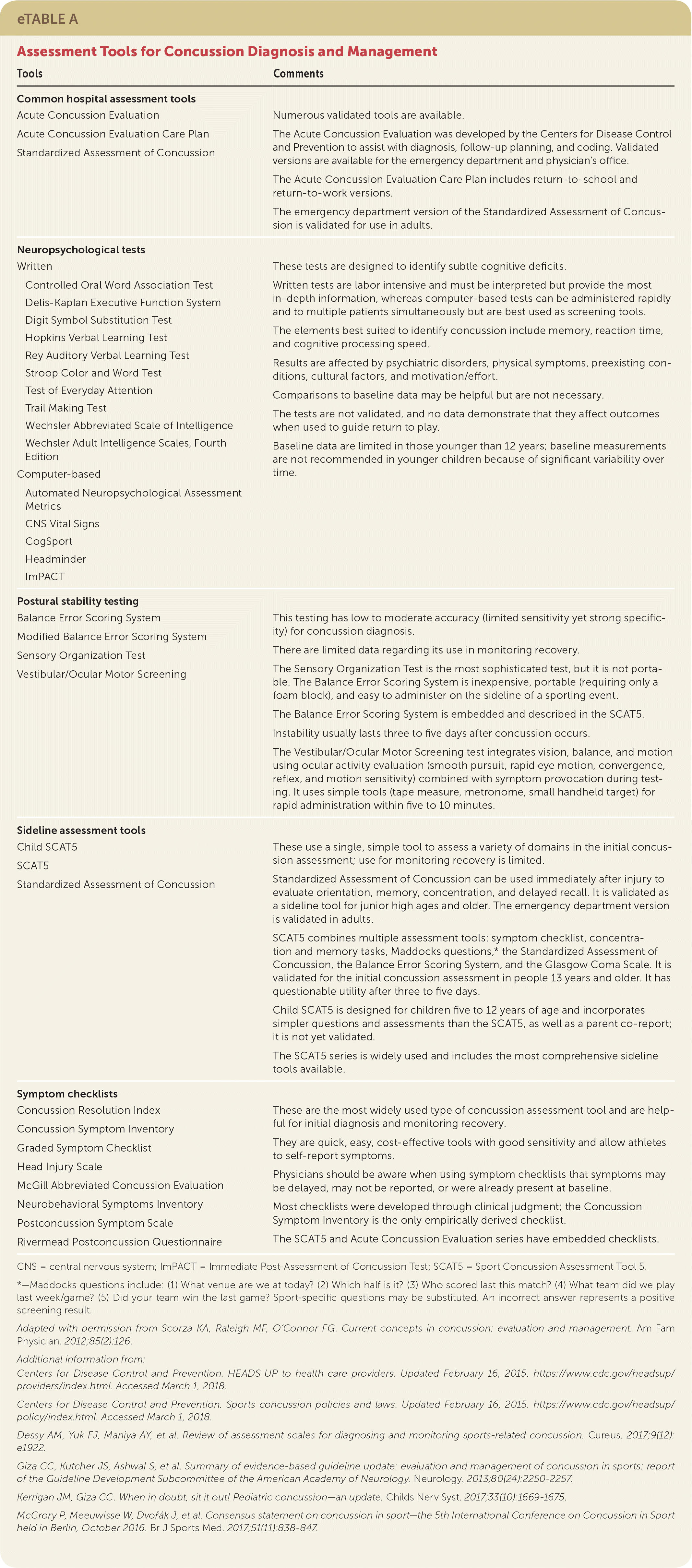
| Acute Concussion Evaluation Acute Concussion Evaluation Care Plan Standardized Assessment of Concussion | Numerous validated tools are available. The Acute Concussion Evaluation was developed by the Centers for Disease Control and Prevention to assist with diagnosis, follow-up planning, and coding. Validated versions are available for the emergency department and physician's office. The Acute Concussion Evaluation Care Plan includes return-to-school and return-to-work versions. The emergency department version of the Standardized Assessment of Concussion is validated for use in adults. |
| Neuropsychological tests | |
Written
| These tests are designed to identify subtle cognitive deficits. Written tests are labor intensive and must be interpreted but provide the most in-depth information, whereas computer-based tests can be administered rapidly and to multiple patients simultaneously but are best used as screening tools. The elements best suited to identify concussion include memory, reaction time, and cognitive processing speed. Results are affected by psychiatric disorders, physical symptoms, preexisting conditions, cultural factors, and motivation/effort. Comparisons to baseline data may be helpful but are not necessary. The tests are not validated, and no data demonstrate that they affect outcomes when used to guide return to play. Baseline data are limited in those younger than 12 years; baseline measurements are not recommended in younger children because of significant variability over time. |
Computer-based
| |
| Postural stability testing | |
| Balance Error Scoring System Modified Balance Error Scoring System Sensory Organization Test Vestibular/Ocular Motor Screening | This testing has low to moderate accuracy (limited sensitivity yet strong specificity) for concussion diagnosis. There are limited data regarding its use in monitoring recovery. The Sensory Organization Test is the most sophisticated test, but it is not portable. The Balance Error Scoring System is inexpensive, portable (requiring only a foam block), and easy to administer on the sideline of a sporting event. The Balance Error Scoring System is embedded and described in the SCAT5. Instability usually lasts three to five days after concussion occurs. The Vestibular/Ocular Motor Screening test integrates vision, balance, and motion using ocular activity evaluation (smooth pursuit, rapid eye motion, convergence, reflex, and motion sensitivity) combined with symptom provocation during testing. It uses simple tools (tape measure, metronome, small handheld target) for rapid administration within five to 10 minutes. |
| Sideline assessment tools | |
| Child SCAT5 SCAT5 Standardized Assessment of Concussion | These use a single, simple tool to assess a variety of domains in the initial concussion assessment; use for monitoring recovery is limited. Standardized Assessment of Concussion can be used immediately after injury to evaluate orientation, memory, concentration, and delayed recall. It is validated as a sideline tool for junior high ages and older. The emergency department version is validated in adults. SCAT5 combines multiple assessment tools: symptom checklist, concentration and memory tasks, Maddocks questions,* the Standardized Assessment of Concussion, the Balance Error Scoring System, and the Glasgow Coma Scale. It is validated for the initial concussion assessment in people 13 years and older. It has questionable utility after three to five days. Child SCAT5 is designed for children five to 12 years of age and incorporates simpler questions and assessments than the SCAT5, as well as a parent co-report; it is not yet validated. The SCAT5 series is widely used and includes the most comprehensive sideline tools available. |
| Symptom checklists | |
| Concussion Resolution Index Concussion Symptom Inventory Graded Symptom Checklist Head Injury Scale McGill Abbreviated Concussion Evaluation Neurobehavioral Symptoms Inventory Postconcussion Symptom Scale Rivermead Postconcussion Questionnaire | These are the most widely used type of concussion assessment tool and are helpful for initial diagnosis and monitoring recovery. They are quick, easy, cost-effective tools with good sensitivity and allow athletes to self-report symptoms. Physicians should be aware when using symptom checklists that symptoms may be delayed, may not be reported, or were already present at baseline. Most checklists were developed through clinical judgment; the Concussion Symptom Inventory is the only empirically derived checklist. The SCAT5 and Acute Concussion Evaluation series have embedded checklists. |