Clinical Question
Does the use of aspirin decrease the risk of all-cause or cardiovascular mortality in patients with hypertension?
Evidence-Based Answer
The use of aspirin for primary prevention likely decreases the risk of all cardiovascular events (number needed to treat [NNT] = 175) but does not modify all-cause or cardiovascular mortality and increases the risk of major bleeding (number needed to harm [NNH] = 175) in patients with hypertension.1
Practice Pointers
Cardiovascular disease (CVD) is the leading cause of mortality worldwide, causing 17.9 million deaths (32% of the total) in 2019.2 Hypertension is a significant risk factor in the progression of morbidity and increases all-cause mortality.3 The authors of this review sought to determine the value of taking aspirin as the primary prevention of all-cause and cardiovascular mortality in patients with hypertension.
This Cochrane review included six single- or double-blinded randomized controlled trials (published between 1996 and 2019) involving 61,015 participants who were 30 to 85 years of age.1 Inclusion criteria were a systolic blood pressure of 140 mm Hg or greater or a diastolic blood pressure of 90 mm Hg or greater. The treatment durations were between three months and five years. Primary outcomes were all-cause and cardiovascular mortality. Secondary outcomes were nonfatal cardiovascular events and major bleeding events. Major bleeding was defined as hemorrhagic stroke or blood loss involving a decrease in hemoglobin greater than 2 g per dL (20 g per L).
Aspirin in daily dosages of 75 mg, 81 mg, or 100 mg (three studies; n = 35,794) did not improve all-cause mortality (odds ratio [OR] = 0.97; 95% CI, 0.87 to 1.08) or cardiovascular mortality (OR = 0.98; 95% CI, 0.82 to 1.17) compared with placebo. Aspirin decreased the risk of nonfatal cardiovascular events (OR = 0.63; 95% CI, 0.45 to 0.87; NNT = 37) and all cardiovascular events (OR = 0.86; 95% CI, 0.77 to 0.96; NNT = 175). However, aspirin increased the risk of major bleeding events (OR = 1.77; 95% CI, 1.34 to 2.32; NNH = 175). The outcome of increased risk of major bleeding events was derived from evidence rated as high certainty on the GRADE rating system.
The U.S. Preventive Services Task Force (USPSTF) recommends that adults 40 to 59 years of age with a 10% or greater 10-year CVD risk make individual decisions when considering the initiation of low-dose aspirin for the primary prevention of CVD because evidence indicates that the net benefit of aspirin use in this group is small.4 People not at increased risk of bleeding who are willing to take low-dose aspirin daily are more likely to benefit (Grade C recommendation). The USPSTF recommends against initiating low-dose aspirin for the primary prevention of CVD in adults 60 years or older (Grade D recommendation).4 The American College of Cardiology and American Heart Association recommend that low-dose aspirin be considered for the primary prevention of atherosclerotic CVD in certain adults at higher risk who are between 40 and 70 years of age and not at increased risk of bleeding. However, aspirin should not be administered on a routine basis for the primary prevention of atherosclerotic CVD among adults older than 70 years or among adults at any age who are at increased risk of bleeding.5 Guideline-directed management of hypertension is an effective way to decrease a patient’s overall atherosclerotic CVD risk score.
SUMMARY TABLE Outcomes of Aspirin Use and the Risk of Mortality in Patients With Hypertension
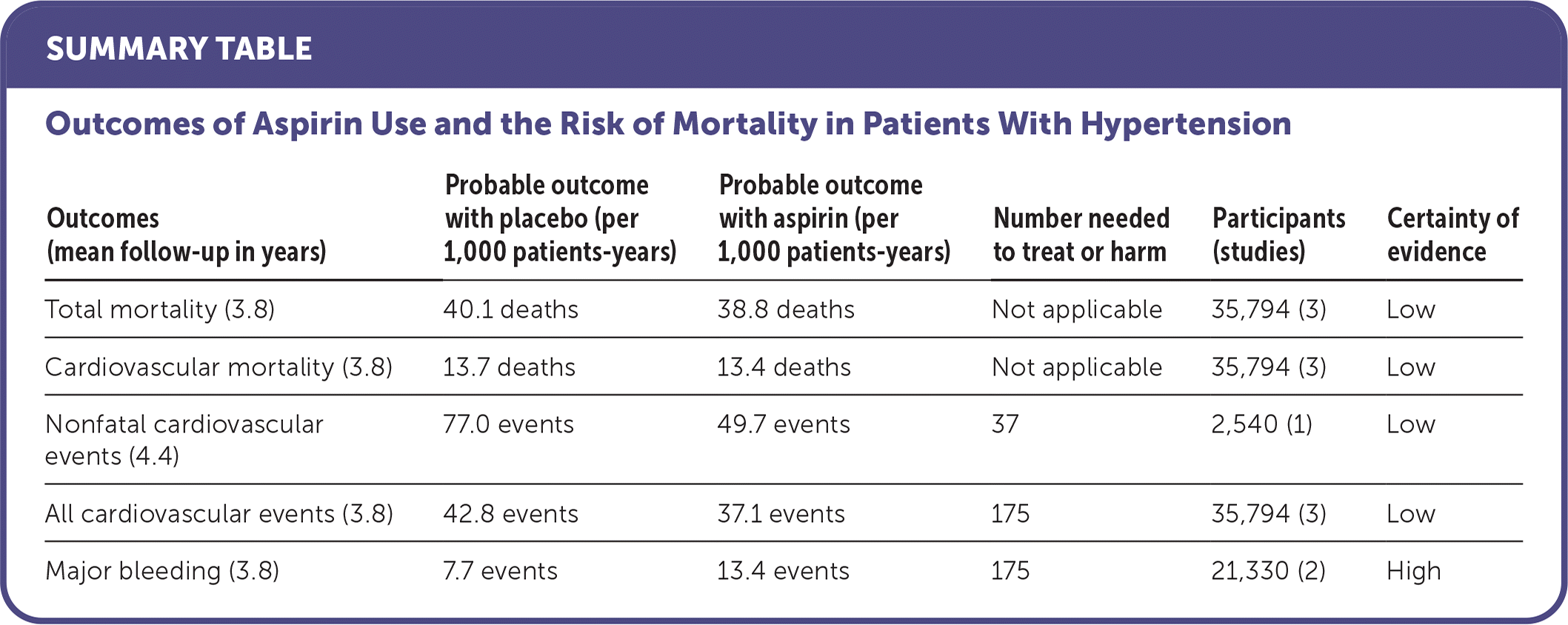
| Outcomes (mean follow-up in years) | Probable outcome with placebo (per 1,000 patients-years) | Probable outcome with aspirin (per 1,000 patients-years) | Number needed to treat or harm | Participants (studies) | Certainty of evidence |
|---|---|---|---|---|---|
| Total mortality (3.8) | 40.1 deaths | 38.8 deaths | Not applicable | 35,794 (3) | Low |
| Cardiovascular mortality (3.8) | 13.7 deaths | 13.4 deaths | Not applicable | 35,794 (3) | Low |
| Nonfatal cardiovascular events (4.4) | 77.0 events | 49.7 events | 37 | 2,540 (1) | Low |
| All cardiovascular events (3.8) | 42.8 events | 37.1 events | 175 | 35,794 (3) | Low |
| Major bleeding (3.8) | 7.7 events | 13.4 events | 175 | 21,330 (2) | High |
Patient Perspective
Most of us know someone who has had a heart attack. Taking a simple and cheap medication such as aspirin seems inviting to prevent a heart attack, until the risk of gastrointestinal bleeding tempers any excitement. This appears to be an area in which shared decision-making is essential. Perhaps the patient wants to take aspirin because close relatives have had heart attacks. The accompanying table seems to be a good starting point for a shared decision between physician and patient about taking low-dose aspirin. It’s unclear if the studies included in the review involved coated aspirin or if this affects the gastrointestinal bleeding risk. Even though no one has experienced a heart attack in my household, my spouse chooses to take a coated, low-dose aspirin every other day.
Editor's Note: The NNT and NNH reported in this Cochrane for Clinicians were calculated by the authors based on raw data provided in the original Cochrane review.
The practice recommendations in this activity are available at https://www.cochrane.org/CD003186.
The opinions and assertions contained herein are the private views of the authors and are not to be construed as official or as reflecting the views of the U.S. Navy, U.S. Department of Defense, or the U.S. government.