
Mentors leave an indelible mark on who we become as physicians, and their loss changes us as well.
Mentorship is crucial during medical education and residency, and it often makes an indelible mark on who we become as physicians. When a mentor dies, it leaves an indescribable void.
My mentor's name was Dennis, but he was “Dr. S” to most of us, or “dfs,” as he signed his e-mails — a small indication of how humble and unassuming he was. Dr. S embodied the art of medicine. He practiced with joy that was contagious, and he truly listened — to his students, his care team, and especially his patients.
Dr. S had an incredible career and remained a lifelong learner. He saw patients of all ages, was certified in colposcopy and geriatric care, and rounded on patients in the hospital and on hospice until he retired. He chaired an ethics committee, led his AAFP state chapter, published often, and even pioneered a free clinic, where he continued working after retirement. He was a preceptor, ran student Balint groups to champion mental health, and conducted group visits to manage patients' chronic conditions as well as to extol the virtues of Tai Chi for aging gracefully. For his dedication, he was inducted into the national Gold Humanism Honor Society and named AAFP Family Physician of the Year. To me, he was unstoppable, a simply amazing human being, physician, and friend. And then, he died.
His death left a chasm that I'm still trying to repair. A few months ago, I saw a useful graphic on the nature of grieving (see "A depiction of grief"). The basic idea, which I now use when counseling patients, is that we often expect life to continue and grief to grow smaller. In fact, the opposite is true. Grief stays the same, but life grows around it.
A DEPICTION OF GRIEF
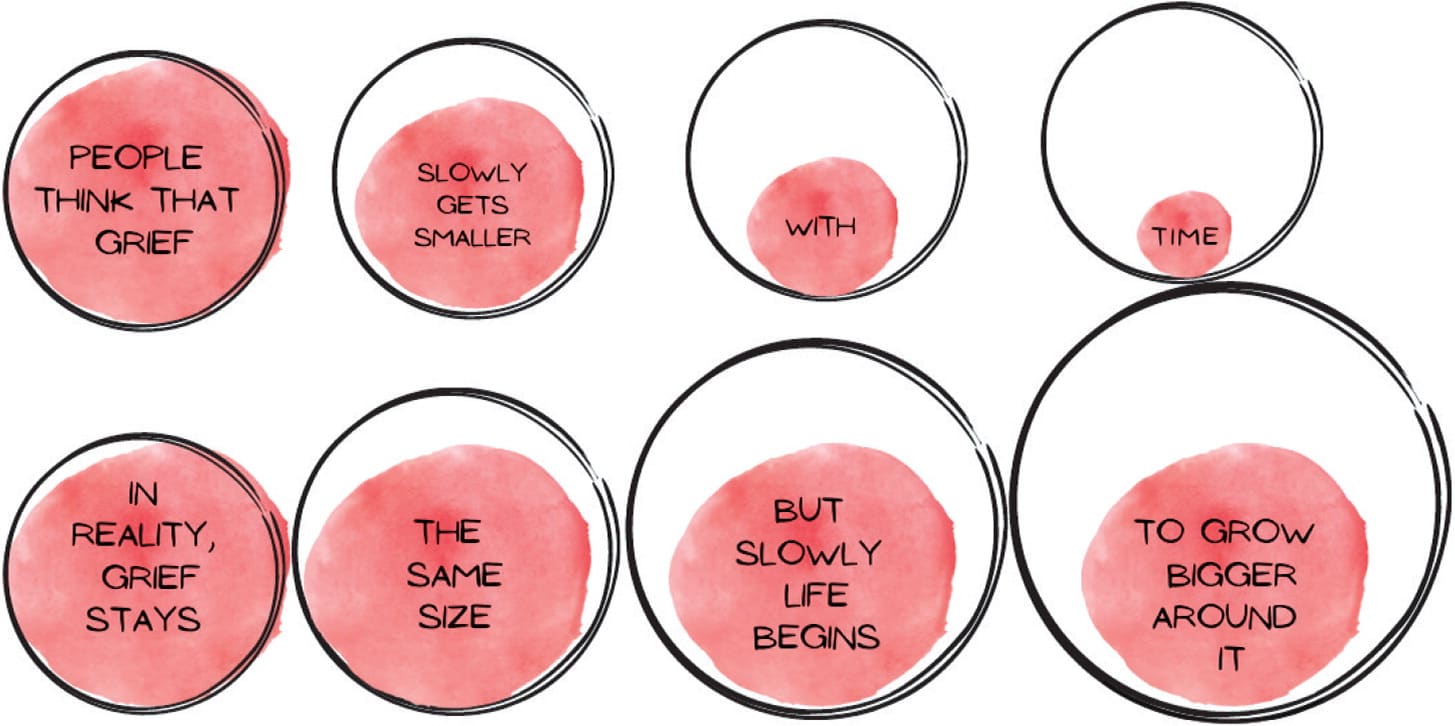
Source: Growing around grief. What's Your Grief? June 7, 2021. Accessed July 26, 2024. https://whatsyourgrief.com/growing-around-grief/. Used with permission. Concept based on: Tonkin L. Growing around grief – another way of looking at grief and recovery. Bereavement Care. 1996;15(1):10.
THREE LESSONS
Dr. S taught me countless lessons that I still try to apply in my work every day. Here are a few that I hope will help you too.
• Put the patient's care at the center of the practice. Dr. S considered patients equal partners with the care team, all working toward the same goals. He treated “Wendy in Room 1,” not “the patient with leg pain in Room 1.” He was the kind of physician who often knew his patients' fears before they said them out loud and quickly got to the root of their wishes, needs, and goals. Patients clearly appreciated his approach to shared decision-making. His office was wallpapered with “thank you” cards and photographs sent by grateful patients over the years.
• Be analytical but open-minded. Dr. S taught me to be rigorous and to look at the evidence. But he also taught me to meet patients where they are and not discount “POEMs” (patient-oriented evidence that matters), such as how a treatment might affect a patient's quality of life.1 In this way, we treat patients with respect and dignity. Dr. S also showed me how simply listening can promote healing. I will never forget his patience, kindness, and easy humor with patients.
• Take care of colleagues as well. Being a doctor is hard sometimes. As Dr. S used to say, it's “not for the faint of heart, but it strengthens your heart and sharpens resolve.” Amid the demands of modern medicine, we face challenges of access, disparity, resource poverty, technology, and even global pandemics. In recent years, physicians, residents, and medical students have reported alarming rates of burnout and compassion fatigue.2 It's likely even more don't report their struggles. Dr. S taught me that the best way to face these challenges is to do it together and take care of each other.
Read the full article
Get immediate access, anytime, anywhere.
Choose a single article, issue, or full-access subscription.
Earn up to 5 CME credits per issue.