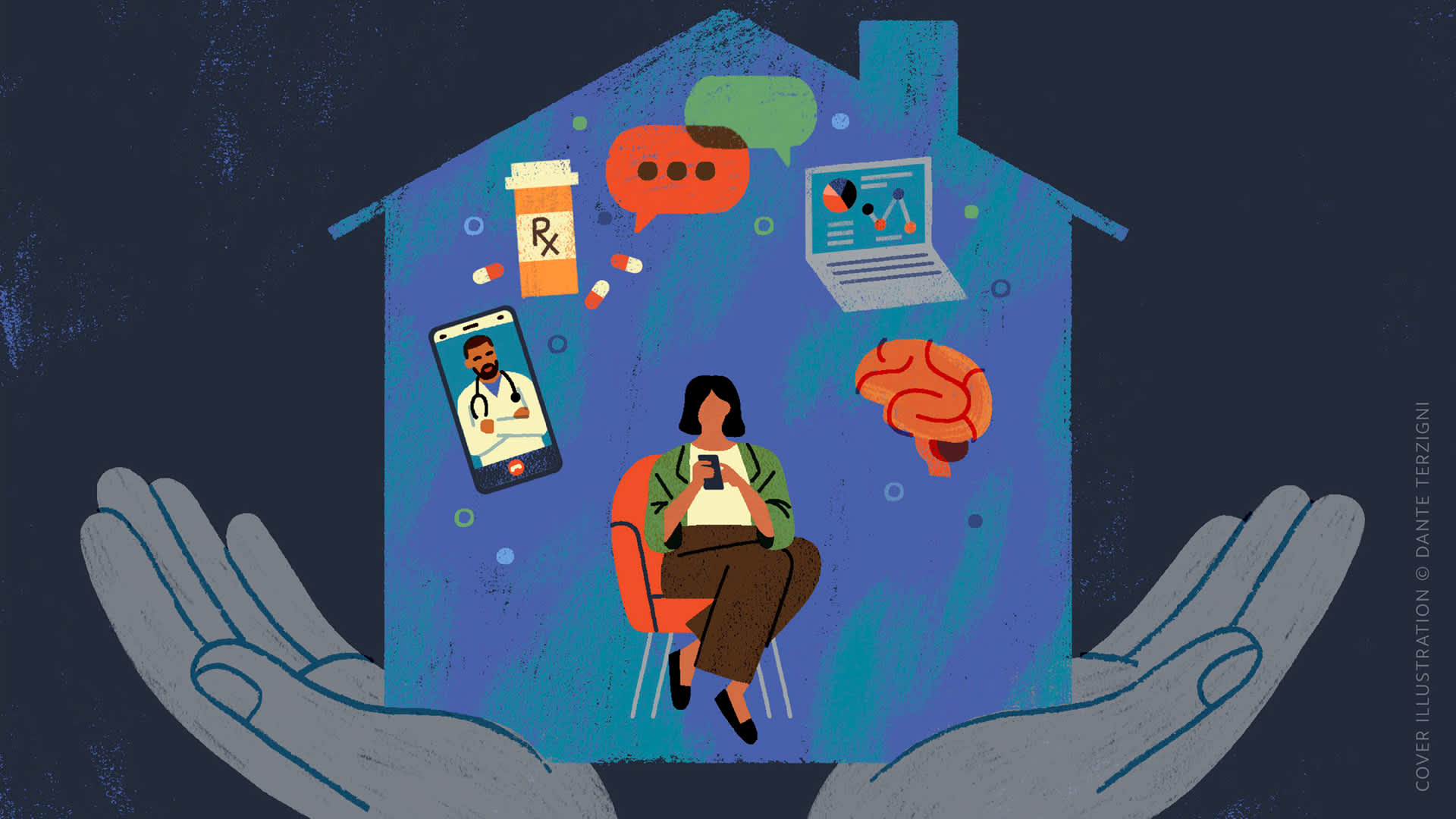

The answer to physician burnout and patient access could lie in using technology to augment the traditional doctor-patient relationship.
The gap between the demand for primary care in the U.S. and the capacity to meet that demand is widening. As the number of primary care clinicians per capita declines, only 43% of U.S. adults report having a long-term primary care relationship.1,2 A 2021 National Academies report warned that “primary care in the United States is slowly dying.”3
Standard solutions call for more money and more clinicians. While the U.S. should pursue these approaches, they are unlikely to succeed on their own, particularly in the short term. In this opinion piece, we (two primary care doctors and two patients with histories of serious illness) suggest embracing a primary care triad of the future: a doctor, a patient, and an artificial intelligence (AI) health coach. We envision a multitasking AI program to supplement, rather than replace, a strong and trusting patient-clinician therapeutic alliance.
In the discussion that follows, we anthropomorphize a hypothetical AI coach, naming it “Multi.” We then explore this intervention's effects through two fictional vignettes that show how it can address the related problems of poor primary care access and persistent clinician overwork.
MS. FERNANDEZ, AGE 37
While walking her dog, Ms. Fernandez experiences sudden severe pain in her left knee. She can barely walk, but the next available primary care appointment at her local community health center is four weeks away. She logs onto her patient portal, writes a history of her acute condition, and receives an instant consultation with “Multi,” the health center's AI coach. Multi suggests rest, ice, compression, and acetaminophen, teaches Ms. Fernandez how to use a cane with an instructional video, and schedules an in-person appointment with an orthopedic physician assistant (PA). At the appointment, the PA suspects a meniscus tear, performs an intra-articular steroid injection, and asks Multi to schedule physical therapy (PT). With PT scheduling two weeks out, Multi teaches Ms. Fernandez exercises with the help of instructional videos in the meantime. Multi records and edits the notes for all encounters throughout the illness. Ms. Fernandez's primary care clinician at the health center reviews all the app's work. By the time her primary care appointment arrives, she is almost back to normal.
In this example, the AI coach immediately initiates care with evidence-based treatment recommendations and instructional videos, mitigating the four-week wait without requiring Ms. Fernandez's primary care physician to shuffle their schedule.4 Ambient voice recording documents her in-person encounters with the orthopedic PA and physical therapist, and the resulting notes are available for her and her clinicians to review and edit.5 If Ms. Fernandez prefers, Multi can answer her queries in Spanish, or translate visits conducted in English into notes in Spanish.6
While Multi clearly adds value in this scenario, it's important to remember that because AI programs sometimes provide inaccurate information, Multi's notes and translations need oversight, just as clinicians do.
MR. CURTIS, AGE 72
Mr. Curtis is slipping through the cracks of the health care system. He has been diagnosed with Parkinson's disease and is paying little attention to his hypertension and type 2 diabetes. He lives alone in a small rural town where the only doctor moved away due to relentless overwork. Mr. Curtis has no family nearby, but a friend in church sets him up with Multi's virtual primary care network, which finds him a primary care doctor who can see him via telehealth. Multi introduces Mr. Curtis to a local pharmacy technician who instructs him in blood pressure and blood sugar monitoring. With pharmacist oversight, Multi helps Mr. Curtis monitor and titrate blood pressure and diabetes medications, using well-established protocols. Multi, which is trained in lifestyle improvement and motivational interviewing, introduces Mr. Curtis to a peer coach who also has diabetes and motivates him to actively engage in managing his blood sugar.
Read the full article
Get immediate access, anytime, anywhere.
Choose a single article, issue, or full-access subscription.
Earn up to 5 CME credits per issue.