
‘Starfield Signal’ charts AI leadership pathway for family physicians
News Staff
August 13, 2025
Aug. 13, 2025, News Staff — An optimistic new report co-published by the AAFP maps the existing intersections of primary care and artificial intelligence (AI) tools—and points to where their shared evolution may lead.

“While AI is poised to reshape primary care, the critical question is how it will do so. If implemented thoughtfully and in close partnership with clinicians, AI could help stabilize primary care and reverse the impact of decades of underinvestment and fragmentation,” the report says.
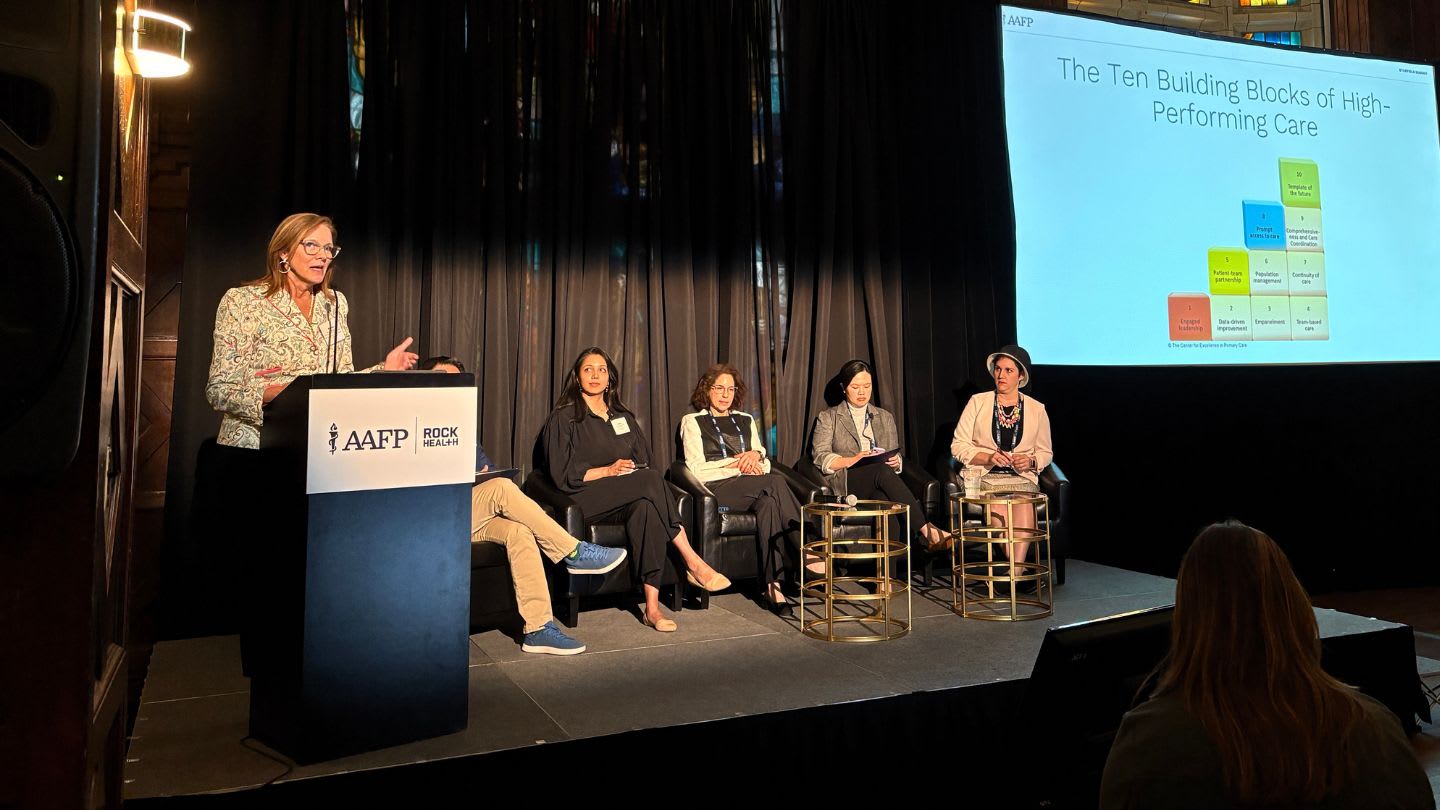
Titled “The Starfield Signal: A Shared Vision and Roadmap for AI in Primary Care,” it follows the May Starfield summit convened by the Academy and the health care innovation firm Rock Health, and collates research, insights and planning conducted so far in the joint initiative.
The purpose of both the summit and its follow-up report is “to show how AI can be harnessed to strengthen—not supplant—the core values of primary care,” Steven Waldren MD, the AAFP’s chief informatics officer, told AAFP News.
“’The Starfield Signal’ summarizes the shared vision created at the summit, outlines a road map for action and reflects on the event itself as a model for cross-sector collaboration,” he added.
Starfield events, named for the late physician and health systems researcher Barbara Starfield, are meant to unite stakeholders in topical conversations “around the principles of Implementation Science, which seeks to promote the integration of research into policy and practice,” the Starfield website notes. This summit convened more than 80 such stakeholders, including physicians, technology leaders, payers, researchers, policymakers and patient advocates.
A shared vision and roadmap for AI in primary care
The Starfield Signal
Review the collective insights of a diverse group of leaders who believe that AI can address many challenges to help primary care achieve its full potential.
Download reportGetting from ‘vision’ to action
Following an introductory letter by AAFP Executive Vice President and CEO Shawn Martin and Rock Health CEO Katie Drasser, the report’s five chapters lay out
- why primary care is uniquely positioned to benefit from AI,
- why AI developers should focus on primary care,
- how AI can strengthen primary care,
- potential barriers (including infrastructure, payment and trust), and
- a set of near- and mid-term stakeholder actions that could advance effective AI integration in primary care.
“If primary care physicians are not included in the identification of challenges or unmet needs for AI to address, AI tools won’t be effective for primary care,” the report cautions. “Further, if primary care physicians are not involved in tool development or testing, tools may be insufficient to meet real-world workflows or could worsen them.”
To address this and other concerns, the report’s “roadmap” centers on three strategic aims:
- convening the right stakeholders (including “innovation networks” of primary care practices to pilot AI tools, forums for practices to share information and primary care-specific benchmarks for safety, equity and transparency of AI tools);
- advocating for policy and payment reform; and
- building resources and tools (including frameworks for practices to evaluate AI products and vendors, AI education and CME and multilingual patient-engagement support).
Waldren said that the summit itself suggests that the resulting report’s AI mandate is achievable.
“The Starfield AI summit was a powerful demonstration of what is possible when diverse voices come together,” he said. “The summit’s structure—rooted in co-creation, not presentation—enabled candid dialogue and consensus building among diverse voices. Besides frontline family physicians, participants included internists, pediatricians, academic leaders, health system executives, EHR vendors and AI experts.
“No one avoided the hard questions, and all acknowledged that AI alone cannot fix structural issues such as underfunding and workforce shortages,” Waldren added. “But AI that’s guided by the values of primary care could help reverse decades of underinvestment and fragmentation.”
Learn more about artificial intelligence in family medicine