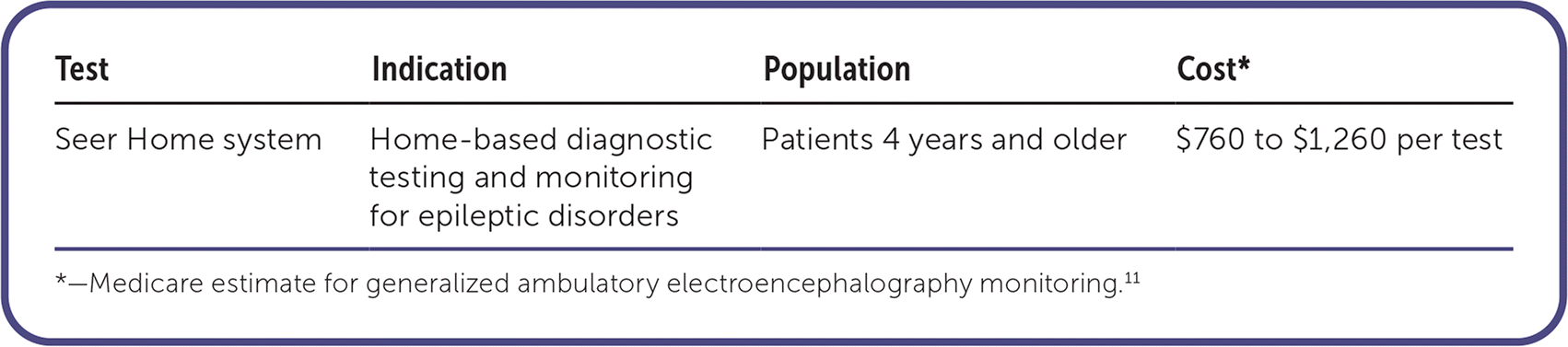
The Seer Home system is a group of combined technologies that deliver home video-electroencephalography-electrocardiography (EEG-ECG) monitoring for up to one week in patients four years and older.1 The device (Seer Sense) is worn around the shoulders and has gel-adhesive electrodes that connect to the patient's head and chest. Video footage is recorded, and EEG-ECG data are wirelessly transmitted to a monitoring hub where an artificial intelligence–enabled review platform synthesizes information but does not draw diagnostic conclusions. A technician monitors and reviews the data, and the patient's physician can access a web portal with full data. The U.S. Food and Drug Administration has granted this device 510(k) clearance.2
Accuracy
Clinical testing is not required when a medical device receives traditional 510(k) clearance. The indications for use are compared with similar devices previously on the market. In this case, the Seer Home system was compared with the MobileMedTek Electro Tek. Ambulatory EEG systems with proven safety and effectiveness have been on the market for many years.2
When inpatient video-EEG was compared with ambulatory video-EEG, no significant difference was seen in diagnostic yield.3 However, well-powered studies are limited, and results are influenced by pretest probability, leading to a large range in diagnostic yield or capturing one event on video. In previous studies, diagnostic yield ranged from 24.9% to 85% for ambulatory video-EEG because of the variability of pretest probability in the patient populations.4
A prospective study compared 41 patients monitored via ambulatory video-EEG with 64 patients monitored via inpatient video-EEG. Both groups were monitored for 48 hours.5 Patients were recruited by neurologist referral, and the study was not randomized because patients had to be suitable for home investigation. The study found comparable diagnostic effectiveness (measured by the number of seizure events recorded) between the two groups. When evaluating between epileptic and nonepileptic events, the diagnostic question (when a patient was referred to discern between epileptic vs. nonepileptic seizures) was answered in 67% of ambulatory video-EEGs and 63% of inpatient video-EEGs.
In an unpublished retrospective review including 6,265 patients (45% with events), higher rates of events were captured with the Seer Home system compared with ambulatory EEG products (94% vs. 80%, respectively). This was due to significant improvements in video technology, including wide-angle view and automatic transition to low-light infrared recording.6
Benefit
Ambulatory video-EEG monitoring systems are useful diagnostic tools because monitoring outside of the patient's home can artificially affect the results.1 Additionally, ambulatory video-EEG has been helpful in capturing interictal epileptiform discharges before initiating antiepileptic drugs, ending the use of these drugs in seizure-free patients; classifying epilepsy syndromes; and quantifying seizure burden to guide antiepileptic drug therapy.7
The manufacturer of the Seer Home system advertises a supplemental proprietary digital application that tracks potential epileptiform activity with the goal of generating a “forecast” for future seizure events. Forecasting depends on the theory of cyclic rhythms in seizure activity. By using patient-reported event data, the Seer app can categorize periods of time as low, medium, and high risk of seizure in the next hour.8 This may help alleviate the psychosocial burden and potential safety concerns caused by the uncertainty of seizure occurrences, especially for the 30% of patients with epilepsy who are refractory to antiepileptic drugs.
The manufacturer further advertises that forecasting is more predictive when paired with wearable devices that provide additional information such as heart rate, stress, sleep, and physical activity.8 This is based on a relatively limited study of a small cohort of 50 Seer app users in which seizure activity was predicted in approximately one-half of the cohort (a total of 109 seizure events).9
Patient convenience is an additional benefit of in-home monitoring. Multiple studies show a considerable patient preference for ambulatory video-EEG over inpatient video-EEG.4
Harms
There are limited low-powered studies comparing the diagnostic yield for ambulatory video-EEG vs. inpatient video-EEG. When pretest probability is low, diagnostic yield is also low.4 There is a hypothetical risk of strangulation during a seizure event, and immediate medical assistance is not available with ambulatory monitoring.10 At-home setup of video equipment and placement of electrodes leads to the risk of loss of data or the presence of artifact.3 A nondiagnostic home video-EEG may still require admission for further evaluation with inpatient video-EEG. Reducing use of anti-seizure medication is not recommended during ambulatory monitoring because of safety risks, including status epilepticus. Admission for inpatient monitoring is needed if the physician is planning to reduce medications or considering evaluation for epilepsy surgery.4,5,10
Cost
The cost of the Seer Home system is not available. Medicare estimates that ambulatory EEG monitoring costs range from $760 to $1,260 per test.11 This estimate does not factor in the costs of associated clinic visits and fees for the specialists who read and interpret the study results.
The cost of an ambulatory video-EEG is estimated to be two-thirds less than inpatient stays for video-EEG.4 Availability of home video-EEG may reduce time to diagnosis.10
Bottom Line
The Seer Home system allows monitoring from home for up to one week and others similar diagnostic yield as inpatient monitoring. Improved video technology has resulted in higher capture rates than previous ambulatory EEG products. Ambulatory video-EEG is considerably less expensive and generally preferred by patients over a prolonged inpatient stay. However, the utility of the Seer Home system is limited for family physicians. Generally, without additional training to interpret EEGs, most physicians refer patients to a neurologist or epileptologist for further evaluation.
The opinions and assertions expressed herein are those of the authors and do not reflect the official policy or position of the U.S. Army, the U.S. Department of Defense, or the U.S. government.