A 49-year-old man presented with a progressively worsening rash on both shins that had been present for 10 years (Figure 1). Nocturnal pruritus interfered with his sleep. He had been using a loofah to scrub his legs when bathing.
FIGURE 1
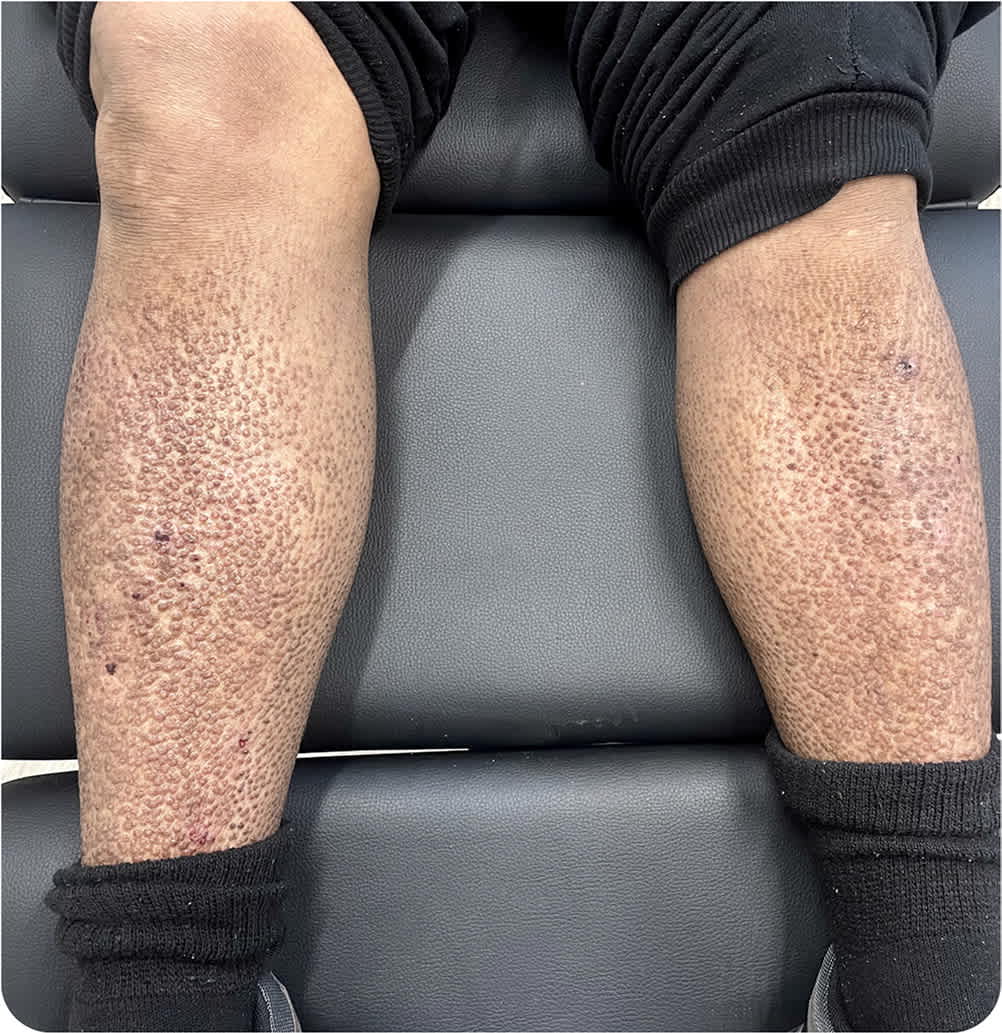
Physical examination revealed multiple small, indurated papules on both shins. Some lesions had coalesced into large, scaly plaques. A punch biopsy of the left shin revealed homogenous eosinophilic deposits within widened dermal papillae, with prominent vascularity and pigment-laden macrophages. The results of crystal violet and thioflavin T stains were positive.
Question
Based on the patient's history and physical examination findings, which one of the following is the most likely diagnosis?
- A. Folliculitis.
- B. Granuloma annulare.
- C. Lichen amyloidosis.
- D. Lichen simplex chronicus.
Discussion
The answer is C: lichen amyloidosis, a type of primary cutaneous amyloidosis associated with chronic pruritus. It typically develops after 50 years of age and is more common in patients with darker skin tones. Lesions present as small, hyperpigmented papules that coalesce into larger plaques with a rippled distribution pattern. The lesions are mainly present on extensor surfaces of the extremities, most commonly the shins.
Pathologic examination of a biopsy reveals hyperkeratosis, amorphous deposits of eosinophilic material, and scattered pigment-laden macrophages adjacent to the dermal-epidermal junction. Congo red, crystal violet, and thioflavin T stains are used to identify the amyloid deposits.1,2 The presence of cutaneous amyloid should prompt a workup for systemic causes of amyloid deposition and the involvement of other organs.
Folliculitis is inflammation of the hair follicles due to infectious or noninfectious causes. Noninfectious folliculitis is often secondary to friction-related trauma. Lesions present as small, pruritic papules on an erythematous base. Each papule is pierced by a central hair. Pathology shows neutrophils around the hair follicle, and older lesions may show chronic granulomatous inflammation with giant cells containing keratin and fragmented hair.3 Folliculitis is differentiated from lichen amyloidosis by the presence of a central hair in the lesions.
Granuloma annulare presents as papules that are erythematous or the same color as the surrounding skin and in a ring-like configuration, most commonly on the hands or feet. Otherwise, patients are usually asymptomatic. Pathology shows a focal degeneration of collagen surrounded by an inflammatory infiltrate consisting of lymphocytes and histiocytes in a palisading or interstitial distribution.4 Differentiation from lichen amyloidosis is made with the histopathology findings and clinical difference in lesion configuration.
Lichen simplex chronicus is a neurodermatitis that presents as a single or multiple thickened, excoriated plaques with hyperpigmentation, erythema, or both. Lichenification occurs due to scratching or other forms of mechanical irritation to the skin. The most commonly affected locations are self-accessible parts of the body, such as the scalp, head, neck, hands, arms, or genitals.5 It is differentiated from lichen amyloidosis by the absence of amyloid deposits in the histopathology and because it does not feature a rippled distribution pattern.
SUMMARY TABLE
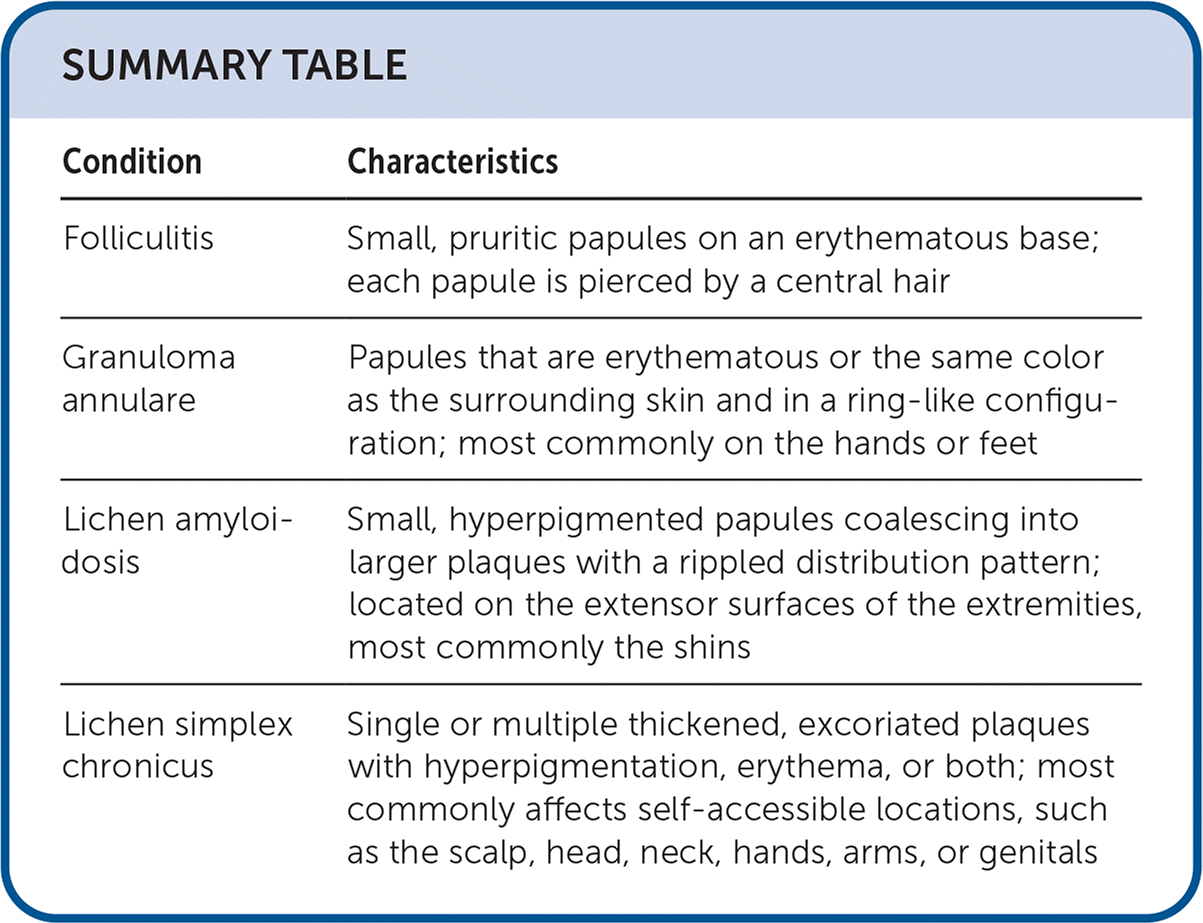
| Condition | Characteristics |
|---|---|
| Folliculitis | Small, pruritic papules on an erythematous base; each papule is pierced by a central hair |
| Granuloma annulare | Papules that are erythematous or the same color as the surrounding skin and in a ring-like configuration; most commonly on the hands or feet |
| Lichen amyloidosis | Small, hyperpigmented papules coalescing into larger plaques with a rippled distribution pattern; located on the extensor surfaces of the extremities, most commonly the shins |
| Lichen simplex chronicus | Single or multiple thickened, excoriated plaques with hyperpigmentation, erythema, or both; most commonly affects self-accessible locations, such as the scalp, head, neck, hands, arms, or genitals |