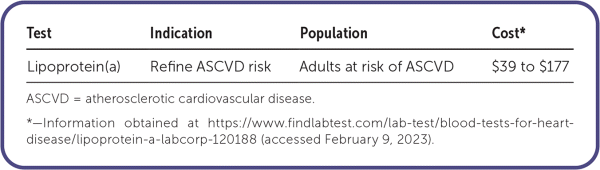
| Test | Indication | Population | Cost* |
|---|---|---|---|
| Lipoprotein(a) | Refine ASCVD risk | Adults at risk of ASCVD | $39 to $177 |
ASCVD = atherosclerotic cardiovascular disease.
*—Information obtained at https://www.findlabtest.com/lab-test/blood-tests-for-heart-disease/lipoprotein-a-labcorp-120188 (accessed February 9, 2023).
Lipoprotein(a), or Lp(a), is a genetically determined low-density lipoprotein (LDL) subtype, which has been identified as a causal risk factor for atherosclerotic cardiovascular disease (ASCVD).1–3 The Lp(a) test is approved by the U.S. Food and Drug Administration; however, there are no universally accepted screening indications. The American College of Cardiology/American Heart Association (ACC/AHA) recommends screening for adults who have a family or personal history of premature ASCVD.4 The ACC/AHA further considers Lp(a) levels greater than 50 mg per dL (125 nmol per L) to be risk-enhancing for ASCVD.1–12
Accuracy
A large prospective cohort study including 460,506 patients demonstrated a modest association between Lp(a) level and ASCVD risk.8 The average patient age was 57 years, 45% were men, 94.3% were White, and 3.8% had a history of documented ASCVD at the time of enrollment. Median Lp(a) levels were 7.8 mg per dL (19.6 nmol per L), with high risk defined as a level greater than 70 mg per dL (150 nmol per L). In the subset of patients with pre-existing ASCVD, 20% had high-risk Lp(a) levels. Over the 11-year study, patients with high-risk Lp(a) levels had a greater likelihood of developing coronary artery disease (hazard ratio [HR] = 1.63; 95% CI, 1.56 to 1.70) or having a secondary event in the setting of known disease (HR = 1.23; 95% CI, 1.10 to 1.37).8
A 2019 randomized controlled trial of 25,096 patients with known ASCVD and LDL cholesterol greater than 70 mg per dL (1.81 mmol per L) or non–high-density lipoprotein cholesterol greater than 100 mg per dL (2.59 mmol per L) studied the value of measuring Lp(a) to determine ASCVD risk.9 The average patient age was 62 years, 75% were men, and 85% were White. The population was divided into quartiles based on Lp(a) levels (less than 5.2 mg per dL [13 nmol per L], 5.2 to 14.8 mg per dL [13 to 37 nmol per L], 14.8 to 66 mg per dL [37 to 165 nmol per L], and greater than 66 mg per dL [165 nmol per L]). Being in the highest two quartiles was associated with a history of myocardial infarction at the time of enrollment. Compared with those in the lowest quartile, patients with Lp(a) levels of 14.8 to 66 mg per dL had an increased risk of death from coronary artery disease, clinical myocardial infarction, or need for urgent revascularization (HR = 1.24; 95% CI, 1.02 to 1.50). Those with Lp(a) levels greater than 66 mg per dL had an even higher risk (HR = 1.33; 95% CI, 1.1 to 1.6). This risk persisted after multivariate adjustments for age, sex, race, comorbidities, and LDL cholesterol or apolipoprotein B, with an increased risk of major coronary events in the entire population (adjusted HR = 1.06; 95% CI, 1.02 to 1.09) and highest quartile (adjusted HR = 1.22; 95% CI, 1.01 to 1.48).
Read the full article
Get immediate access, anytime, anywhere.
Choose a single article, issue, or full-access subscription.
Earn up to 14 CME credits per issue.