In 2024, the Centers for Disease Control and Prevention and the US Department of Health and Human Services Office of Population Affairs updated national guidelines on provision of quality contraceptive services and sexual and reproductive health care. New recommendations systematically promote care that is person-centered and accessible for all people. Contraceptive services may be addressed through a stepwise approach in which the clinician asks about an individual’s contraceptive preferences based on their needs, desires, and prior experiences and then collaboratively works with the patient to align methods with their values and preferences. The clinician should discuss all methods that can be used safely based on medical eligibility criteria regardless of method availability and defer the decision to the patient. Physical assessment includes in-office or self-reported blood pressure measurement before starting an estrogen-containing contraceptive or pelvic examination when inserting an intrauterine device. If it is reasonably certain that the patient is not pregnant, any contraceptive may be started immediately; otherwise, a nonintrauterine bridge method may be initiated with follow-up pregnancy testing. To reduce barriers, a 1-year supply of short-acting or injectable contraceptives may be prescribed, and telehealth may be incorporated. The Centers for Disease Control and Prevention supports advance provision of emergency contraceptives. New recommendations include pain control during intrauterine device insertion, management of bleeding irregularities related to contraception, updated eligibility criteria (eg, venous thromboembolism, kidney disease), and new methods (eg, progestin-only formulations). Expanded sexual and reproductive health care services, such as screening for cervical cancer or sexually transmitted infections, should be offered, but patient acceptance of these services is not required during contraception management.
Access to quality sexual and reproductive health care is fundamental to patient health and quality of life.1–3 Accordingly, provision of quality contraceptive care requires ongoing incorporation of new evidence and technologies for continuous improvement in delivery of care.4,5 The Centers for Disease Control and Prevention (CDC) and the US Department of Health and Human Services Office of Population Affairs have released updated, comprehensive, evidence-based contraception recommendations based on systematic literature reviews, expert panels, and patient perspectives that emphasize the principles of equity and person-centeredness2,4,6,7 (eTable A). These guidelines can be used synergistically. New recommendations include person-centered care strategies, contraceptive services contextualized into broader sexual and reproductive health care, pain control during intrauterine device (IUD) insertion, management of bleeding irregularities related to contraception, updated safety for people with medical conditions (eg, venous thromboembolism, kidney disease), and new contraceptive methods (eg, progestin-only formulations, vaginal pH modulator).2,6,7 Table 12,6,8–12 and Table 27,13–19 summarize select changes from the 2024 US Medical Eligibility Criteria for Contraceptive Use and US Selected Practice Recommendations for Contraceptive Use.
SORT: KEY RECOMMENDATIONS FOR PRACTICE
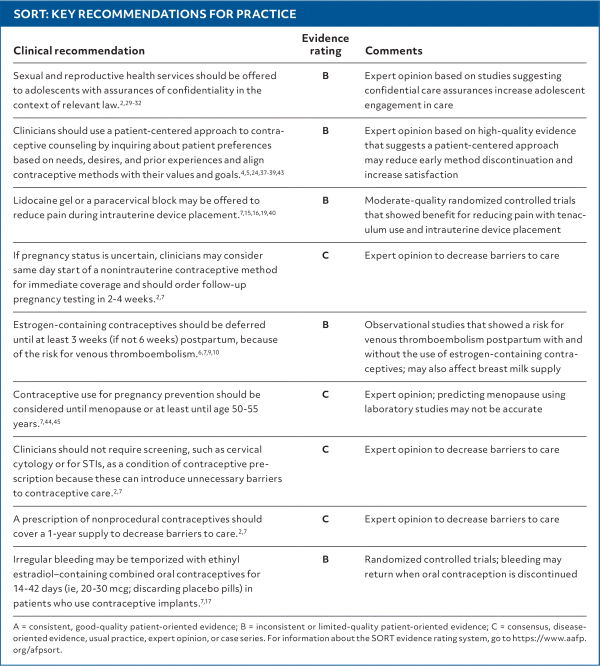
| Clinical recommendation | Evidence rating | Comments |
|---|---|---|
| Sexual and reproductive health services should be offered to adolescents with assurances of confidentiality in the context of relevant law.2,29–32 | B | Expert opinion based on studies suggesting confidential care assurances increase adolescent engagement in care |
| Clinicians should use a patient-centered approach to contraceptive counseling by inquiring about patient preferences based on needs, desires, and prior experiences and align contraceptive methods with their values and goals.4,5,24,37–39,43 | B | Expert opinion based on high-quality evidence that suggests a patient-centered approach may reduce early method discontinuation and increase satisfaction |
| Lidocaine gel or a paracervical block may be offered to reduce pain during intrauterine device placement.7,15,16,19,40 | B | Moderate-quality randomized controlled trials that showed benefit for reducing pain with tenaculum use and intrauterine device placement |
| If pregnancy status is uncertain, clinicians may consider same day start of a nonintrauterine contraceptive method for immediate coverage and should order follow-up pregnancy testing in 2–4 weeks.2,7 | C | Expert opinion to decrease barriers to care |
| Estrogen-containing contraceptives should be deferred until at least 3 weeks (if not 6 weeks) postpartum, because of the risk for venous thromboembolism.6,7,9,10 | B | Observational studies that showed a risk for venous thromboembolism postpartum with and without the use of estrogen-containing contraceptives; may also affect breast milk supply |
| Contraceptive use for pregnancy prevention should be considered until menopause or at least until age 50–55 years.7,44,45 | C | Expert opinion; predicting menopause using laboratory studies may not be accurate |
| Clinicians should not require screening, such as cervical cytology or for STIs, as a condition of contraceptive prescription because these can introduce unnecessary barriers to contraceptive care.2,7 | C | Expert opinion to decrease barriers to care |
| A prescription of nonprocedural contraceptives should cover a 1-year supply to decrease barriers to care.2,7 | C | Expert opinion to decrease barriers to care |
| Irregular bleeding may be temporized with ethinyl estradiol–containing combined oral contraceptives for 14–42 days (ie, 20–30 mcg; discarding placebo pills) in patients who use contraceptive implants.7,17 | B | Randomized controlled trials; bleeding may return when oral contraception is discontinued |
A = consistent, good-quality patient-oriented evidence; B = inconsistent or limited-quality patient-oriented evidence; C = consensus, disease-oriented evidence, usual practice, expert opinion, or case series. For information about the SORT evidence rating system, go to https://www.aafp.org/afpsort.
Read the full article
Get immediate access, anytime, anywhere.
Choose a single article, issue, or full-access subscription.
Earn up to 14 CME credits per issue.