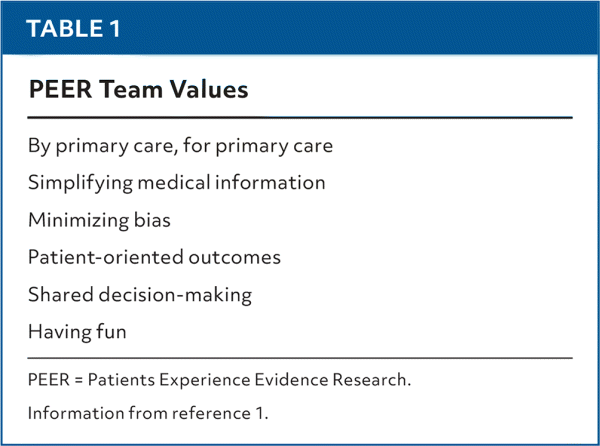
Patients Experience Evidence Research (PEER) is a trail-blazing team founded at the University of Alberta in Edmonton, Canada, that bridges the gap between research and practice in primary care.1 PEER blends medical evidence, clinical expertise, and cutting-edge research in the delivery of trustworthy scholarly products and medical education. Started by the authors of this editorial and Drs. G. Michael Allan and Scott Garrison, PEER has grown to 21 members, including family physicians, pharmacists, and nurses across Canada who are committed to education by primary care for primary care. The PEER team values are listed in Table 1.1
TABLE 1. PEER Team Values
| By primary care, for primary care |
| Simplifying medical information |
| Minimizing bias |
| Patient-oriented outcomes |
| Shared decision-making |
| Having fun |
PEER = Patients Experience Evidence Research.
Information from reference 1.
PEER began in 2009 with publication of the easy-to-read evidence summaries Tools for Practice. It now also creates simplified primary care guidelines, organizes popular conferences, conducts research, and more. PEER produces high-quality medical information based on evidence without pharmaceutical or industry bias.
Tools for Practice: These free, concise reviews provide evidence-based answers to clinical questions, giving primary care physicians practical insights into the current medical literature. Rather than summarizing one study, they summarize all the best available evidence on each clinical question. Led by Dr. Adrienne Lindblad, they are published biweekly and reach more than 40,000 health care professionals.
In the 380 Tools for Practice published to date, 96% of the authors were primary care clinicians. These reviews are routinely featured in Canadian Family Physician and are among its most read articles. Tools for Practice have addressed topics across primary care, from infant sleep training to semaglutide (Wegovy) for weight loss.
Simplified Guidelines: Following the tenets of the Institute of Medicine’s Clinical Practice Guidelines We Can Trust and the Grading of Recommendations Assessment, Development and Evaluation (GRADE) framework,2,3 Simplified Guidelines are primary care–led and without pharmaceutical industry conflicts of interest. Recommendations are informed by systematic reviews and focus on patient-oriented outcomes. PEER considers the “time needed to treat” concept in its evidence-to-decision framework.4 Simplified Guidelines include guideline summaries, decision aids, and easy-to-use algorithms for shared decision-making. The guidelines have covered topics such as lipids, cannabinoids, opioid use disorder, and chronic pain.5–10
CME events: Practical Evidence for Informed Practice (PEIP) is PEER’s flagship event and Alberta’s largest primary care conference. Offering in-person and virtual attendance, PEIP features relevant, evidence-based, and entertaining reviews of primary care topics. PEER also helps organize events such as PEER North (focusing on northern medicine) and Making Evidence Matter for Everyone. CME credits from PEER conferences are transferable to American Academy of Family Physicians.
Research and collaborative activities: PEER conducts clinically relevant primary care research independently and via the Pragmatic Trials Collaborative. Led by Dr. Garrison, the collaborative recently completed the BedMed trial, Canada’s largest non–industry-sponsored, primary care randomized controlled trial.11 BedMed recruited 3,357 hypertensive patients from 436 Canadian family physician practices and randomized them into groups taking blood pressure medications at bedtime or in the morning. BedMed found that bedtime administration of antihypertensive medications was well tolerated but did not reduce cardiovascular events compared to morning administration.
PEER’s most well-known study, which investigated television medical talk shows and the evidence supporting their recommendations, gained international attention and became one of the most read articles in the history of the BMJ.12 The study showed that about one-half of the recommendations made on these shows were contradicted by evidence or had no evidence to support them. PEER’s most cited publication, a systematic review on the most common conditions in primary care, was led by Dr. Caitlin Finley.13 At the time, Dr. Finley was a master of science student. She is now a family physician and PEER’s newest team member. The review found that symptomatic conditions, such as cough and back pain, are the most common reasons for primary care visits.
PEER collaborative activities include the Best Science Medicine podcast and the Pricing Doc, which helps physicians understand medication costs in Alberta.
Collaborating organizations and future plans: PEER works with a team of dedicated health care professionals who are passionate about producing high-quality scholarly work. Collaborating organizations include The College of Family Physicians of Canada; its provincial chapters in Alberta, Saskatchewan, and Ontario; local universities; and Canadian Family Physician.
Future plans include continuing to challenge dogma in practice and finding new ways to make evidence usable for all primary care clinicians. PEER’s practical tools are rooted in evidence that transcends borders and are designed to help primary care physicians make well-informed decisions and improve patient outcomes in a manner that respects physicians’ expertise, time, and patient relationships.