Heel pain accounts for 2 million office visits annually and is associated with higher body mass index, manual jobs, and a sedentary lifestyle. Retrocalcaneal bursitis is more common in women 40 to 60 years of age with Haglund deformity and a thickened Achilles tendon. Calcaneal apophysitis (Sever disease) is the most common cause of heel pain in active children and adolescents; in the outpatient setting, it accounts for up to 16% of musculoskeletal conditions in children. In os trigonum syndrome, athletes such as soccer players, gymnasts, and dancers who are engaged in repetitive plantar flexion commonly present with worsening posterior ankle pain and an antalgic gait. Risk factors for peroneal tendon injuries include corticosteroid injections into the peroneal sheath, use of fluoroquinolones, rheumatoid arthritis, hyperparathyroidism, and diabetes. Magnetic resonance imaging is the most accurate test for the diagnosis of most causes of heel pain, but ultrasonography is being used more often as it becomes more readily available at the point of care. Most patients with heel pain improve with conservative treatment, and surgical management should be reserved for recalcitrant cases. Pain catastrophizing and kinesiophobia are associated with diminished foot function and poorer prognosis.
Heel pain accounts for 2 million office visits annually and is associated with higher body mass index, manual jobs, and a sedentary lifestyle.1 Evaluation and management of heel pain are based on the location of pain (Figure 12). Mechanical etiologies, such as Achilles tendinopathy, are common causes of heel pain (Table 12). However, neurologic, arthritic, oncologic, infectious, and traumatic etiologies should be considered. Figure 2 provides a practical approach for the diagnosis of heel pain.2
SORT: KEY RECOMMENDATIONS FOR PRACTICE
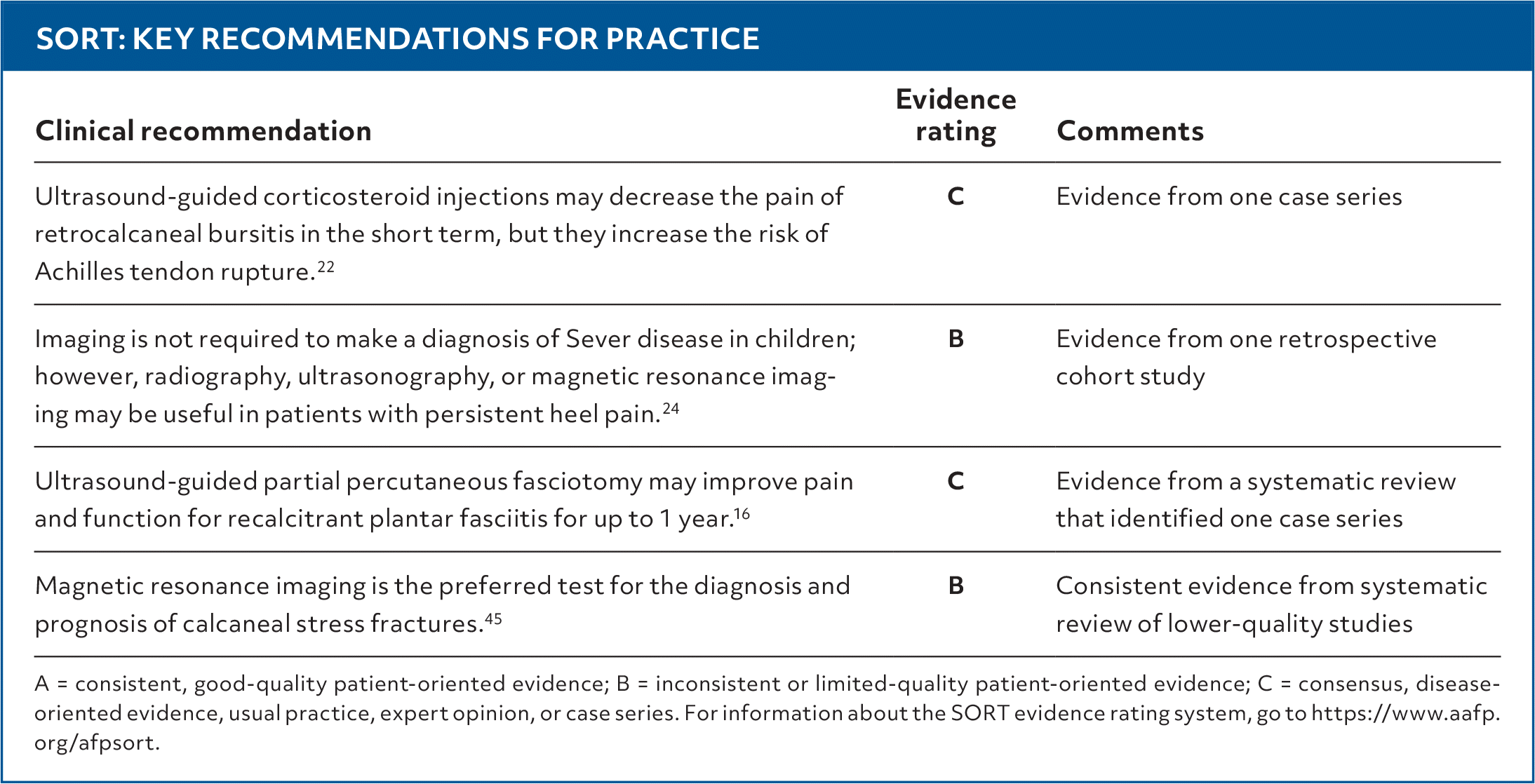
| Clinical recommendation | Evidence rating | Comments |
|---|---|---|
| Ultrasound-guided corticosteroid injections may decrease the pain of retrocalcaneal bursitis in the short term, but they increase the risk of Achilles tendon rupture.22 | C | Evidence from one case series |
| Imaging is not required to make a diagnosis of Sever disease in children; however, radiography, ultrasonography, or magnetic resonance imaging may be useful in patients with persistent heel pain.24 | B | Evidence from one retrospective cohort study |
| Ultrasound-guided partial percutaneous fasciotomy may improve pain and function for recalcitrant plantar fasciitis for up to 1 year.16 | C | Evidence from a systematic review that identified one case series |
| Magnetic resonance imaging is the preferred test for the diagnosis and prognosis of calcaneal stress fractures.45 | B | Consistent evidence from systematic review of lower-quality studies |
A = consistent, good-quality patient-oriented evidence; B = inconsistent or limited-quality patient-oriented evidence; C = consensus, disease-oriented evidence, usual practice, expert opinion, or case series. For information about the SORT evidence rating system, go to https://www.aafp.org/afpsort.
FIGURE 1.
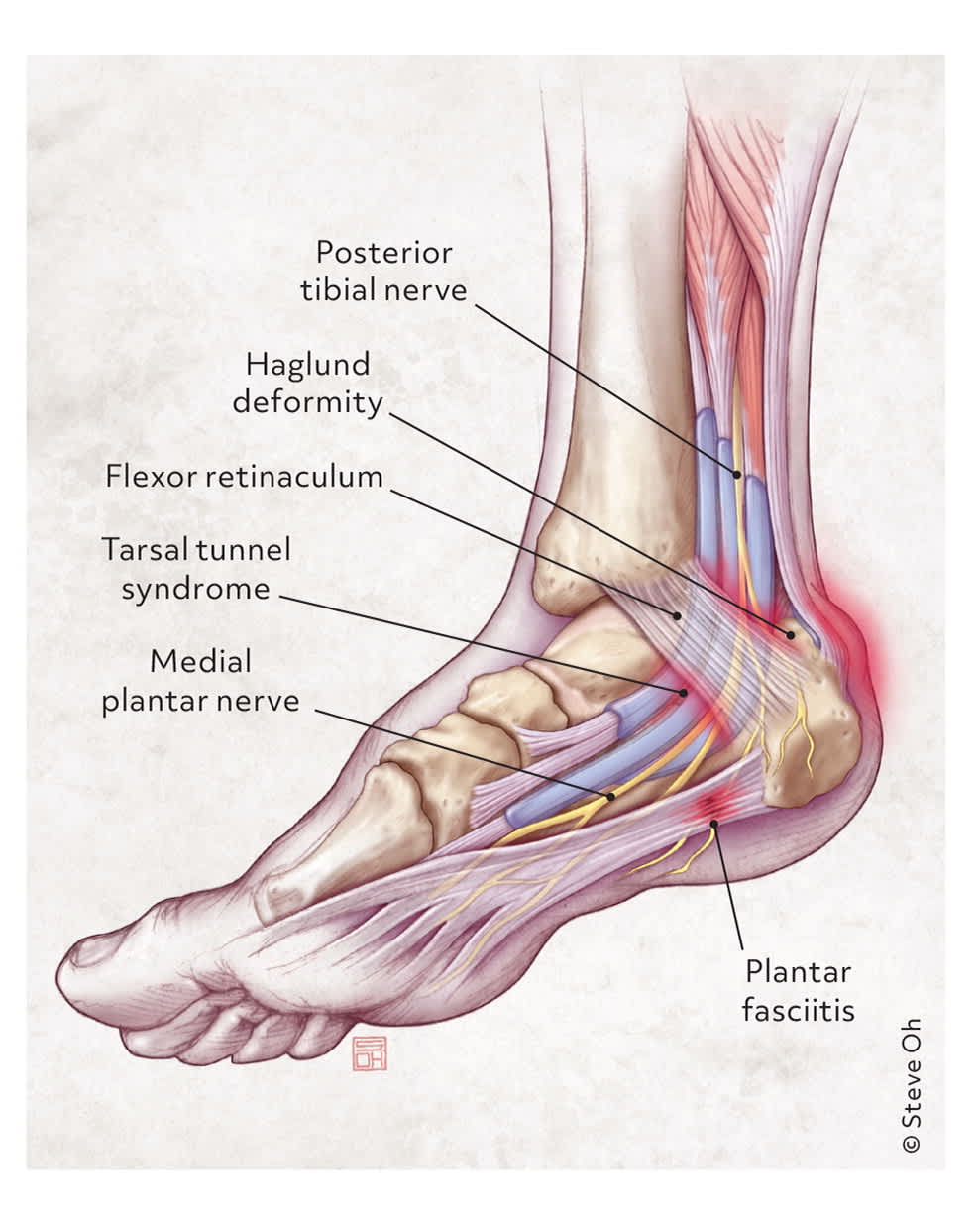
Heel pain and corresponding anatomy.
Illustration © Steve Oh
Adapted with permission from Tu P, Bytomski JR. Diagnosis of heel pain. Am Fam Physician. 2011;84(8):912.
TABLE 1. Mechanical Causes of Heel Pain by Location
| Etiology | Clinical features | Initial treatment |
|---|---|---|
| Posterior | ||
| Achilles tendinopathy | Achy, sharp pain with tenderness along the tendon Worsens with increased activity Occasional palpable prominence from tendon thickening Worsens with passive dorsiflexion | Activity modification, rest and weight-bearing as tolerated, decrease pressure to affected area, heel lifts or orthotics, NSAIDs or analgesics, deep friction massage, ankle bracing, and eccentric exercises |
| Haglund deformity | Pain at the superior aspect of the posterior calcaneus Radiography may show early deformities | Decrease pressure to affected area and NSAIDs or analgesics |
| Retrocalcaneal bursitis | Pain, erythema, and swelling around the Achilles tendon Tenderness on direct palpation | Decrease pressure to affected area, NSAIDs or analgesics, and corticosteroid injections (preferably ultrasound guided) |
| Calcaneal apophysitis (Sever disease) | Pain in adolescents that worsens with increased activity or during growth spurt Tenderness at Achilles insertion Pain with passive dorsiflexion and mediolateral calcaneal compression | Activity modification, NSAIDs or analgesics, ice, stretching and strengthening exercises, and orthotics or shoe modifications |
| Inferior | ||
| Calcaneal stress fracture | Commonly occurs following an increase in activity level or a change to harder walking surfaces Pain with activity that progressively worsens to pain at rest Diagnosed with imaging | Activity modification with occasional non–weight-bearing activity, heel pads, walking boots, crutches, or a controlled ankle motion walker |
| Heel pad syndrome | Deep, bruise-like pain and tenderness at middle of heel | Decrease pressure to affected area, NSAIDs or analgesics, heel cups, taping, and proper footwear |
| Heel spurs | Radiographic findings at site of pain | Decrease pressure to affected area |
| Nerve entrapment (medial or lateral plantar nerve, nerve to abductor digiti minimi) | Sensations of burning, tingling, or numbness Occasionally preceded by increased activity or trauma | Decrease pressure to affected area, NSAIDs or analgesics, ice, and stretching exercises |
| Neuroma | Sensations of burning or tingling Painful lump with palpation | Decrease pressure to affected area |
| Plantar fasciitis | Pain with first steps after prolonged rest Tenderness on medial calcaneal tuberosity and plantar fascia | Rest and activity modification, stretching and strengthening exercises, NSAIDs or analgesics, ice massage, and arch support |
| Midfoot (medial) | ||
| Flexor digitorum longus tendinopathy | Tenderness posterior to medial malleolus and obliquely across sole of foot to base of distal phalanges of lateral toes | Activity modification, decrease pressure to affected area, NSAIDs or analgesics, and eccentric exercises |
| Flexor hallucis longus tendinopathy | Tenderness posterior to medial malleolus and on plantar surface of great toe | Activity modification, decrease pressure to affected area, NSAIDs or analgesics, and eccentric exercises |
| Posterior tibialis tendinopathy | Tenderness at navicular and medial cuneiform | Activity modification, decrease pressure to affected area, NSAIDs or analgesics, and eccentric exercises |
| Tarsal tunnel syndrome | Burning, tingling, or shooting pain and numbness in posteromedial ankle and heel (may extend to toes) that worsens with standing and activity Positive Tinel sign Muscle atrophy in severe cases | Activity modification, orthotics, NSAIDs, neuromodulator therapy, and corticosteroid injections |
| Midfoot (lateral) | ||
| Peroneal tendinopathy | Tenderness in lateral calcaneus along path to base of fifth metatarsal | Activity modification, decrease pressure to affected area, NSAIDs or analgesics, and eccentric exercises |
| Sinus tarsi syndrome | Pain in lateral calcaneus and ankle Feeling of foot or ankle instability Worse after exercise or on uneven surfaces May have history of repeated ankle sprains | Orthotics, ice massage, NSAIDs or analgesics, physical therapy (eg, balance/proprioception, strengthening exercises), and corticosteroid injections |
NSAID = nonsteroidal anti-inflammatory drug.
Adapted with permission from Tu P, Bytomski JR. Diagnosis of heel pain. Am Fam Physician. 2011;84(8):910–911.
Read the full article
Get immediate access, anytime, anywhere.
Choose a single article, issue, or full-access subscription.
Earn up to 14 CME credits per issue.