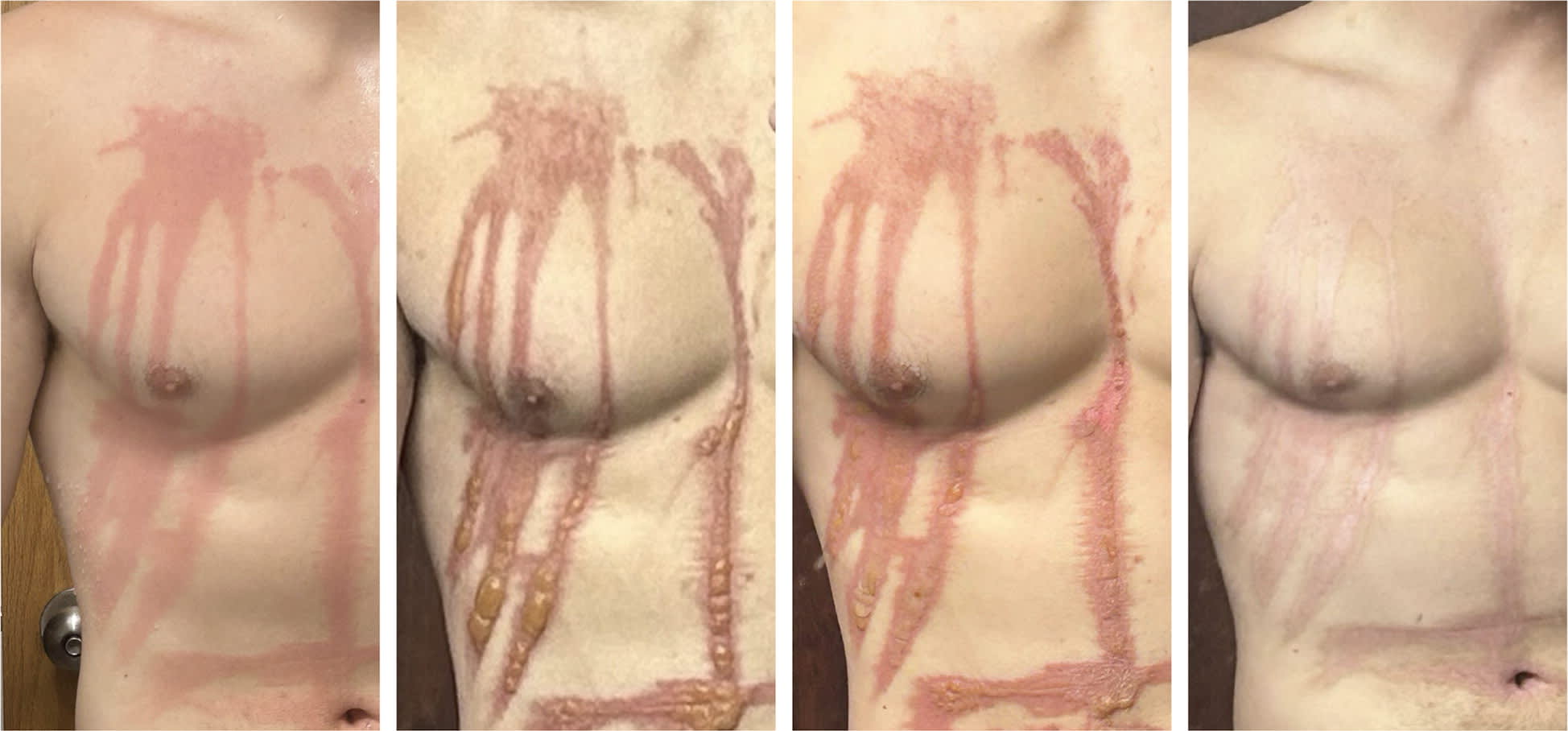
A 22-year-old man presented with a confluent, blistering rash on his torso. He had participated in a river float 2 days earlier, passing slowly through dappled shade for about 4 hours. Early in the river float, he spilled lime juice on his chest and abdomen; he was also shirtless and did not apply sunscreen. The day after the river float, he noticed mild discomfort and redness in an unusual distribution over his chest and abdomen. By that evening, the pain and redness had worsened, and the rash was raised. After he presented for evaluation, the blisters burst, releasing serous fluid. After 19 days, the pain had resolved completely, but erythema persisted (Figure 1).
FIGURE 1
QUESTION
Based on the patient's history and physical examination, which one of the following is the most likely diagnosis?
- A. Contact dermatitis.
- B. Phytophotodermatitis.
- C. Psoriasis.
- D. Sunburn.
- E. Tinea versicolor.
DISCUSSION
The answer is B: phytophotodermatitis, which is caused by long-wave ultraviolet (UV) radiation after sensitization by furocoumarins.1 These substances are produced by a number of plant families and are found in the highest concentrations in celery, parsley, limes, and grapefruits. Furocoumarins are absorbed topically and intercalate with DNA, where they catalyze cross-linking in the presence of UV light, causing cell damage and cell death. In this case, the rash was consistent with the area of lime juice exposure, which was crucial in determining the cause of the rash.
Contact dermatitis has two forms. Irritant contact dermatitis results from the direct toxic effect of chemicals on skin cells.2 Allergic contact dermatitis is a type IV hypersensitivity reaction to foreign antigens.
Psoriasis is a chronic inflammatory disease of the skin characterized by erythema, thickening, and scaling. Rather than worsening with sun exposure, psoriasis often responds favorably to phototherapy with UVB radiation.3
Sunburn is the direct damage to the DNA of skin cells by UV radiation. It is generalized to any area of skin that is exposed to excessive sunlight.
Tinea versicolor is a superficial dermal infection by Malassezia species, which classically results in patches of variable pigmentation after repeated sun exposure. Skin damage with UV exposure is not typical.4
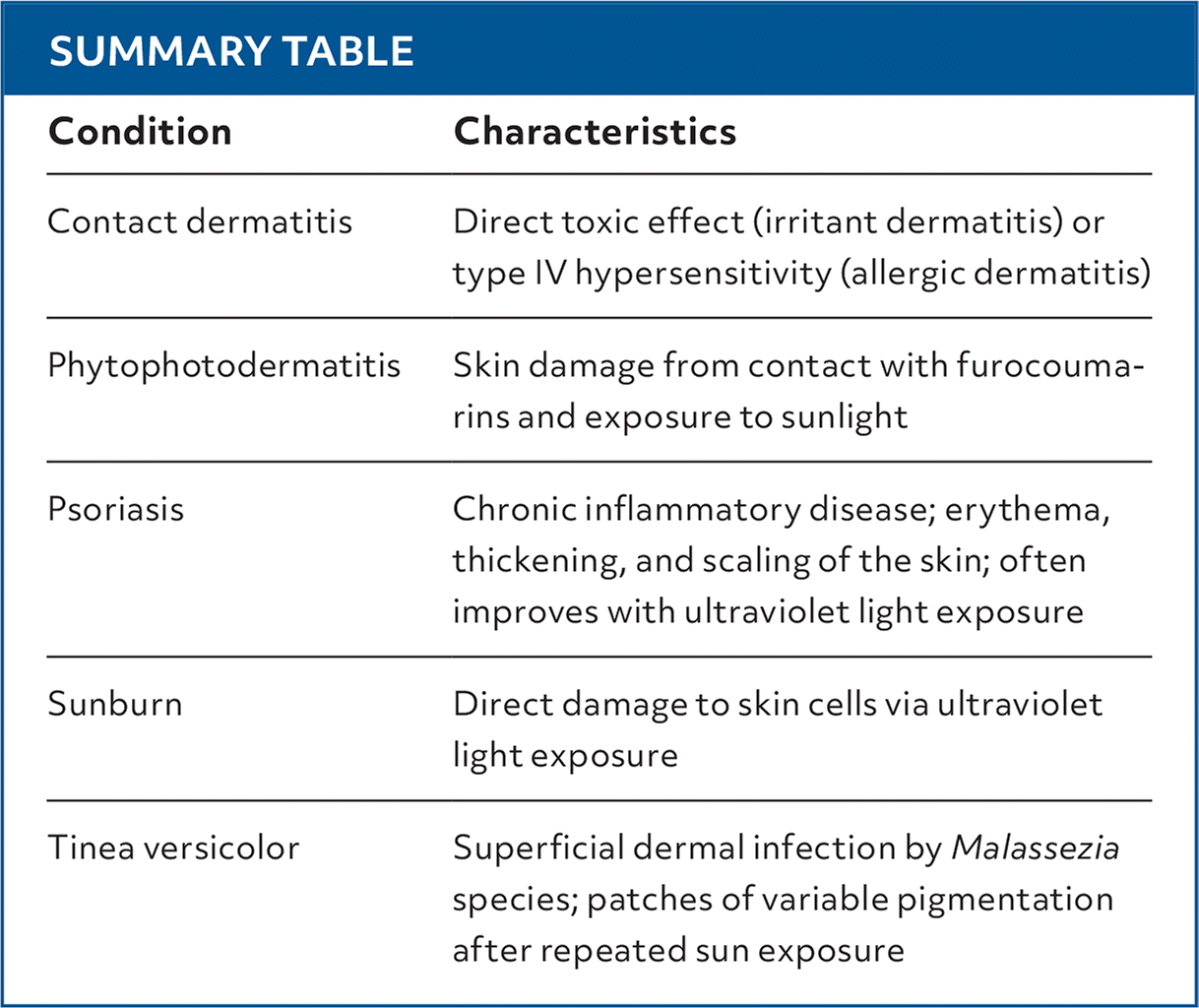
SUMMARY TABLE
| Condition | Characteristics |
|---|---|
| Contact dermatitis | Direct toxic effect (irritant dermatitis) or type IV hypersensitivity (allergic dermatitis) |
| Phytophotodermatitis | Skin damage from contact with furocoumarins and exposure to sunlight |
| Psoriasis | Chronic inflammatory disease; erythema, thickening, and scaling of the skin; often improves with ultraviolet light exposure |
| Sunburn | Direct damage to skin cells via ultraviolet light exposure |
| Tinea versicolor | Superficial dermal infection by Malassezia species; patches of variable pigmentation after repeated sun exposure |
Read the full article
Get immediate access, anytime, anywhere.
Choose a single article, issue, or full-access subscription.
Earn up to 14 CME credits per issue.