
Already a member or subscriber? Sign in now

You Deserve Kindness Too: Self-Compassion for Physicians

TIMOTHY D. RILEY, MD
BETTINA APRILE, MD
JULIE A. RADICO, PsyD, ABPP

FPM. 2025;32(6):36.

Author disclosures: no relevant financial relationships.

What if we treated ourselves with the same compassion we extend to others?

Think about the last time you made a mistake in your practice. Did you feel frustrated, ashamed, or like an impostor? What was your inner dialogue? Now imagine a colleague reaching out to talk about a mistake they made. How would you speak to them? Do you notice a difference?

We often apply shame and judgment to ourselves, in stark contrast to the compassion we usually extend to colleagues. When we allow this harsh inner dialogue to go unchecked, it can become a vicious cycle, with self-criticism leading to more pain, regret, and shame.1 Fortunately, there is a path out of this trap: self-compassion.

WHAT IS SELF-COMPASSION?

Self-compassion is the deliberate practice of offering yourself the same kindness you would offer a loved one in a similar situation. It has three components: self-kindness (being gentle toward oneself during adversity), common humanity (being aware that all humans face challenges), and mindfulness (being aware of the present difficulty without judging or over-identifying with it).2

This goes against traditional medical culture, which demands that we be perfect. But self-compassion can make us better doctors. It increases our ability to process uncomfortable experiences and respond with intention and humility, rather than reacting from pain and defensiveness.3 This leads to increased agency and empowerment to navigate difficult situations. Activating brain systems that regulate emotions and seek connection allows us to bring our best selves to our interactions and relationships.2,4

Self-compassion isn't about ignoring mistakes or shirking responsibility. Research suggests it actually increases our motivation to take responsibility for our actions.3

Self-compassion also helps us see mistakes more clearly. Often, they have more to do with system flaws than individual failures. Self-compassion allows us to operate from a place of emotional stability, which helps us identify systemic problems and advocate to change them.

(For help practicing self-compassion, try the exercise in Table 1.)
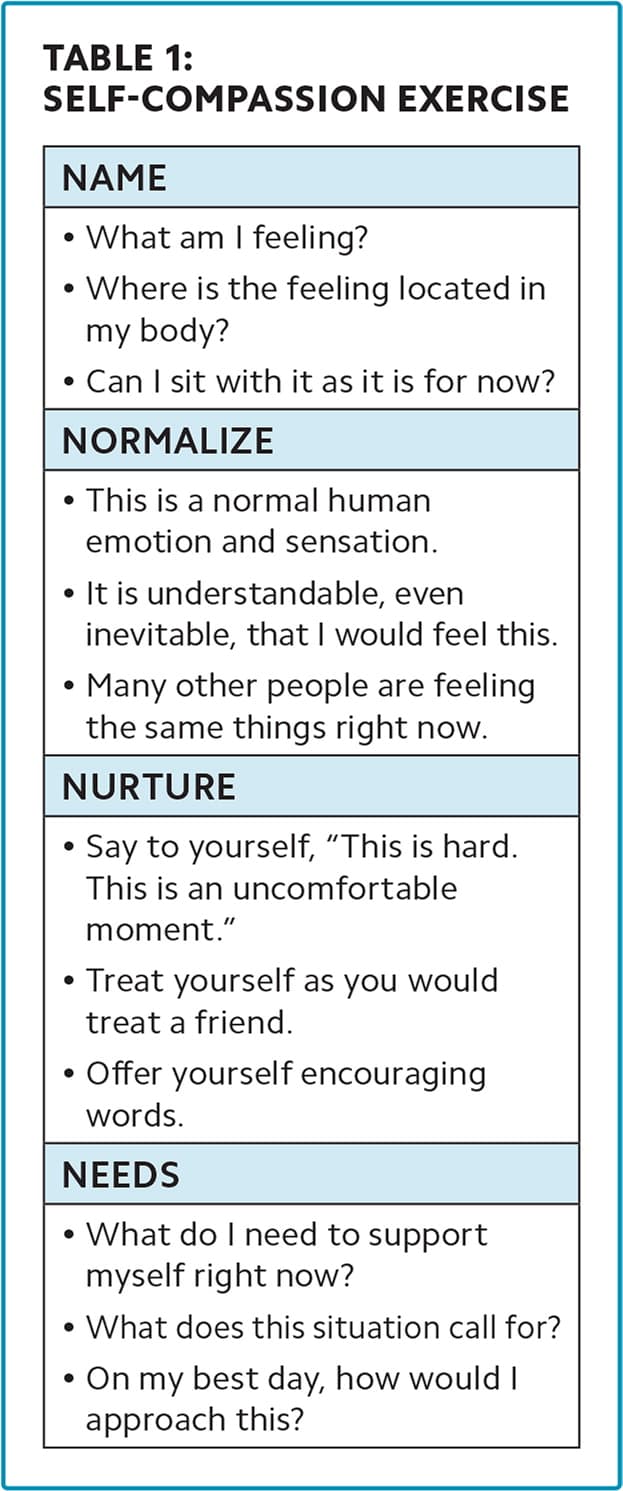
NAME
  • What am I feeling?

  • Where is the feeling located in my body?

  • Can I sit with it as it is for now?

NORMALIZE
  • This is a normal human emotion and sensation.

  • It is understandable, even inevitable, that I would feel this.

  • Many other people are feeling the same things right now.

NURTURE
  • Say to yourself, “This is hard. This is an uncomfortable moment.”

  • Treat yourself as you would treat a friend.

  • Offer yourself encouraging words.

NEEDS
  • What do I need to support myself right now?

  • What does this situation call for?

  • On my best day, how would I approach this?

WE GET TO CHOOSE

Failures and frustrations are inevitable in a profession as complex as family medicine, but we can choose how we respond to them. Self-compassion may not be our default, but it is the better choice.

Dr. Riley is a professor and associate vice chair for wellness, Penn State University Department of Family and Community Medicine, Hershey, Pa.

Dr. Aprile is an assistant professor, Penn State Department of Family and Community Medicine.

Dr. Radico, formerly with Penn State, is now owner of Radico Psychological and Consultation Services, Southampton, Pa.

Send comments to fpmedit@aafp.org, or add your comments to the article online.

Author disclosures: no relevant financial relationships.

  1. 1.Thomas M, Bigatti S. Perfectionism, impostor phenomenon, and mental health in medicine: a literature review. Int J Med Educ. 2020;11:201-213.
  2. 2.Muris P, Otgaar H. Self-esteem and self-compassion: a narrative review and meta-analysis on their links to psychological problems and well-being. Psychol Res Behav Manag. 2023;16:2961-2975.
  3. 3.Neff KD. Self-compassion: theory, method, research, and intervention. Annu Rev Psychol. 2023;74:193-218.
  4. 4.Conversano C, Ciacchini R, Orrù G, Di Giuseppe M, Gemignani A, Poli A. Mindfulness, compassion, and self-compassion among health care professionals: what's new? A systematic review. Front Psychol. 2020;11:1683.

WE WANT TO HEAR FROM YOU

The opinions expressed here do not necessarily represent those of FPM or our publisher, the American Academy of Family Physicians. We encourage you to share your views. Send comments to fpmedit@aafp.org, or add your comments below.

Copyright © 2026 by the American Academy of Family Physicians.

This content is owned by the AAFP. A person viewing it online may make one printout of the material and may use that printout only for his or her personal, non-commercial reference. This material may not otherwise be downloaded, copied, printed, stored, transmitted or reproduced in any medium, whether now known or later invented, except as authorized in writing by the AAFP. See permissions for copyright questions and/or permission requests.