

Fatty acids can be divided into four general categories: saturated, monounsaturated, polyunsaturated, and trans fats. Saturated fatty acids and trans fats are associated with an increased risk of coronary heart disease. Monounsaturated fatty acids and polyunsaturated fatty acids are associated with a decreased risk of coronary heart disease, although these associations are not uniformly supported in the literature. Omega-3 fatty acids, which are a type of polyunsaturated fatty acid, have been studied as potential therapy for a variety of medical conditions because of their suspected anti-inflammatory properties. Omega-3 fatty acids have also been shown to provide some benefit to patients with cystic fibrosis, and may have a protective effect against dementia. Physicians should counsel patients about the importance of avoiding hydrogenated oils and foods containing trans fats because of their association with coronary heart disease in observational studies.
Fatty acids are long-chain hydrocarbons that can be separated into four categories: saturated, mono-unsaturated, polyunsaturated, and trans fats. More than 20 types of fatty acids are found in foods; some of these are listed in Table 1. Sources of fatty acids include fruits, vegetable oils, seeds, nuts, animal fats, and fish oils. Essential fatty acids, such as omega-3 fatty acids, serve important cellular functions. They are a necessary part of the human diet because the body has no biochemical pathway to produce these molecules on its own.
SORT: KEY RECOMMENDATIONS FOR PRACTICE
| Clinical recommendation | Evidence rating | References |
|---|---|---|
| Increased intake of saturated fats and trans fats may increase the risk of coronary heart disease. | B | 4–7, 9, 40, 41 |
| Increased intake of monounsaturated and polyunsaturated fats may decrease the risk of coronary heart disease. | B | 4, 7–13 |
| Regular omega-3 fatty acid supplementation may provide some benefits for persons with cystic fibrosis and dementia. | B | 20, 21 |
| There is no clear effect of omega-3 fatty acid consumption on cardiovascular events in persons with, or at high risk of, cardiovascular disease. | B | 18 |
A = consistent, good-quality patient-oriented evidence; B = inconsistent or limited-quality patient-oriented evidence; C = consensus, disease-oriented evidence, usual practice, expert opinion, or case series. For information about the SORT evidence rating system, go to https://www.aafp.org/afpsort.xml.
Table 1. Well-Known Fatty Acids
| Name | Number of carbon atoms | Type of fatty acid | Essential fatty acid | Common sources |
|---|---|---|---|---|
| Palmitic acid | 16 | Saturated | No | Palm oil |
| Stearic acid | 18 | Saturated | No | Animal fat |
| Oleic acid | 18 | Monounsaturated | No | Olive oil |
| Linoleic acid | 18 | Polyunsaturated | Yes | Safflower oil |
| Linolenic acid | 18 | Polyunsaturated | Yes | Soybean oil |
| Arachidonic acid | 20 | Polyunsaturated | Yes | Meat, dairy |
| Eicosapentaenoic acid | 20 | Polyunsaturated | Yes | Fish oil |
| Docosahexaenoic acid | 22 | Polyunsaturated | Yes | Fish oil |
Biochemical Structure
In saturated fatty acids, the carbon chain has the maximum number of hydrogen atoms attached to every carbon atom. If a pair of hydrogen atoms is missing because of a double bond between two carbon atoms, it is called an unsaturated fatty acid. A fatty acid with a single double bond is monounsaturated, whereas a fatty acid with more than one double bond is polyunsaturated (Figure 1). The carbon-carbon double bond found in monounsaturated or polyunsaturated fatty acids can exist in the cis or trans configuration. When the two hydrogen atoms are on opposite sides of the double bond, the configuration is called trans. When the hydrogen atoms are on the same side of the double bond, the configuration is called cis (Figure 2).
Figure 1.
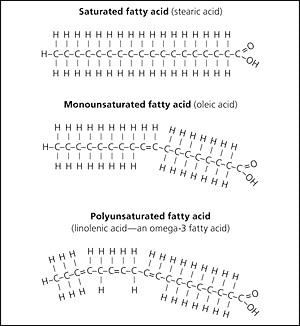
Molecular structure of fatty acids.
Figure 2.

The carbon-carbon double bond found in monounsaturated or polyunsaturated fatty acids can exist in the cis or trans configuration. When the two hydrogen atoms are on opposite sides of the double bond, the configuration is called trans. When the hydrogen atoms are on the same side of the double bond, the configuration is called cis.
Saturated Fats
Studies have shown that consuming saturated fatty acids has a detrimental effect on serum lipids by increasing low-density lipoprotein (LDL) cholesterol levels.1 There is some evidence that short-chain fatty acids (fewer than 10 carbon atoms) are less likely to affect serum cholesterol levels, whereas longer-chain fatty acids (12, 14, or 16 carbon atoms) are more likely to raise LDL levels.2 One exception to this is stearic acid (18 carbon atoms), which does not appear to raise serum cholesterol levels.3 Increased consumption of saturated fatty acids has also been associated with an increased risk of coronary heart disease (CHD; Table 2).4–13
Monounsaturated Fats
Several large observational studies have found an association between an increased intake of monounsaturated fatty acids and a decreased risk of CHD (Table 2).4–13 One large study failed to find a similar association, although it was limited to a trial of beta-carotene and alpha-tocopherol in persons who smoke.9 Evidence from controlled clinical studies has shown that monounsaturated fatty acids favorably affect a number of risk factors for CHD, including lowering total and LDL cholesterol levels, protecting against thrombogenesis, reducing LDL susceptibility to oxidation, and producing a more favorable glycemic profile.14
Table 2. Fatty Acids and Coronary Heart Disease
| Study | Number of patients | Study type | Years of follow-up | Findings |
|---|---|---|---|---|
| Saturated fatty acids | ||||
| Seven Countries Study4 | 12,770 men | Cross-population | 5, 10, 15 | Strong correlation between total cholesterol and the percent of energy intake from saturated fatty acids |
| Japan-Honolulu-San Francisco Study5 | 11,900 men | Cross-population | NA | Correlation between increased consumption of saturated fatty acids, and increased serum cholesterol levels and increased rate of CHD mortality |
| Ireland-Boston Diet-Heart Study6 | 1,001 men | Prospective cohort | 20 | Patients who died of CHD had a higher intake of saturated fatty acids and cholesterol |
| Nurses' Health Study7 | 80,082 women | Prospective cohort | 14 | Positive association between percent of energy intake from saturated fatty acids and increased risk of CHD |
| Monounsaturated fatty acids | ||||
| Seven Countries Study4 | 12,770 men | Cross-population | 5, 10, 15 | Low death rate from heart disease in men consuming large quantities of olive oils (primarily monounsaturated fatty acids) |
| Nurses' Health Study7 | 80,082 women | Prospective cohort | 14 | Association between increased energy intake from monounsaturated fatty acids and a relative risk reduction in coronary disease |
| Coronary Mortality in France and Finland8 | NA | Epidemiologic | NA | Association between increased consumption of monounsaturated fatty acids and low rates of CHD mortality |
| Alpha-Tocopherol, Beta-Carotene Cancer Prevention Study9 | 21,930 men who smoke | Prospective cohort | 6.1 | No association between monounsaturated fatty acids and the risk of CHD |
| Polyunsaturated fatty acids | ||||
| Finnish Mental Hospital Study10 | 676 men | RCT | 6 | Increased consumption of polyunsaturated fatty acids associated with reduction of CHD |
| Los Angeles Veteran Hospital11 | 424 men | RCT | 8 | Increased consumption of polyunsaturated fatty acids associated with reduction of CHD |
| Oslo Diet-Heart Study12 | 206 men with history of myocardial infarction | RCT | 5 | Increased energy from polyunsaturated fatty acids associated with significant reduction in cholesterol and coronary events |
| Minnesota Coronary Survey13 | 4,393 men, 4,664 women | RCT | 4.5 | Increased consumption of polyunsaturated fatty acids associated with reduction in serum cholesterol but no change in CHD |
CHD = coronary heart disease; NA = not applicable; RCT = randomized controlled trial.
Polyunsaturated Fats
Polyunsaturated fatty acids, which include omega-3 fatty acids, have been studied extensively for their effect on several diseases (Table 3).15–25 Omega-3 fatty acids have been shown to provide some benefit to patients with cystic fibrosis, and may have a protective effect against dementia.20,21 Omega-3 fatty acids are thought to be beneficial in some inflammatory-related diseases because they displace omega-6 fatty acids, including arachidonic acid, in the cell membrane. This reduces the creation of metabolic end products, including prostaglandins, thromboxanes, and leukotrienes.26
Table 3. Cochrane Reviews of Omega-3 Fatty Acids
| Disease process | Cochrane review conclusions |
|---|---|
| Asthma | Little evidence to recommend persons with asthma modify intake of omega-3 fatty acids15 |
| Cancer cachexia | Insufficient data16 |
| Claudication | Omega-3 has limited benefit in persons with intermittent claudication, but no evidence of consistent improved clinical outcomes17 |
| Coronary heart disease | No clear effect of omega-3 fatty acid consumption on cardiovascular events in persons with, or at high risk of, cardiovascular disease18 |
| Crohn disease | Insufficient data to recommend routine use of omega-3 supplements for maintenance of remission19 |
| Cystic fibrosis | Regular omega-3 supplements may provide some benefits for persons with cystic fibrosis20 |
| Dementia | May be a protective effect of omega-3 fatty acids against dementia21 |
| Diabetes (type 2) | Omega-3 supplementation lowers triglyceride and very-low-density lipoprotein levels in patients with diabetes, but may raise low-density lipoprotein levels; no effect on glycemic control or fasting insulin22 |
| Kidney transplant recipients | Insufficient evidence to recommend fish oil therapy23 |
| Schizophrenia | Inconclusive results; use of omega-3 remains experimental24 |
| Ulcerative colitis | No evidence to support omega-3 fatty acids in maintenance of remission25 |
Additionally, maternal omega-3 fatty acid supplementation during pregnancy and lactation may provide a beneficial effect on the cognitive development of infants and children, but evidence is inconclusive about the benefits of omega-3 supplementation in pre-term and full-term infants.27 Several review articles have examined the relationship between omega-3 fatty acid intake and cancer incidence, including prostate cancer, colon cancer, and skin cancer.28–30 A recent systematic review concluded that the literature does not support an association between increased omega-3 fatty acid intake and reduced cancer incidence.31
Various studies4–13 and a report from the Institute of Medicine32 support the increased consumption of polyunsaturated fatty acid for the prevention of CHD (Table 24–13). However, a Cochrane review of 48 randomized controlled trials (RCTs) and 41 cohort analyses suggests that further high-quality trials are needed to confirm the protective effect of omega-3 fatty acids in persons at increased risk of cardiovascular disease.18 The authors concluded that increased consumption of omega-3 fatty acids did not significantly alter total mortality or combined cardiovascular events in persons with cardiovascular disease, in persons at high risk of cardiovascular disease, or in the general population.18 Excessive consumption of polyunsaturated fats is not recommended because of the increased risk of excessive weight gain and the increased risk of gallstone formation in some persons.33
Trans Fats
Most trans fats are manufactured through a process called hydrogenation, which is the artificial addition of hydrogen atoms to unsaturated oils. Hydrogenation converts liquid vegetable oils to solid or semi-solid fats that remain stable at room temperature. These fats can then be incorporated into certain food products (e.g., cookies, chips) to increase shelf life (Table 434). Until recently, trans fats have been the predominant fat used in most types of commercial baked goods.
Table 4. Fat and Cholesterol Content of Foods Containing Fatty Acids*
| Product | Common serving size | Total fat (g) | Saturated fat (g) | Percent daily value for saturated fat | Trans fat (g) | Combined saturated and trans fat (g) | Cholesterol (mg) | Percent daily value for cholesterol |
|---|---|---|---|---|---|---|---|---|
| Butter† | 1 tablespoon | 11 | 7 | 35 | 0 | 7 | 30 | 10 |
| Cake (pound cake)‡ | 1 slice (80 g) | 16 | 3.5 | 18 | 4.5 | 8 | 0 | 0 |
| Candy bar‡ | 1 (40 g) | 10 | 4 | 20 | 3 | 7 | <5 | 1 |
| Cookies (cream filled)‡ | 3 (30 g) | 6 | 1 | 5 | 2 | 3 | 0 | 0 |
| Doughnut‡ | 1 | 18 | 4.5 | 23 | 5 | 9.5 | 25 | 8 |
| French fried potatoes (fast food)‡ | Medium size (147 g) | 27 | 7 | 35 | 8 | 15 | 0 | 0 |
| Margarine, stick§ | 1 tablespoon | 11 | 2 | 10 | 3 | 5 | 0 | 0 |
| Margarine, tub§ | 1 tablespoon | 7 | 1 | 5 | 0.5 | 1.5 | 0 | 0 |
| Mayonnaise (soybean oil)‖ | 1 tablespoon | 11 | 1.5 | 8 | 0 | 1.5 | 5 | 2 |
| Milk, skim§ | 1 cup | 0 | 0 | 0 | 0 | 0 | 5 | 2 |
| Milk, whole‡ | 1 cup | 7 | 4.5 | 23 | 0 | 4.5 | 35 | 12 |
| Potato chips‡ | Small bag (42.5 g) | 11 | 2 | 10 | 3 | 5 | 0 | 0 |
| Shortening‡ | 1 tablespoon | 13 | 3.5 | 18 | 4 | 7.5 | 0 | 0 |
*—Nutrient values rounded based on the U.S. Food and Drug Administration (FDA) nutrition labeling regulations.
†— From the FDA Table of Trans Values, January 20, 1995.
‡— 1995 U.S. Department of Agriculture (USDA) composition data.
§— From the 2002 USDA National Nutrient Database for Standard Reference, Release 15.
‖— Prerelease values derived from the 2003 USDA National Nutrient Database for Standard Reference, Release 16.
Adapted from the U.S. Food and Drug Administration. Revealing trans fats. FDA Consumer Magazine. September–October 2003. Publication no. FDA05–1329C. http://www.fda.gov/FDAC/features/2003/503_fats.html. Accessed March 11, 2009.
The consumption of trans fats has been directly linked to an increase in CHD. Trans fats appear to have a detrimental effect on serum lipids by increasing LDL cholesterol and triglyceride levels, and reducing high-density lipoprotein cholesterol levels.35–39 Studies have shown that substituting 2 percent of total energy intake with trans-fatty acids is associated with a 14 to 36 percent increase in the incidence of CHD (Table 5).7,9,40,41 Observational data from the Nurses' Health Study suggests that replacing 5 percent of energy from saturated fat with energy from unsaturated fats could reduce the risk of CHD by 42 percent; however, replacing only 2 percent of energy from trans fats with energy from nonhydrogenated, unsaturated fats could reduce the risk of CHD by 53 percent.7 There are no prospective RCTs that have demonstrated a reduction in morbidity and mortality through selective reduction of trans-fat consumption.
Table 5. Trans Fat Consumption and CHD
| Study | Number of patients | Years of follow-up | Relative risk of CHD with trans-fat consumption* |
|---|---|---|---|
| Alpha-Tocopherol, Beta-Carotene Cancer Prevention Study9 | 21,930 men who smoke | 6.1 | 1.14 (95% CI, 0.96 to 1.35) |
| Zutphen Elderly Study39 | 667 men | 10 | 1.28 (95% CI, 1.01 to 1.61) |
| Health Professionals Follow-up Study40 | 43,757 men | 6 | 1.36 (95% CI, 1.03 to 1.81) |
| Nurses' Health Study7 | 80,082 women | 14 | 1.33 (95% CI, 1.07 to 1.66) |
CHD = coronary heart disease; CI = confidence interval.
*—For each isocaloric substitution of 2 percent of total energy intake with trans-fatty acids.
Dietary Recommendations
The Nutrition Committee of the American Heart Association has recommended that no more than 30 percent of a person's daily calories come from fat.42 Of that, less than 7 percent of total calories should be from saturated fatty acids, and less than 1 percent should be from trans-fatty acids.42 Certain fatty acids, such omega-3 fatty acids, are preferable to saturated fats and should be substituted for saturated fats when possible. Physicians should emphasize to patients that consuming too much of any fat contributes to caloric intake and weight gain. Physicians should also stress the importance of minimizing or avoiding trans fats from hydrogenated oils because of their harmful effects on cholesterol levels and their link to heart disease.
