

The fall respiratory season typically refers to the period of increased respiratory illness, including for the influenza (flu) virus, respiratory syncytial virus (RSV) and SARS-CoV-2 (COVID-19) virus.1 Although it is possible to become infected year-round, infections from these viruses typically begin to rise in the fall, with peaks occurring during the winter months. Immunization remains one of the most effective interventions to reduce infections and prevent hospitalizations and deaths from these and other viruses.2
AAFP Immunization Resources
- The American Academy of Family Physicians (AAFP) Immunizations and Vaccines webpage is now the primary hub for reliable and up-to-date resources, education, guidance, schedules and tools where family physicians can find trusted information about vaccines.
- The AAFP Immunization Schedules webpage has replaced the Centers for Disease Control and Prevention (CDC) Advisory Committee on Immunization Practice (ACIP) schedules as the primary source for family physicians to receive guidance for immunization recommendations, including for flu, RSV and COVID-19 vaccines.
- The AAFP will release updated guidance on the prevention, diagnosis and management of fall respiratory viruses on the AAFP Immunizations and Vaccines webpage in early fall 2025.
Key 2025 Federal Fall Respiratory Virus Vaccine Recommendation Changes
- Recent ACIP recommendation updates have included COVID-19 vaccine recommendations for children and during pregnancy, an updated influenza vaccination recommendation (including a thimerosal-specific recommendation) and the addition of clesrovimab for infants under eight months during their first RSV season in 2025.3,4
- The U.S. Food and Drug Administration approved FluMist (Influenza Vaccine Live, Intranasal) for self-administration for the prevention of influenza disease caused by influenza virus subtypes A and B in individuals 2 through 49 years of age.5
- In August, 2025 the FDA discontinued the Emergency Use Authorization for all COVID-19 vaccinations. The FDA placed new label restrictions on the 2025 products use in pregnancy, in healthy children/adults and coadministration with influenza vaccine.
AAFP COVID-19 Vaccine Recommendations
- In June 2025, CDC guidance for COVID-19 vaccination for children and pregnant people changed.6 After reviewing the current available evidence, the AAFP has not adopted the CDC recommendation.
- The COVID-19 vaccines for use in the United States beginning in fall 2025 should be monovalent JN.1-lineage-based COVID-19 vaccines (2025-2026 Formula).
- The AAFP recommends vaccinating:7 ♦ Pregnant people against COVID-19 during any trimester or postpartum during lactation. ♦ All children aged 6-23 months against COVID-19. ♦Children/teens aged 2 -18 years with a single dose of the COVID vaccine if in a high-risk group. ♦Children/teens aged 2-18 years in families who desire protection against COVID-19. ♦All adults 18 years and older, with an emphasis on adults aged 65 years and older, at increased risk for severe COVID-19 infection, and who have never received a COVID-19 vaccine.
- Use the Centers for Disease Control and Prevention “Underlying Conditions and the Higher Risk for Severe COVID-19” as a guide for identifying who is in a high-risk category (Feb, 2025).
- The AAFP considers healthcare workers at high risk due to their occupational exposure.
AAFP Influenza Vaccine Recommendations
- The AAFP recommends people six months and older receive an annual influenza vaccine.8
- The AAFP supported a joint statement on thimerosal in vaccines in June 2000, which established the goal of removing thimerosal from all pediatric vaccines as a precautionary measure.9 To date, research has not supported the concern raised around the potential health effects of exposure to thimerosal.10
- Family physicians may find increased interest in thimerosal conversations this fall season due to the ACIP preference for thimerosal-free influenza vaccines in the 2025 recommendation.
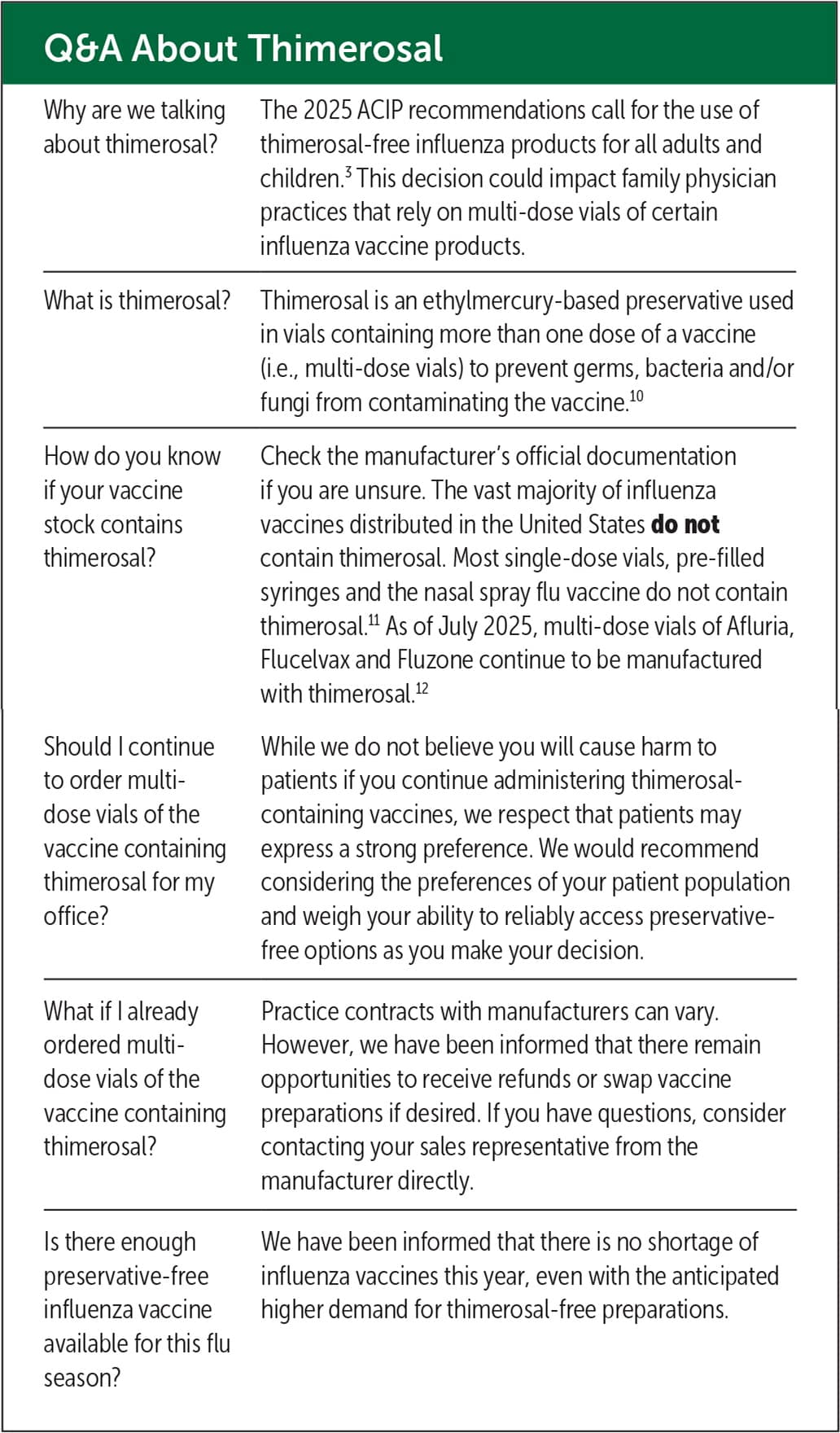
Q&A About Thimerosal
| Why are we talking about thimerosal? | The 2025 ACIP recommendations call for the use of thimerosal-free influenza products for all adults and children.3 This decision could impact family physician practices that rely on multi-dose vials of certain influenza vaccine products. |
| What is thimerosal? | Thimerosal is an ethylmercury-based preservative used in vials containing more than one dose of a vaccine (i.e., multi-dose vials) to prevent germs, bacteria and/or fungi from contaminating the vaccine.10 |
| How do you know if your vaccine stock contains thimerosal? | Check the manufacturer’s official documentation if you are unsure. The vast majority of influenza vaccines distributed in the United States do not contain thimerosal. Most single-dose vials, pre-filled syringes and the nasal spray flu vaccine do not contain thimerosal.11 As of July 2025, multi-dose vials of Afluria, Flucelvax and Fluzone continue to be manufactured with thimerosal.12 |
| Should I continue to order multi-dose vials of the vaccine containing thimerosal for my office? | While we do not believe you will cause harm to patients if you continue administering thimerosal-containing vaccines, we respect that patients may express a strong preference. We would recommend considering the preferences of your patient population and weigh your ability to reliably access preservative-free options as you make your decision. |
| What if I already ordered multi-dose vials of the vaccine containing thimerosal? | Practice contracts with manufacturers can vary. However, we have been informed that there remain opportunities to receive refunds or swap vaccine preparations if desired. If you have questions, consider contacting your sales representative from the manufacturer directly. |
| Is there enough preservative-free influenza vaccine available for this flu season? | We have been informed that there is no shortage of influenza vaccines this year, even with the anticipated higher demand for thimerosal-free preparations. |
AAFP RSV Vaccine Recommendations
- The AAFP has varying recommendations for RSV vaccines depending on age and risk. ♦ Maternal RSV vaccination (i.e., Pfizer’s Abrysvo) or infant immunization with an FDA-approved monoclonal antibody is recommended.13○ The optimal timing for monoclonal antibody administration is shortly before the RSV season begins (e.g., October–November) or within an infant’s first week of life if born October through March (ideally during the birth hospitalization).○ The optimal timing of maternal vaccination is during weeks 32 through 36 of pregnancy, between September through January.○ Most infants will not require both maternal vaccination and monoclonal antibodies.
- The AAFP recommends a single dose of any FDA-licensed RSV vaccine for all adults 75 years and older and adults 50–74 years at increased risk of severe RSV. ♦ The optimal timing for vaccination is in the late summer and early fall, before RSV circulation elevates in the community.
- The AAFP continues to review the data around the risk-based recommendation for adults 50–74 years old.
Vaccine Communication Resources
Vaccine hesitancy, misinformation and disinformation remain a significant challenge for patients and family physicians. Empathetic listening, shared decision-making and providing trusted, evidence-based resources can assist with patient conversations. The AAFP has a variety of tools, resources and education available to help you and your care team prepare for conversations about immunizations. The AAFP Immunizations and Vaccines webpage is the hub for resources with links to patient education, CME, videos and handouts. For patient-facing resources on familydoctor.org, visit familydoctor.org/vaccines.
AAFP Social Media and Vaccine Resource Hubs
Instagram: @the_aafp
Facebook: @familymed
LinkedIn: @american-academy-of-family-physicians
AAFP Podcast: aafp.org/podcast
Family physician hub: aafp.org/vaccines
Patient hub: familydoctor.org/vaccines