
Common foot deformities can impact mobility, quality of life, and overall foot health. Great toe deformities (eg, hallux valgus, hallux rigidus/limitus), lesser toe deformities, and arch deformities (eg, pes planus, pes cavus) are structural abnormalities that can arise from hereditary factors, trauma, biomechanical dysfunctions, or systemic conditions. These deformities can cause hyperkeratotic lesions that may contribute to pain and even lead to ulcerations. A standardized comprehensive foot examination, proper diagnosis, and early intervention are important to avoid complications. Conservative and surgical treatments can be tailored to the specific deformity and individual patient needs. Radiographs are useful for assessing these deformities and for surgical planning. Conservative management can include patient education, activity modification, and shoe adjustments. Surgical interventions can be used for treating advanced deformities or persistent pain.
Case 3. JJ is a 53-year-old patient with uncontrolled type 2 diabetes, hypertension, and obesity who previously underwent a left hallux amputation due to a diabetic foot ulcer with osteomyelitis. She now has a stage 3 pressure ulcer of the right plantar distal hallux with severe hallux valgus; decreased range of motion of the right first metatarsophalangeal joint; first ray hypermobility; pes planus; metatarsus adductus; and semirigid hammer toe deformities of digits 2, 3, and 4 on the right foot. Her mother had successful bunion surgery, but JJ is reluctant to pursue surgical treatments and asks you about effective nonsurgical options.
Great Toe Deformities
HALLUX VALGUS
Hallux valgus, which causes bunion deformity, is more commonly seen in women1 (Figure 1). The deformity stems from the metatarsophalangeal joint, in which there is lateral deviation (abduction) of the hallux from the midline of the body. Hallux valgus affects 11% of adults younger than 20 years, 12% of those aged 20 to 60 years, and 23% of those older than 60 years.2 Pain typically occurs on the medial aspect of the head of the first metatarsal due to joint capsule irritation or decreased joint space of the metatarsophalangeal joint. Pain can also be present on the plantar aspect of the first metatarsal. Hallux valgus is a progressive deformity that can be aggravated by shoe choice.3 Hallux valgus can lead to abnormal pressure on the adjacent digit, leading to a hammer toe, which may overlap or underride the hallux4 (Figure 2).
Figure 1
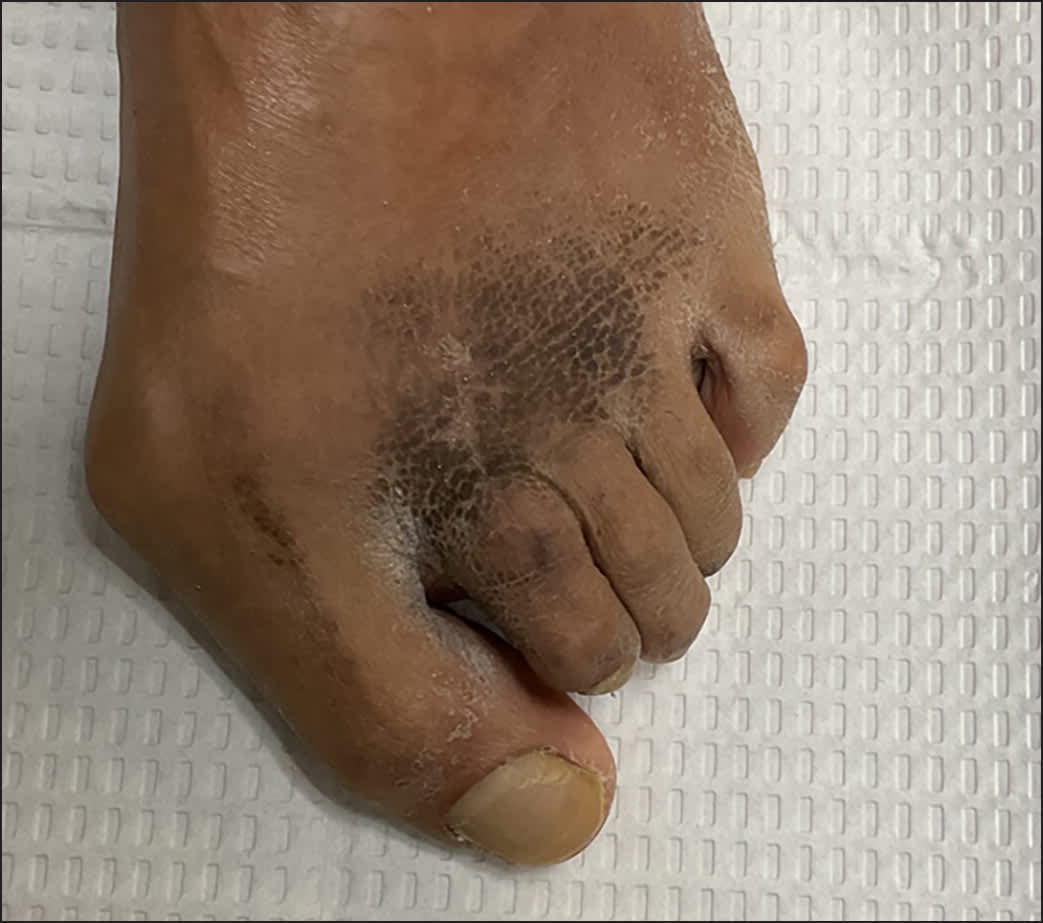
Hallux Valgus Bunion Deformity
Figure 2
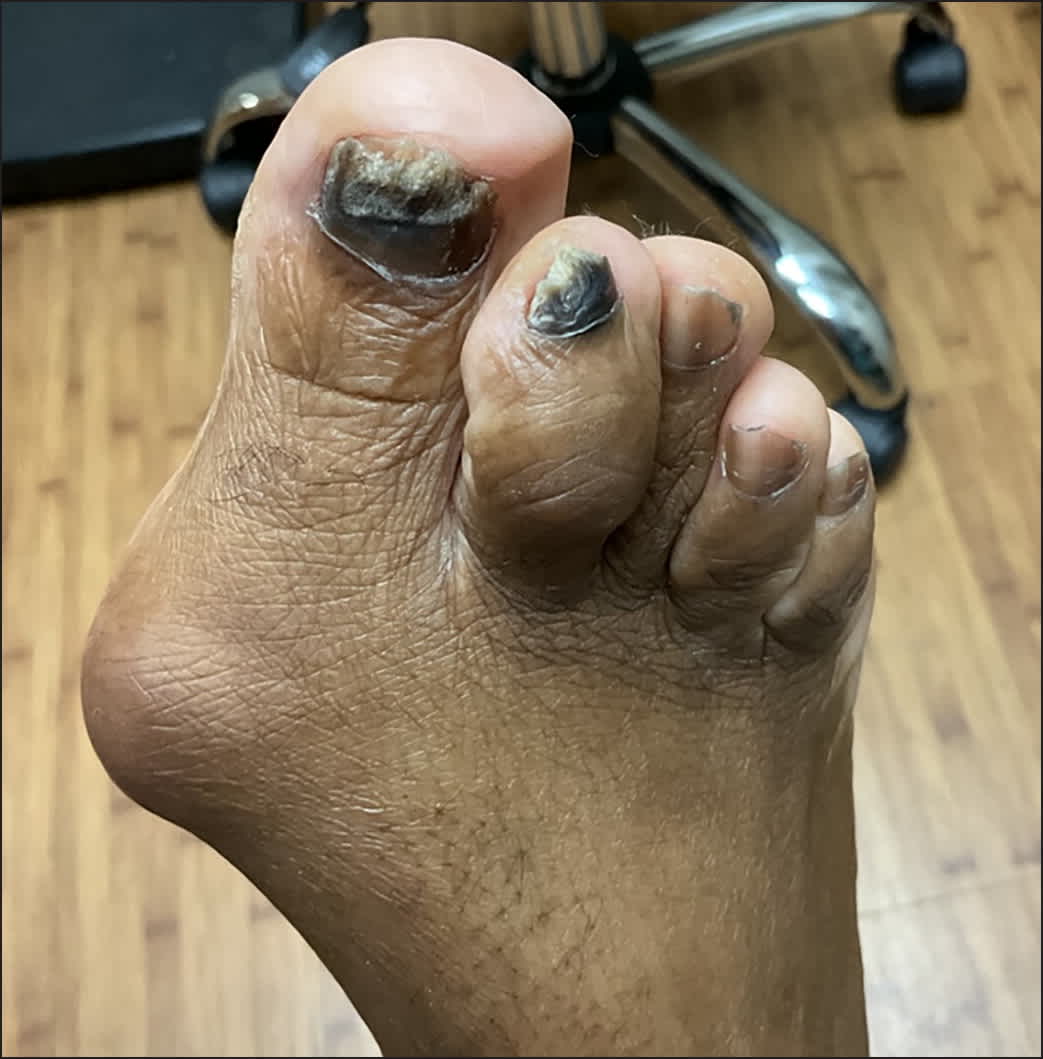
Hallux Valgus Bunion Deformity With Overriding Hammer Toe of Second Digit
The intermetatarsal angle, formed by the longitudinal bisections of the first and second metatarsals, increases with severity of the hallux valgus deformity. A standardized comprehensive foot examination, including musculoskeletal, dermatologic, neurologic, and vascular assessments, should be performed.5 Intermetatarsal angles of 0° to 8° are considered normal.1,6 Intermetatarsal angles greater than 8° are associated with larger hallux valgus deformities (Figure 37).
Figure 3
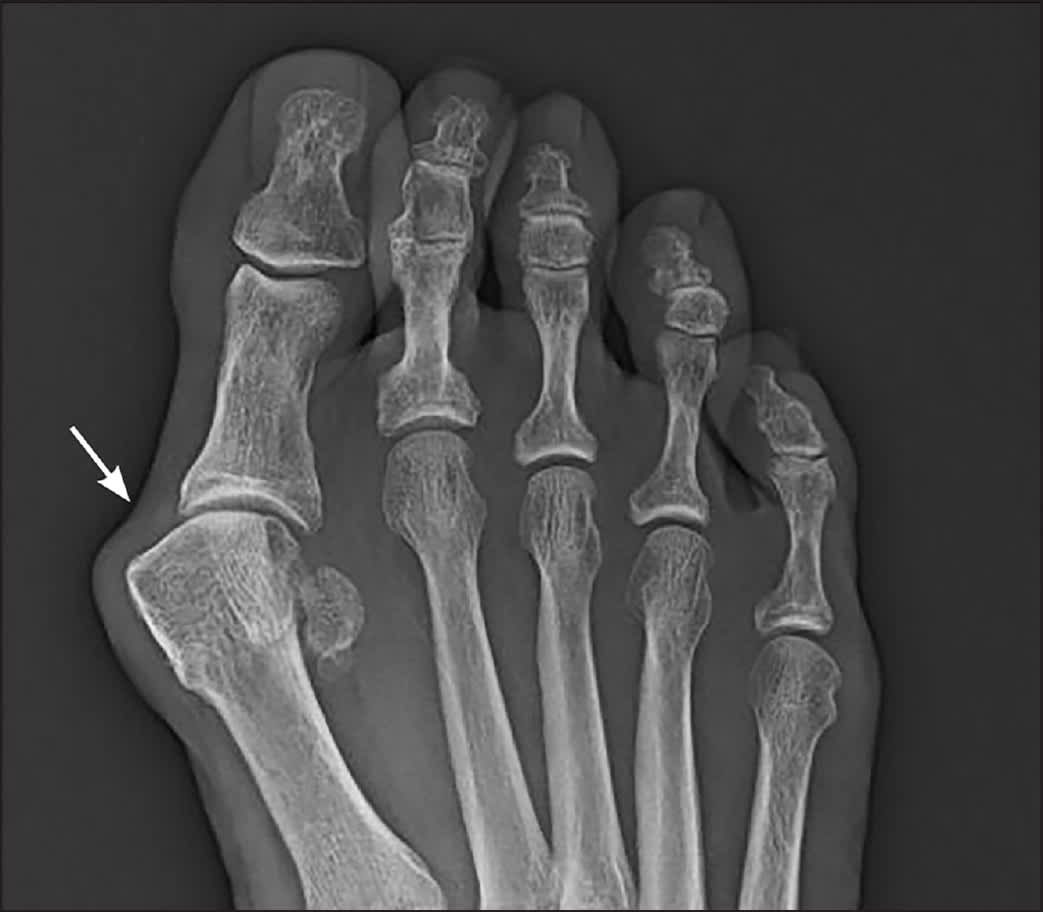
Anteroposterior Radiograph of the Right Foot Showing a Hallux Valgus Deformity (arrow)
Reprinted with permission from Becker BA, Childress MA. Common foot problems: over-the-counter treatments and home care. Am Fam Physician. 2018;98(5):300.
Reduction of pain, correction of deformity, and improved shoe fit can be accomplished with treatment of hallux valgus.1,8 Conservative management should begin with patient education (eg, avoiding tight-fitting shoes) and accommodative padding, shoes with a wider toe box, and custom orthotic inserts designed to arrest the deformity by stabilizing the foot.1,8 Therapeutic injections can manage joint capsule inflammation caused by abnormal pressure. Surgical management consists of several osteotomy types and arthrodesis of the first metatarsophalangeal joint.8,9 Decisions regarding surgical corrective procedures are based on such variables as radiographic angles, bone density, first ray hypermobility, sesamoid position, range of motion of the first metatarsophalangeal joint, and patient comorbidities. Compared with conservative or nonsurgical methods, surgery for hallux valgus often results in less pain and better function.9
Read the full edition
Get immediate access, anytime, anywhere.
Choose a single edition, 1-year or 2-year full-access subscription.
Earn 4 CME credits for this edition.