

Already a member or subscriber? Sign in now

Food Allergy Point-of-Care Tool for Family Physicians

FPM. 2025;32(4):43-45.

The publication of this content is supported by a sponsorship from Genentech, a member of the Roche Group, and brought to you by the AAFP. Journal editors were not involved in the development of this content.

Immunoglobulin E (IgE)-mediated food allergies affect more than 5.6 million children and more than 27 million adults in the United States.13 In IgE-mediated food allergic reactions, symptoms — including anaphylaxis — develop rapidly following exposure to an allergen.4 By contrast, non-IgE food allergies cause delayed reactions that mostly affect the digestive system,5 and food intolerances do not affect the immune system at all.6 Although more than 170 foods are known to cause IgE-mediated food allergic reactions, nine foods account for 90% of all cases.7,8

The American Academy of Family Physicians developed this point-of-care tool to help family physicians recognize, evaluate and manage IgE-mediated food allergy and prevent anaphylaxis.

Most Common Food Allergens7,8

Peanuts – Peanut butter, sauces, candies

Tree Nuts – Almonds, cashews, hazelnuts, pistachios

Milk – Cheese, yogurt, baked goods

Eggs – Mayonnaise, pasta, baked goods

Wheat – Bread, pasta, processed foods

Soy – Tofu, soy milk, soy sauce

Fish – Salmon, tuna, sauces

Shellfish – Shrimp, crab, lobster

Sesame – Seeds, tahini, bread

Hidden sources of food allergens include cross-contact in shared fryers, processed foods, unlabeled ingredients, and cross-reactivity between pollen and certain foods.

Key Points for Patient and Caregiver Education

Food label reading: “Contains” vs. “May contain” vs. “Processed in a facility with”

Cross-contamination: Avoidance of shared utensils, buffets, shared fryers

School/workplace plans: Food allergy action plan (e.g., www.foodallergy.org/living-food-allergy/food-allergy-essentials/food-allergy-anaphylaxis-emergency-care-plan); allergy response training for school/workplace staff

Emergency preparedness: Use of epinephrine auto-injector (e.g., EpiPen, Auvi-Q)

Management of IgE-Mediated Food Allergy
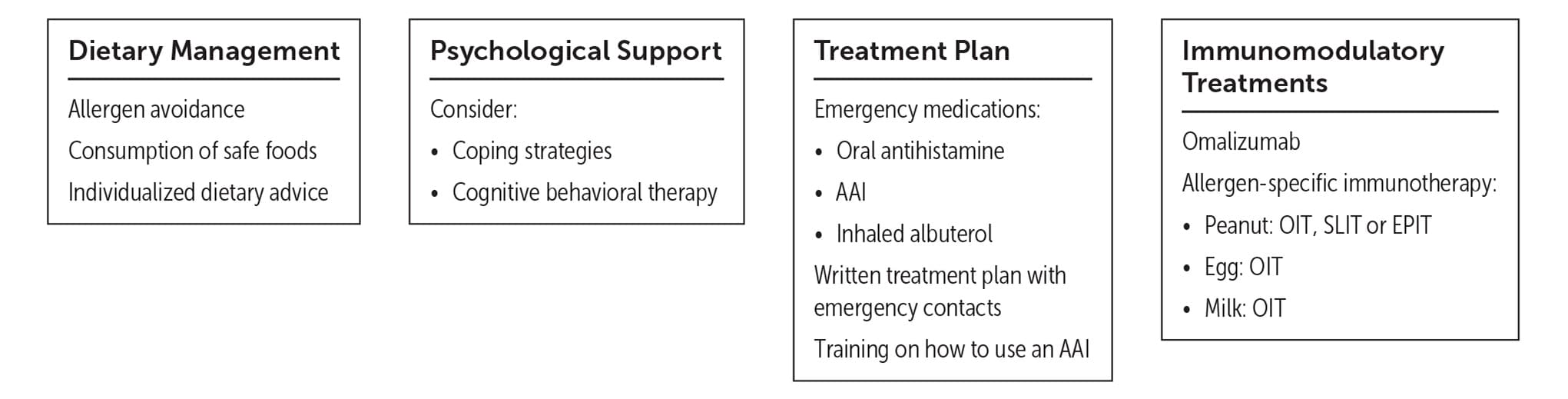
AAI = adrenaline auto-injector; EPIT = epicutaneous immunotherapy; OIT = oral immunotherapy; SLIT = sublingual immunotherapy.

Adaptation of Figure 1 in Santos AF, Riggioni C, Agache I, et al. EAACI guidelines on the management of IgE-mediated food allergy. Allergy. 2025;80(1):14–36. https://onlinelibrary.wiley.com/doi/10.1111/all.16345

This is an open access article under the terms of the CC BY 4.0 License.
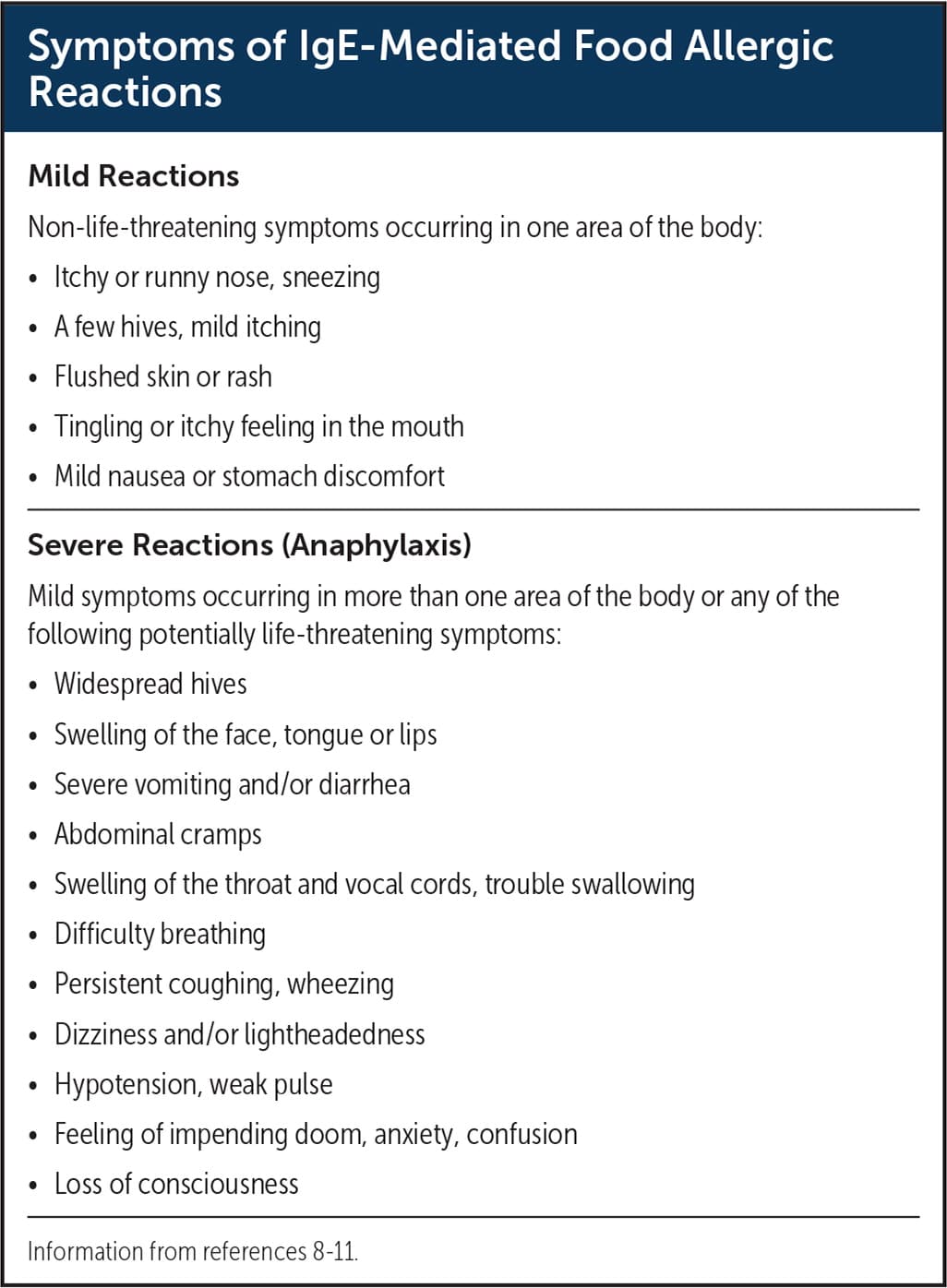
Symptoms of IgE-Mediated Food Allergic Reactions

Mild Reactions
Non-life-threatening symptoms occurring in one area of the body:
  • Itchy or runny nose, sneezing

  • A few hives, mild itching

  • Flushed skin or rash

  • Tingling or itchy feeling in the mouth

  • Mild nausea or stomach discomfort

Severe Reactions (Anaphylaxis)
Mild symptoms occurring in more than one area of the body or any of the following potentially life-threatening symptoms:
  • Widespread hives

  • Swelling of the face, tongue or lips

  • Severe vomiting and/or diarrhea

  • Abdominal cramps

  • Swelling of the throat and vocal cords, trouble swallowing

  • Difficulty breathing

  • Persistent coughing, wheezing

  • Dizziness and/or lightheadedness

  • Hypotension, weak pulse

  • Feeling of impending doom, anxiety, confusion

  • Loss of consciousness

Information from references 8–11.

ADDITIONAL AAFP RESOURCES

Food Allergy Management and Prevention for Clinicians

Get clinical tools, prevention strategies and evidence-based care guidance for diagnosing and managing food allergies.

The publication of this content is supported by a sponsorship from Genentech, a member of the Roche Group, and brought to you by the AAFP. Journal editors were not involved in the development of this content.

  1. 1.Gupta RS, Warren CM, Smith BM, et al. The public health impact of parent-reported childhood food allergies in the United States. Pediatrics. 2018;142(6):e20181235.
  2. 2.Gupta RS, Warren CM, Smith BM, et al. Prevalence and severity of food allergies among US adults. JAMA Netw Open. 2019;2(1):e185630.
  3. 3.Annie E. Casey Foundation Kids Count Data Center. Total population by child and adult populations in United States. July 2024. Accessed May 19, 2025. https://datacenter.aecf.org/data/tables/99-total-population-by-child-and-adult-populations#detailed/1/any/false/2545/39,40,41/416
  4. 4.Zhang S, Sicherer S, Berin MC, et al. Pathophysiology of non-IgE-mediated food allergy. Immunotargets Ther. 2021;10:431-446.
  5. 5.Cook VE, Connors LA, Vander Leek TK, et al. Non-immunoglobulin E-mediated food allergy. Allergy Asthma Clin Immunol. 2024;20(Suppl 3):70.
  6. 6.Bright DM, Stegall HL, Slawson DC. Food allergies: diagnosis, treatment, and prevention. Am Fam Physician. 2023;108(2):159-165.
  7. 7.Allergy & Asthma Network. Safe food substitutions for top 9 food allergens. Accessed April 24, 2025. https://allergyasthmanetwork.org/food-allergies/living-with-food-allergies/safe-food-substitutions/
  8. 8.U.S. Food and Drug Administration. Food allergies. March 26, 2025. Accessed May 19, 2025. https://www.fda.gov/food/nutrition-food-labeling-and-critical-foods/food-allergies
  9. 9.Allergy & Asthma Network. Food allergies. Accessed May 19, 2025. https://allergyasthmanetwork.org/food-allergies/
  10. 10.Food Allergy Research & Education. Recognizing and treating reaction symptoms. Accessed May 19, 2025. https://www.foodallergy.org/resources/recognizing-and-treating-reaction-symptoms
  11. 11.Pflipsen MC, Vega Colon KM. Anaphylaxis: recognition and management. Am Fam Physician. 2020;102(6):355-362.

Copyright © 2026 by the American Academy of Family Physicians.

This content is owned by the AAFP. A person viewing it online may make one printout of the material and may use that printout only for his or her personal, non-commercial reference. This material may not otherwise be downloaded, copied, printed, stored, transmitted or reproduced in any medium, whether now known or later invented, except as authorized in writing by the AAFP. See permissions for copyright questions and/or permission requests.