


Over the past several years, the American Academy of Family Physicians (AAFP) has made a deliberate investment in ensuring that family physicians help shape the development, deployment and governance of AI and digital health in primary care. The work has been grounded in a simple yet critical premise: innovation should enhance, not replace the core strengths of primary care with physicians firmly at the center of every clinical decision.
In 2024, the AAFP partnered with Rock Health to directly engage family physicians and other primary care clinicians through a national survey to explore how digital health and AI tools are being used in practice today and where they hold the greatest promise. That physician-led inquiry laid bare both the opportunity and the caution clinicians feel about AI. It highlighted the enthusiasm for tools that reduce administrative burden, along with concerns about workflow disruption, data privacy, bias and clinical accountability.
Those insights culminated in the May 2025 Starfield AI Summit, which convened family physicians, primary care associations, health system leaders, technology developers, payers, ethicists, policymakers and researchers to define a shared vision for the responsible use of AI in primary care.
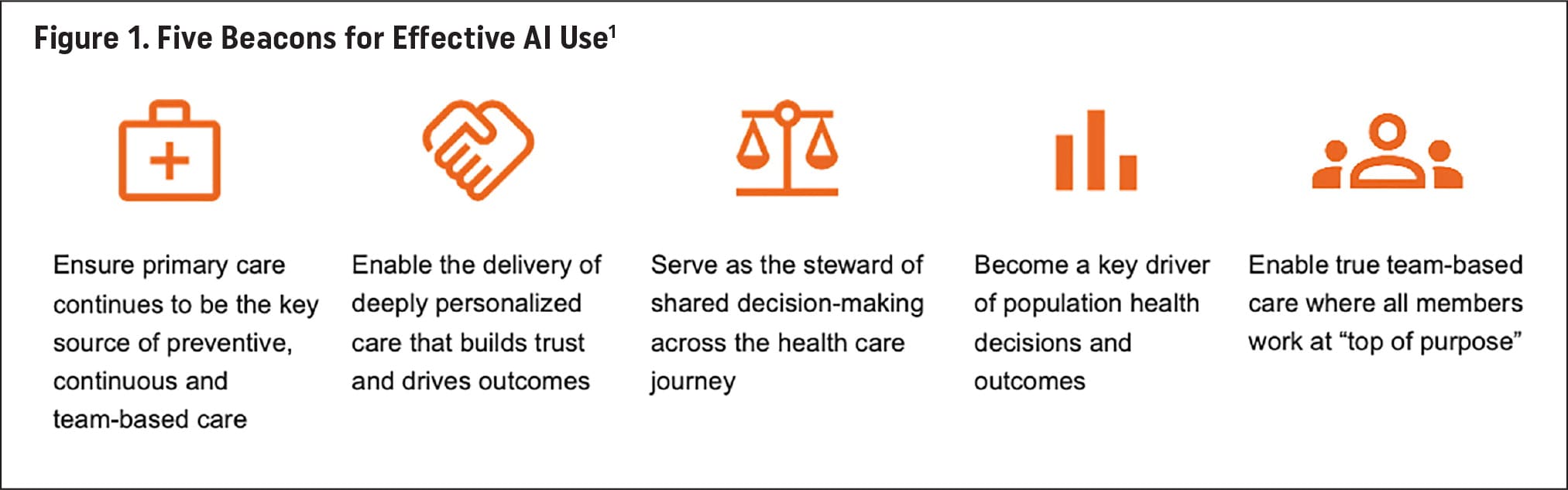
The findings and recommendations from that convening were published in August 2025 as “The Starfield Signal: A Shared Vision and Roadmap for AI in Primary Care.” The report articulated clear principles and priority areas for aligning innovation with the needs of patients and frontline clinicians. This included articulating the five guiding beacons in Figure 1 below to ensure that AI in primary care is trustworthy, physician-led and aligned with core primary care values—a framework that continues to anchor the AAFP's approach to innovation.
Figure 1. Five Beacons for Effective AI Use
AI in Primary Care Today
AI in health care is already happening—regardless of preparedness or governance—so creating opportunities for structured engagement now is essential. National physician surveys from the American Medical Association shows that 81% of physicians now report using some form of AI or augmented intelligence in their professional work, more than double the percentage reported just a few years ago.2
In primary care specifically, the AAFP's survey with Rock Health found that roughly half of family physicians and other primary care clinicians have already used AI-enabled tools for at least one use case for work.3 They cite the most common uses are for clinical documentation support, visit summarization, inbox management and administrative workflows.
While early AI adoption has centered on reducing administrative burden, momentum is quickly moving toward more clinical uses, such as ambient clinical documentation, patient engagement and risk stratification. Physicians consistently emphasize that AI tools must be accurate, transparent, ethically designed and integrated into streamlined practice workflows that serve clinicians and their patients well. The Starfield Signal work highlights a critical gap: family physicians often lack meaningful influence over technology decisions that directly affect their practice.1 As AI adoption accelerates, this gap reinforces the need for a system that prioritizes clinician leadership, strengthens governance, considers the impact on patients and ensures accountability of AI in primary care.
How Is the AAFP Leading Primary Care AI Innovation?
The AAFP is activating the Primary Care Innovation Network (PCIN) to build directly on the foundation of these gaps. The PCIN is the AAFP's flagship initiative to support responsible, physician-led innovation in digital health and AI. It translates the Starfield Signal work from vision into practice by creating an ongoing, structured environment for learning, collaboration and real-world testing. Its purpose is straightforward: to ensure family physicians are positioned firmly at the center of how digital health and AI tools are evaluated, developed and responsibly integrated into primary care practices.
PCIN is inclusive by design. All AAFP members can engage with trusted education, peer-learning opportunities and stay current on the latest research and its implications for practice-level implementation of AI. Members with a deeper interest or capacity can opt into more hands-on, interactive activities directly with technology vendors, such as participating in focus groups or attending a product demonstration. The PCIN is guided by a multi-stakeholder advisory committee that includes family physicians and primary care leaders, as well as health technology industry leaders. Meeting quarterly, the committee will provide strategic guidance, prioritize focus areas and ensure alignment with AAFP policy, ethics and member interests.
At its core, the PCIN aims to create meaningful connections between those delivering primary care and those building technology to support it, ensuring innovations reflect real-world clinical needs and advance high-quality, equitable care in primary care settings.
Core PCIN Activities
Implementing the PCIN marks a significant investment by the AAFP in supporting family physicians through the next era of practice transformation. As a priority strategic initiative, the PCIN is designed to offer multiple ways for members to stay informed, build skills and directly influence how new technologies are developed and used in primary care.
The following is a preview of the core activities that will anchor the work of the PCIN:
1. Innovation Sandbox
The PCIN Innovation Sandbox is an opportunity for interested AAFP members to engage directly with selected health technology vendors to influence and engage in new AI products and features. Activities may include product demonstrations, focus groups and pilot-matching opportunities. Participation is structured, transparent and designed to protect physician autonomy, with vendors required to meet AAFP standards for ethics, equity, privacy and accountability.
2. Translating Research into Practice Opportunities
The PCIN will support the synthesis and translation of emerging evidence on AI and digital health in primary care. In collaboration with the Robert Graham Center, this work will include rapid analysis and practical summaries of evidence-based research that help physicians assess new technologies, identify practice implementation opportunities and understand their impact on care delivery.
3. Peer Networking and Education
Through virtual communities, webinars, discussion forums and learning collaboratives, the PCIN will connect physicians who are navigating similar innovation challenges. These peer spaces promote shared learning, candid discussion and collective problem-solving. The PCIN will also support ongoing education through AAFP CME content, podcasts and blogs to translate emerging AI and digital health insights into practical, real-world applications for family physicians.
4. Events and Convenings
The PCIN will be visible across the AAFP's national convenings, including a planned AI Hackathon at the Family Medicine Experience (FMX) in Nashville, TN, on Tuesday, October 20, 2026. The Hackathon will bring practicing physicians together with technology innovators to co-design practical, primary care-ready solutions, reinforcing that family medicine is not just a testing ground for innovation but a driver of it.
Call to Action: How to Get Involved
The PCIN is designed for family physicians at every stage of the innovation journey.
- Stay informed: Engage with PCIN content through AAFP communications, blogs, webinars and events. A new landing page will be coming soon on the AAFP's brand new website!
- Learn and connect: Participate in peer discussions and educational offerings focused on AI and digital health. The FMX 2026 session builder is where you can register for a variety of AI sessions and our brand new AI Hackathon pre-con.
- Go deeper: Opt into Innovation Sandbox activities or learning collaboratives if you're interested in hands-on engagement directly with technology vendors.
- Lead: Share your perspectives, lessons learned and priorities to help shape how AI is advancing primary care. Consider joining the AAFP's Technology Empowered Clinical Optimization (TECO) Member Interest Group to connect with your peers.
By participating in the AAFP's PCIN, family physicians can gain new insights, skills and knowledge to support your success through this rapidly changing AI era. The AAFP is committed to ensuring that AI and digital health serve as tools to restore the joy in practice, strengthen physician-patient relationships, improve patient outcomes and sustain primary care as the foundation of a strong U.S. health care system.