

We do our residents a disservice if we let them finish training without a basic understanding of the labyrinthine health care system.
One complaint I often hear from medical students and residents is that their training did not prepare them well for the complexities of the U.S. health care system. They need to better understand things like insurance plans, coding and billing, the medical-legal landscape, hospital and clinic interactions, and state and federal regulations.
Traditional medical training addresses basic science early on and clinical sciences toward the end of medical school and residency. Too often, the “third leg” of medicine — health systems science (HSS) — gets inadequate attention, which can undermine an otherwise successful medical career.
OUR THREE-PHASE APPROACH
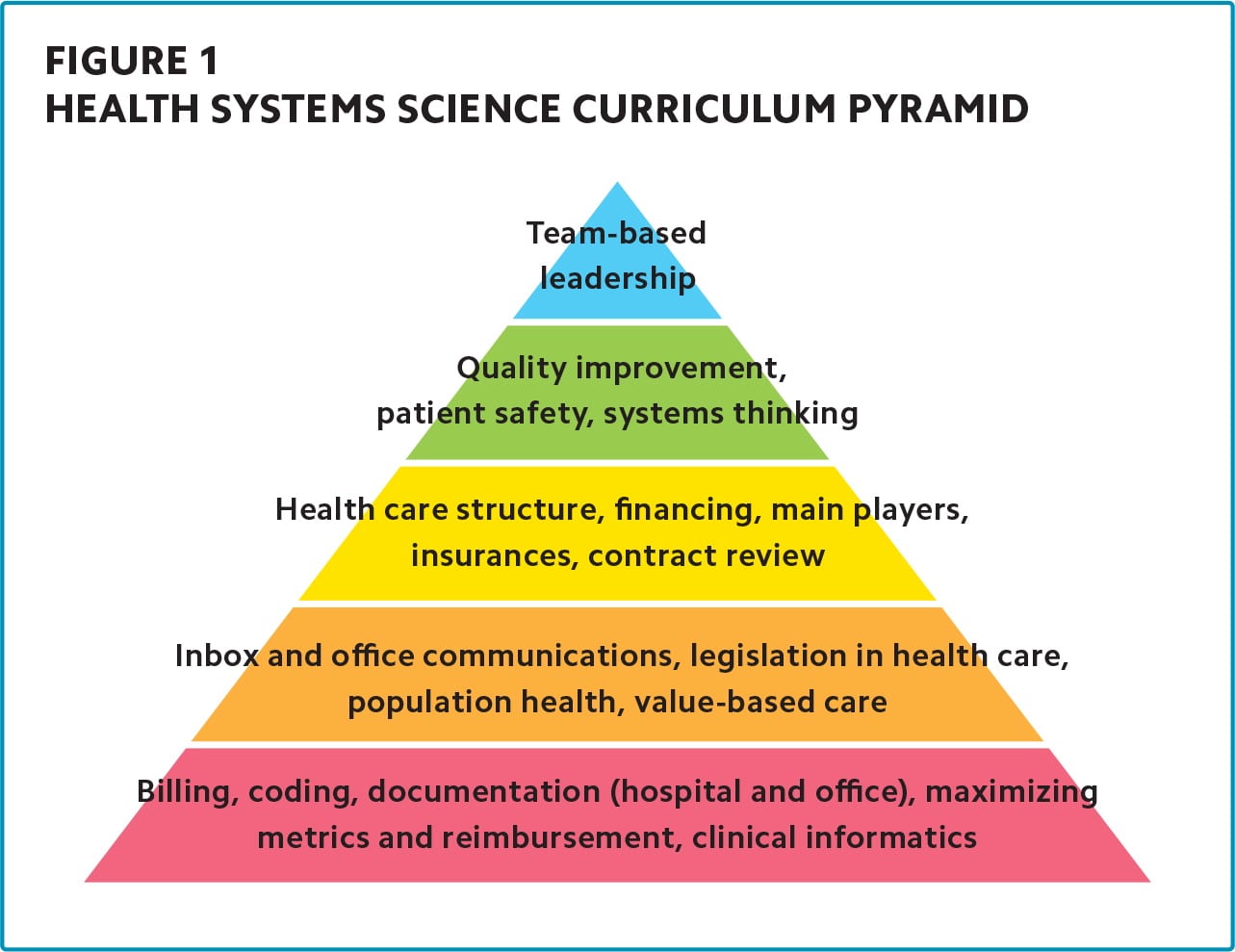
Our residency program implemented an HSS curriculum (Figure 1) combined with other educational experiences, which we incorporate at various stages:
- Foundational basics. Our curriculum begins with basic training in the post-graduate year 1 (PGY-1), teaching skills such as billing, documentation, and coding. We may also schedule guest speakers with expertise in human resources, financial management, contract management, staff and physician recruitment, and other relevant areas.
- Advanced practice management. As residents build their medical skills, the PGY-2 curriculum incorporates more advanced aspects of practice management, such as inbox management, intra-office communication, and reviewing contracts. This enables residents to begin to understand system-level problems and participate in solving them as their competence in complex medical care grows.
- Experiential rotation. In PGY-3, residents have a four-week HSS rotation. (See sample curriculum below.) The goal is to expose our trainees to the many roles physicians play in the health care system — from administrative to clinical — and help them understand how the various realms of medicine interact. Trainees must complete assigned readings and take a “before” and “after” test to gauge how much knowledge they gained during the rotation.
FIGURE 1. HEALTH SYSTEMS SCIENCE CURRICULUM PYRAMID
DID IT WORK?
When we launched our HSS curriculum, we asked residents to rate their comfort level with HSS topics at the outset, where 1 represented the lowest comfort level and 5 represented the highest. In that first cohort, 46% answered 1, 27% answered 2, and 27% answered 3. Our goal was to get all responses to 3 or above by graduation. The first cohort exceeded that, with all responses increasing to 4. Additionally, when residents took the HSS proficiency test, they averaged 10 out of 20 points before their rotation and 16 out of 20 after.
Much of our model can be adapted by other residency programs, or practices looking to upgrade their physicians' knowledge of the health care system. Resources are available from sources such as the Society of Teachers of Family Medicine.1
As more family medicine residencies adopt similar training, our specialty will be better equipped to help heal what ails our system while we heal our patients.
Table 1. SAMPLE HSS THIRD-YEAR ROTATION DELIVERABLES
|
READINGS: Our Iceberg Is Melting by Kotter and Rathgeber Pennstown Community Hospital – A Case Study* Population Health Improvement: Excel Health case study* Selected readings from AMA Education Consortium's Health Systems Science textbook by Skochelak, et al Optimizing Population Health and Quality Metrics by Perez* For residents interested in hospitalist work: Clinical Documentation Integrity training modules |
|
ASSIGNMENTS: Discuss learning points of Our Iceberg Is Melting with faculty Discuss Optimizing Population Health and Quality Metrics with faculty Answer and turn in the questions at the end of Pennstown Community Hospital case study Answer and turn in the questions at the end of Population Health Improvement Complete a pre-test at the beginning of the rotation and a post-test at the end List three things you learned during each of your meetings with various health care players |
|
MEETINGS: Meet with rotation coordinator at least twice — at the beginning of the rotation and toward the second half of the rotation for discussion, review of readings, etc. Spend one half-day with an outpatient family physician to familiarize yourself with a real-life clinic, workflows, and tips (you may skip this if you formerly rotated at their office) Meet with a clinic manager to understand the day-to-day clinic operation — scheduling, human resources, and patient management challenges Meet with one of the following:
|
* Not widely available
Read the full article
Get immediate access, anytime, anywhere.
Choose a single article, issue, or full-access subscription.
Earn up to 5 CME credits per issue.