
Already a member or subscriber? Sign in now

Addressing IMG Challenges: Practical Mentorship Strategies

KENTO SONODA, MD, MPH, FAAFP
YUKI TAKEUCHI, MD
MAKO WAKABAYASHI, MD
TOMOKO SAIRENJI, MD, MS

FPM. 2026;33(6):16-20.

Author disclosures: no relevant financial relationships.

This content conforms to AAFP criteria for CME.

International medical graduates are critical to the primary care workforce but face unique challenges in residency. Three strategies can help them thrive.

International medical graduates (IMGs) play a vital role in the U.S. health care system, where they make up nearly a quarter of the physician workforce, with the greatest representation and growth in primary care.1 In the 2026 National Resident Matching Program (NRMP) main match, roughly 21% of those who matched to family medicine residencies were “non-U.S. IMGs” (e.g., IMGs who are not U.S. citizens, as opposed to IMGs who are U.S. citizens but graduated abroad).2 This can be a benefit for the specialty. Non-U.S. IMGs diversify the primary care workforce and can improve racial concordance in the community, contributing to improved patient outcomes and reduced health inequities.3 They also help fill primary care gaps in rural or underserved areas.4,5

However, non-U.S. IMGs often face unique challenges in residency, and few resources are available to help faculty members mentor IMGs effectively.

KEY POINTS

  • International medical graduates (IMGs) make up nearly a quarter of the U.S. physician workforce and are critical to filling primary care gaps, particularly in rural and underserved areas.
  • Non-U.S. IMGs enhance diversity and health equity, yet often face unique challenges such as psychological stress, cultural differences, and systemic and structural barriers.
  • Mentorship, orientation redesign, and cultural integration can help non-U.S. IMGs navigate residency and address unique issues.

TABLE 1. RESOURCES TO SUPPORT IMG RESIDENT PHYSICIANS

Resource Organization Web address
International Medical Graduates Toolkit American Medical Association https://www.ama-assn.org/education/international-medical-education/international-medical-graduates-img-toolkit-introduction
Reference Guide for J-1 Physicians Educational Commission for Foreign Medical Graduates (ECFMG) https://www.ecfmg.org/evsp/evsprfgd.pdf
Well-being Resources ECFMG https://www.ecfmg.org/evsp/resources-well-being-resources.html
Adjusting to a New Culture U.S. Department of State https://exchanges.state.gov/non-us/adjusting-new-culture.html

IMG CHALLENGES DURING RESIDENCY

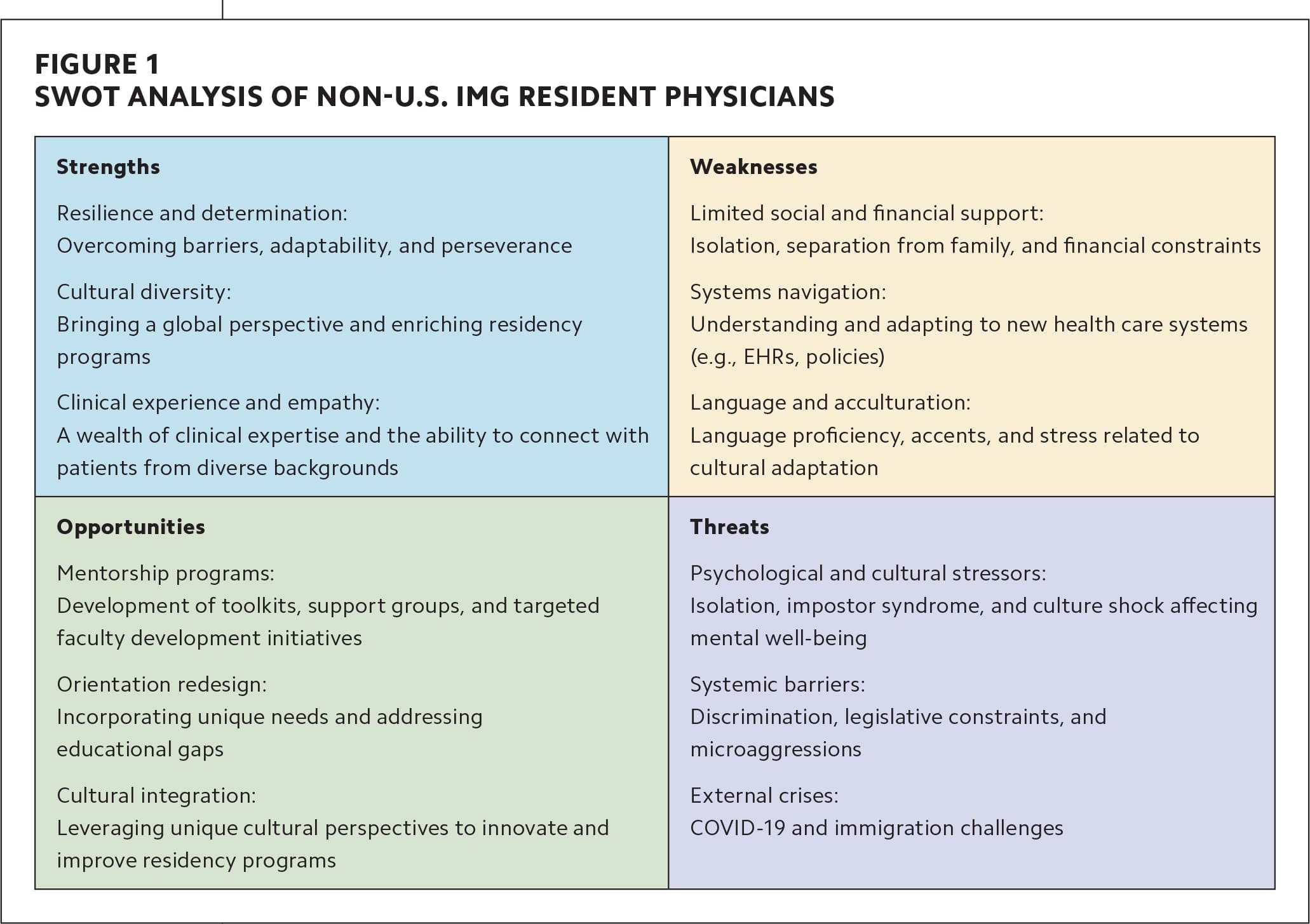
Our author group is composed of a mix of U.S. and non-U.S. IMGs from Japan, and each of us has our own stories of unique struggles in residency. Recognizing our limited perspective, we hosted workshops in 2024 and 2025 at the Society of Teachers of Family Medicine (STFM) annual conferences, where we led diverse residency faculty in a SWOT analysis to identify factors affecting non-U.S. IMGs (Figure 1). The following list of challenges is drawn from that discussion as well as our own experiences and the literature.6,7

FIGURE 1. SWOT ANALYSIS OF NON-U.S. IMG RESIDENT PHYSICIANS
Psychological stress. Substantial time-zone differences and long distances from home make it difficult for IMGs to stay connected with their families, even virtually. This disconnection can lead to feelings of isolation during residency, which is already a stressful time. Many residency programs offer mental health support such as faculty check-ins, protected wellness time, and confidential counseling services. But cultural differences in how mental health is perceived and addressed (e.g., the belief that seeking help is a sign of weakness) can limit the effectiveness of these supports for non-U.S. IMGs.

Dr. Sonoda is an associate professor and director of the family medicine clerkship at the Saint Louis University School of Medicine Department of Family and Community Medicine.

Dr. Takeuchi is a family physician and geriatrician in Rochester, N.Y.

Dr. Wakabayashi is an assistant professor in the Oregon Health & Science University Department of Family Medicine, Portland, Ore.

Dr. Sairenji is a professor in the University of Washington School of Medicine Department of Family Medicine and practices at UW’s Northgate clinic in Seattle.

Send comments to fpmedit@aafp.org, or add your comments to the article online.

Author disclosures: no relevant financial relationships.

  1. 1.Ahmed AA, Hwang WT, Thomas CR Jr, Deville C Jr. International medical graduates in the U.S. physician workforce and graduate medical education: current and historical trends. J Grad Med Educ. 2018;10(2):214-218.
  2. 2.2026 NRMP Match results for family medicine. AAFP. Accessed Aug. 28, 2026. https://www.aafp.org/residency-program-directors/national-resident-matching-program-results
  3. 3.Shen MJ, Peterson EB, Costas-Muñiz R, et al. The effects of race and racial concordance on patient-physician communication: a systematic review of the literature. J Racial Ethn Health Disparities. 2018;5(1):117-140.
  4. 4.Malayala S, Adhikari R, Vasireddy D, Atluri P, Bali A. Medically underserved areas and international medical graduates (IMGs) in the United States: challenges during the COVID-19 era. J Community Hosp Intern Med Perspect. 2021;11(4):457-463.
  5. 5.Thompson MJ, Hagopian A, Fordyce M, Hart LG. Do international medical graduates (IMGs) “fill the gap” in rural primary care in the United States? A national study. J Rural Health. 2009;25(2):124-134.
  6. 6.Triscott JAC, Szafran O, Waugh EH, Torti JMI, Barton M. Cultural transition of international medical graduate residents into family practice in Canada. Int J Med Educ. 2016;7:132-141.
  7. 7.Symes HA, Boulet J, Yaghmour NA, Wallowicz T, McKinley DW. International medical graduate resident wellness: examining qualitative data from J-1 visa physician recipients. Acad Med. 2022;97(3):420-425.
  8. 8.Healey SJR, Fakes K, Nair BR. Inequitable treatment as perceived by international medical graduates (IMGs): a scoping review. BMJ Open. 2023;13(7):e071992.
  9. 9.Zaidi Z, Dewan M, Norcini J. International medical graduates: promoting equity and belonging. Acad Med. 2020;95(12):S82-S87.
  10. 10.Ramanan RA, Taylor WC, Davis RB, Phillips RS. Mentoring matters: Mentoring and career preparation in internal medicine residency training. J Gen Intern Med. 2006;21(4):340-345.
  11. 11.DeCastro R, Griffith KA, Ubel PA, Stewart A, Jagsi R. Mentoring and the career satisfaction of male and female academic medical faculty. Acad Med. 2014;89(2):301-311.
  12. 12.Fraser K, Dennis S, Kim C, et al. Designing effective mentorship for underrepresented faculty in academic medicine. Fam Med. 2023;56(1):42-46.
  13. 13.Wheat S, Cole S. Individualized learning plans: who, what, when, where, why, and how?. Ann Fam Med. 2023;21(6):560-562.
  14. 14.Core Entrustable Professional Activities for Entering Residency: Curriculum Developers’ Guide. AAMC; 2014. Accessed January 31, 2026. https://store.aamc.org/downloadable/download/sample/sample_id/63/%20​
  15. 15.Perez JA. Preparing residents to navigate the health care system. Fam Pract Manag. 2026;33(4):35.
  16. 16.Understanding Health Systems courses and curriculum. STFM. Dec. 22, 2025. Accessed Aug. 31, 2026. https://www.stfm.org/facultydevelopment/otherfacultytraining/understandinghealthsystems/overview/​
  17. 17.Communication Styles. U.S. Department of Health and Human Services. Accessed Aug. 31, 2026. https://thinkculturalhealth.hhs.gov/assets/pdfs/resource-library/communication-styles.pdf​
  18. 18.McCluney CL, Robotham K, Lee S, Smith R, Durkee M. The costs of code-switching. Harv Bus Rev. Nov. 15, 2019. Accessed Aug. 31, 2026. https://hbr.org/2019/11/the-costs-of-codeswitching​

Copyright © 2026 by the American Academy of Family Physicians.

This content is owned by the AAFP. A person viewing it online may make one printout of the material and may use that printout only for his or her personal, non-commercial reference. This material may not otherwise be downloaded, copied, printed, stored, transmitted or reproduced in any medium, whether now known or later invented, except as authorized in writing by the AAFP. See permissions for copyright questions and/or permission requests.