
Already a member or subscriber? Sign in now

Aligning Care With Patients’ Priorities: An Improved Approach to Clinical Decision-Making

TIMOTHY W. FARRELL, MD, AGSF, CPAFH
NATALIE A. SANDERS, DO, FACP
AANAND D. NAIK, MD
MARY E. TINETTI, MD

FPM. 2026;33(6):21-28.

Author disclosures: no relevant financial relationships.

This content conforms to AAFP criteria for CME.

Knowing what matters most to the patient can simplify decision-making for those with multiple complex conditions, reduce unwanted care, and make visits more meaningful.

Family physicians care for increasingly complex patient populations, including older adults, who make up approximately 40% of a typical family medicine practice.1 Among older adults, 75% have multiple chronic conditions.2 Despite this population’s exclusion from most clinical trials, their care typically relies on the application of clinical guidelines designed for single diseases. In addition to offering uncertain benefit, single-disease guidelines may worsen a coexisting condition.3 For example, using beta-blockers to treat heart failure may be at cross-purposes with managing depression. Moreover, older adults with multiple chronic conditions may receive recommendations for services — such as labs, imaging, medications, and self-care tasks — that are unwanted, unhelpful, or burdensome. In short, care based solely on single-disease guidelines often does not align with the outcomes individual patients want most from their health care.4,5

KEY POINTS

  • For older adults with multiple chronic conditions, care aligned with their priorities rather than based solely on individual disease guidelines is associated with less unwanted and burdensome care, improved patient experience, and no increase in ED or hospital stays.
  • Patient Priorities Care is a feasible approach for identifying patients’ health priorities and aligning care with those priorities.
  • A patient health priorities summary template can aid physicians and the rest of the health care team in providing patient priorities-aligned decision-making and care.

THE PPC APPROACH

Patient Priorities Care (PPC) is an evidence-based approach for identifying and aligning care with patients’ health priorities (Figure 1).6–9 The approach was developed under the leadership of two of the authors (Naik and Tinetti) with grants from organizations including The John A. Hartford Foundation and the Department of Veterans Affairs, and with input from clinicians across several disciplines, older adults, care partners, and health system experts. PPC is not a discrete model but rather an open-access approach to decision-making and communication that can be integrated into any clinical setting. All PPC resources, including those shared in this article, are freely available.10

FIGURE 1. PATIENT PRIORITIES-ALIGNED CARE
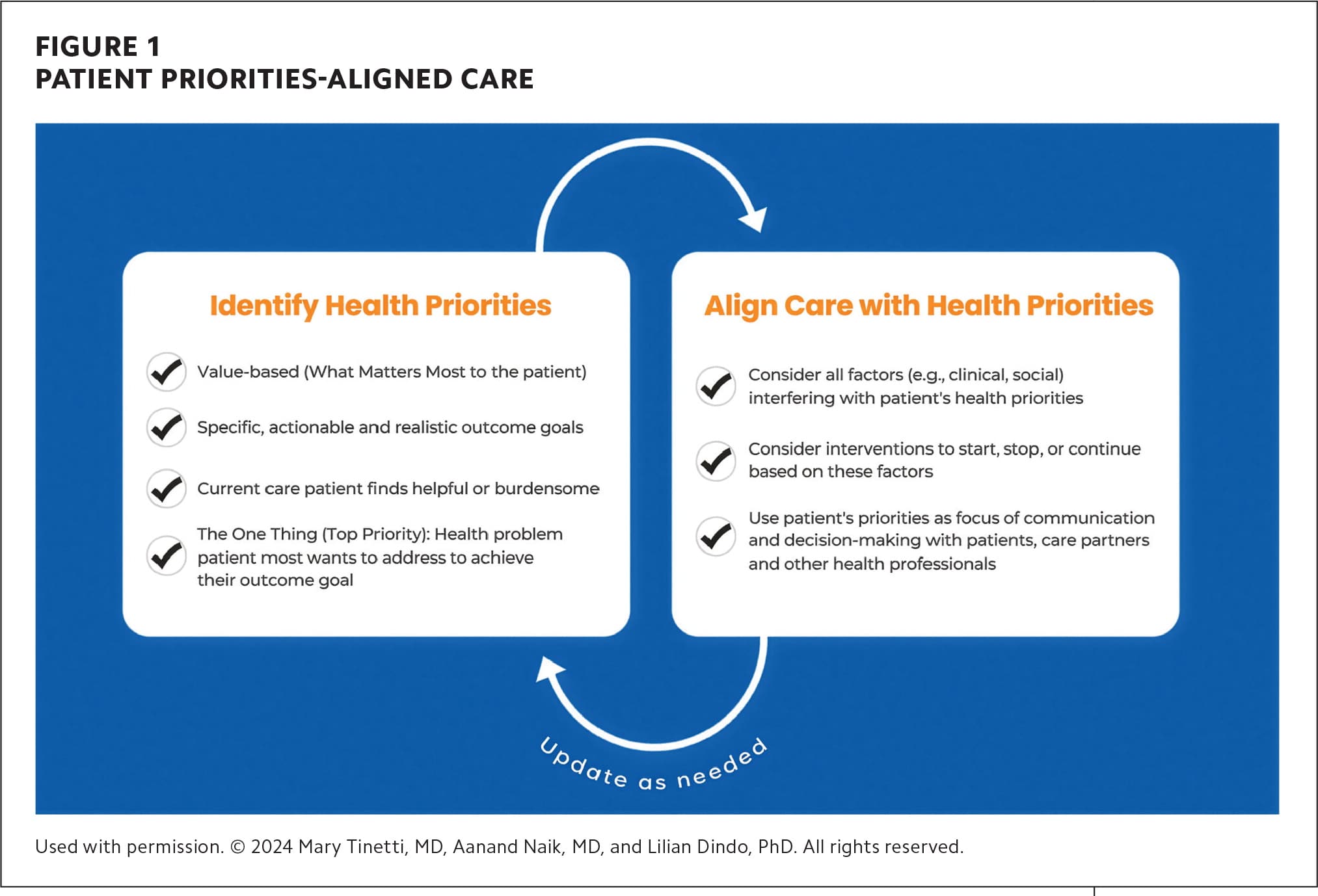
In several studies, the PPC approach resulted in less unwanted care and fewer burdensome health care tasks.6–8 It was also associated with increases in wanted care aligned with patients’ priorities, such as community supports and rehabilitative services.7,11 Clinicians and patients have found this approach to be feasible and acceptable.6, 12,13 Despite concerns about unintended consequences, focusing on patient priorities does not result in more emergency department or hospital visits or worsened disease-specific metrics.8,9 While the PPC approach is appropriate for all patients, it is particularly important for older adults with multiple chronic conditions, functional limitations, or life expectancies between two and 10 years for whom disease guideline-based care may be burdensome, harmful, and of uncertain benefit, and for whom end-of life-care is not yet indicated.14,15

All clinical team members — including physicians, advanced practice clinicians, medical assistants, social workers, and care managers — can participate in patient priorities-aligned care. Although family medicine practices likely already engage in some elements, PPC frames all clinical decision-making and communication among all members of the health care team over time in a structured and reproducible way. This approach shifts the focus of decision-making from siloed diseases to the outcomes that matter to each patient. Seeing the steps written out (below) may make the process seem complex and time consuming. However, many of these steps are implicitly, if not consistently, used by primary care clinicians. The PPC approach makes the process explicit and thorough — and, thus, more effective. Most clinicians report that it becomes quicker, easier, and more natural with experience.

Dr. Farrell is professor of medicine, Division of Geriatrics, Spencer Fox Eccles School of Medicine, University of Utah, and physician investigator, VA Salt Lake City Geriatric Research, Education, and Clinical Center.

Dr. Sanders is professor of medicine, Division of Geriatrics, Spencer Fox Eccles School of Medicine, University of Utah.

Dr. Naik is professor and Nancy & Vincent Guinee distinguished chair, Institute on Aging, School of Public Health and McGovern Medical School, University of Texas Health Science Center, and senior investigator, Houston Center for Innovations in Quality, Effectiveness and Safety, Michael E. Debakey VA Medicine Center, Houston.

Dr. Tinetti is Gladys Phillips Crofoot professor of medicine, Section of Geriatrics, Yale School of Medicine.

This work was supported in part by a grant from The John A. Hartford Foundation.

Send comments to fpmedit@aafp.org, or add your comments to the article online.

Author disclosures: no relevant financial relationships.

  1. 1.Jo A, Dai M, Peterson L, Mainous AG. Trends of geriatric certification and practice patterns of family physicians: 1988–2019. Fam Med. 2023;55(2):95-102.
  2. 2.Ouellet GM, Ouellet JA, Tinetti ME. Challenges in health care for persons with multiple chronic conditions — where to go and how to get there?. JAMA Netw Open. 2024;7(10):e2439837.
  3. 3.Tinetti ME. The gap between clinical trials and the real world: extrapolating treatment effects from younger to older adults. JAMA Intern Med. 2014;174(3):397-398.
  4. 4.Tinetti ME, Naik AD, Dodson JA. Moving from disease-centered to patient goals-directed care for patients with multiple chronic conditions: patient value-based care. JAMA Cardiol. 2016;1(1):9-10.
  5. 5.Boyd CM, Wolff JL, Giovannetti E, et al. Healthcare task difficulty among older adults with multimorbidity. Med Care. 2014;52(3):S118-S125.
  6. 6.Tinetti ME, Naik AD, Dindo L, et al. Association of patient priorities-aligned decision-making with patient outcomes and ambulatory health care burden among older adults with multiple chronic conditions: a nonrandomized clinical trial. JAMA Intern Med. 2019;179(12):1688-1697.
  7. 7.Freytag J, Dindo L, Catic A, et al. Feasibility of clinicians aligning health care with patient priorities in geriatrics ambulatory care. J Am Geriatr Soc. 2020;68(9):2112-2116.
  8. 8.Tinetti M, Hashmi A, Ng H, et al. Patient priorities-aligned care for older adults with multiple conditions: a nonrandomized controlled trial. JAMA Netw Open. 2024;7(1):e2352666.
  9. 9.Tinetti M, Shanahan ML, Dindo L, et al. An innovative approach to aligning healthcare with what matters most to patients: a hybrid type 1 trial protocol of Patient Priorities Care for older adults with multiple chronic conditions. Contemp Clin Trials. 2024;143:107613.
  10. 10.Align care with what matters most. Patient Priorities Care. Accessed April 14, 2026. https://www.patientprioritiescare.org​
  11. 11.Samper-Ternent R, Razjouyan J, Dindo L, et al. Patient Priorities Care increases long-term service and support use: propensity match cohort study. J Am Med Dir Assoc. 2024;25(5):751-756.
  12. 12.Feder SL, Kiwak E, Costello D, et al. Perspectives of patients in identifying their values-based health priorities. J Am Geriatr Soc. 2019;67(7):1379-1385.
  13. 13.Ouellet GM, Kiwak E, Costello DM, et al. Clinician perspectives on incorporating patients’ values-based health priorities in decision-making. J Am Geriatr Soc. 2021;69(1):267-269.
  14. 14.Blaum CS, Rosen J, Naik AD, et al. Feasibility of implementing Patient Priorities Care for older adults with multiple chronic conditions. J Am Geriatr Soc. 2018;66(10):2009-2016.
  15. 15.Naik AD, Dindo LN, Van Liew JR, et al. Development of a clinically feasible process for identifying individual health priorities. J Am Geriatr Soc. 2018;66(10):1872-1879.
  16. 16.Vu T, Mroz EL, Hernandez-Bigos K, et al. Persons living with dementia and multiple chronic conditions identifying health priorities with care partners. J Am Geriatr Soc. 2023;71(6):2005-2008.
  17. 17.Tinetti M, Costello DM, Naik AD, et al. Outcome goals and health care preferences of older adults with multiple chronic conditions. JAMA Netw Open. 2021;4(3):e211271.
  18. 18.Nair AD, Martin LA, Moye J, Karel MJ. Health values and treatment goals of older, multimorbid adults facing life-threatening illness. J Am Geriatr Soc. 2016;64(3):625-631.
  19. 19.Davenport C, Ouellet J, Tinetti M. Use of the patient-identified top priority in care decision-making for older adults with multiple chronic conditions. JAMA Netw Open. 2021;4(10):e2131496.
  20. 20.Patient Priorities Care health professional toolkit. Patient Priorities Care. Accessed June 30, 2025. https://patientprioritiescare.org/health-professional-toolkit​
  21. 21.Clemens J, Leganza JM, Masucci A. Plugging gaps in payment systems: evidence from the take-up of new Medicare billing codes. Contemp Econ Policy. 2025;44(1):105-130.
  22. 22.National Academies of Sciences, Engineering, and Medicine. Improving Primary Care Valuation Processes to Inform the Physician Fee Schedule. The National Academies Press; 2025.
  23. 23.Medicare Learning Network. Chronic Care Management Services. Published June 2025. Accessed November 16, 2025. https://www.cms.gov/files/document/chroniccaremanagement.pdf​
  24. 24.Weida TJ, Weida JA. Implementing advanced primary care management: a practical guide. Fam Pract Manage. 2026;33(5):26-32.

Copyright © 2026 by the American Academy of Family Physicians.

This content is owned by the AAFP. A person viewing it online may make one printout of the material and may use that printout only for his or her personal, non-commercial reference. This material may not otherwise be downloaded, copied, printed, stored, transmitted or reproduced in any medium, whether now known or later invented, except as authorized in writing by the AAFP. See permissions for copyright questions and/or permission requests.