

Autonomy isn’t something you either have or don’t have. It’s a continuum, and the optimal amount is a matter of individual preference, risk tolerance, and sustainability.

“Professional autonomy does not mean absolute freedom, but rather, it lies on a continuum and comes with responsibilities.”
— Doctors of British Columbia policy statement1
In the midst of a busy day at work, you may often find yourself thinking, “If I could just be more in control of my work, my life would be so much better!” If this is true for you, please know you are not alone. Many physicians understandably believe that greater professional autonomy is always desirable and will naturally lead to elevated well-being. At a time when it often feels like the system is conspiring against us, such a position is enticing. However, we have found that the concept of professional autonomy is more complex and nuanced than it might first appear.
Professional autonomy, broadly defined as having self-directed freedom and moral independence, is better considered on a continuum across multiple domains rather than something you either have or don’t have. Whether you work in a small, private family medicine practice or a large, multi-campus, multispecialty health system, it’s worth your time to understand the complexity of professional autonomy and explore whether your level of autonomy is optimized for your personal and professional well-being.
KEY POINTS
- Professional autonomy exists on a continuum across six domains — clinical, operational, ethical, economic, advocacy/policy, and interpersonal.
- More autonomy isn’t always better, as it often comes with greater responsibility and risk. Finding the “autonomy sweet spot” is essential for sustainable satisfaction.
- Physicians should regularly assess their autonomy levels based on personal values, workplace dynamics, and life circumstances, with the understanding that well-being and autonomy influence each other.
THE COMPLEXITY OF PROFESSIONAL AUTONOMY
Professional autonomy can have multiple domains. The following six domains are common and relevant to physicians’ daily work:2,3
- Clinical autonomy — choosing diagnostic and treatment approaches based on individual patient needs and your individual training and expertise without external interference or undue influence,
- Operational autonomy — having significant (or complete) input into scheduling, workload, documentation practices, and workflow design,
- Ethical autonomy — upholding professional values and self-regulating standards even when they conflict with policies or cost-saving measures,
- Economic autonomy — influencing or controlling the financial aspects of your work,
- Advocacy/policy autonomy — advocating for system changes or influencing policies,
- Interpersonal autonomy — having a say in team composition and function, including hiring and other personnel matters.
The emotional friction physicians may feel within any of these domains can result in professional distress. The friction can be caused by either too little autonomy or too much, as greater autonomy often comes with greater responsibility or risk. This is why physicians need to consider their preferred level of autonomy carefully.
The complexity of autonomy doesn’t end with how the results affect us personally. Bioethicists have long argued that an overemphasis on individual autonomy can negatively affect the common good. In other words, when I do only what I want to do, I may not be doing what is good for society (or my community or team). This tension between individual and collective goals requires thoughtful consideration.
Consider this non-medical example. In a solo musical performance, the musician has broad autonomy to interpret the music as they wish, to the point of complete improvisation. When part of a larger ensemble, however, the individual will often restrain their “freedom” in the interest of the musical quality of the larger group. Similarly, in our work as physicians, the more complex the situation (and we work in very complex systems), the less it makes sense to have total autonomy because of the inherent accountability we have to our patients, care teams, organizations, and society.
To determine the “right” amount of autonomy, we must assess the complexity of the situation as well as the amount of personal risk and responsibility we desire. For this reason, greater autonomy may not always lead to optimal clinical practice or professional well-being. While there is some evidence that allowing physicians greater control of their clinical work environment can reduce burnout and improve job retention, even in that study it wasn’t true for every aspect of the work environment.4
AUTONOMY AS A CONTINUUM
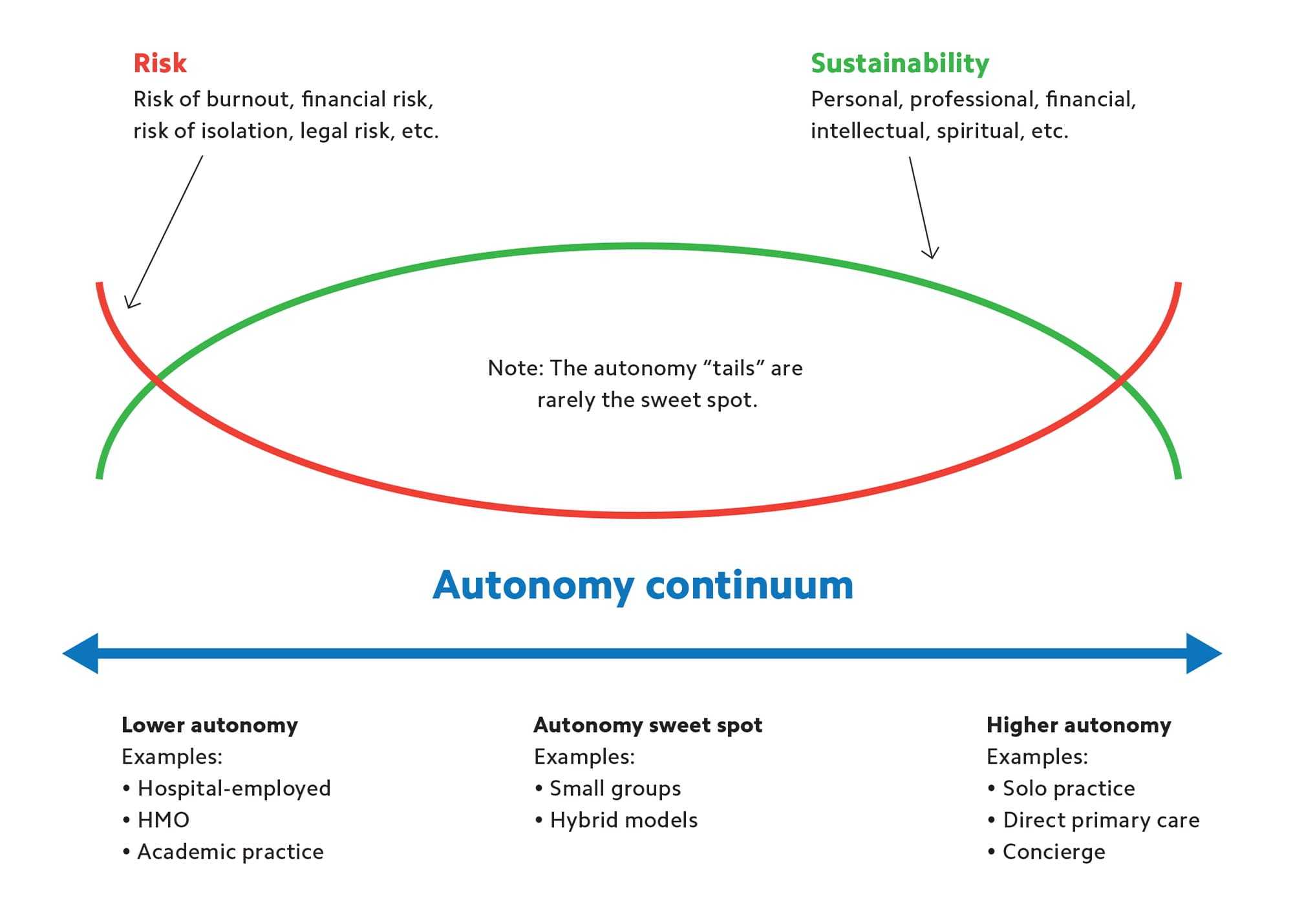
A more effective way to think about autonomy may be to envision it existing along a spectrum or continuum (see Figure 1).
At one end is the professional autonomy of a physician who owns their own solo practice. Within the operational domain, they enjoy high practice flexibility and decision-making authority, but it comes at a cost. They are responsible not only for making every practice decision but also for the outcomes of all those decisions. Within the financial domain, they take on significant financial risk and responsibility, which can weigh heavily on a practice owner. Within the clinical domain, they may feel pressure from patients to diverge from sound medical practice. With no system supports and nothing but their professional integrity to push back with, this can be lonely, emotionally taxing, and risky to one’s well-being.5
At the other end of the continuum is the professional autonomy of a physician employed by a large organization. They may have clearer boundaries around their personal time, increased financial stability, and greater freedom from management responsibilities, but they may also feel like a cog in a corporate machine with no agency to affect even the smallest aspect of their workday. Their low level of autonomy, depending on their position within the organization, may insulate them from some administrative stresses, but it can come at the cost of feeling undervalued, under-heard, and under-supported.
FIGURE 1 THE AUTONOMY CONTINUUM
FINDING THE AUTONOMY SWEET SPOT
Most physicians, regardless of their practice model, have an “autonomy sweet spot” for each domain — the point along the autonomy continuum at which they feel most balanced in terms of personal and professional well-being. This is where desired autonomy meets sustainability — where you have enough control to feel engaged and purposeful, but not so much that it leads to isolation, stress, or burnout.
To assess whether more or less autonomy might improve your professional satisfaction and quality of life, ask yourself the following questions for each domain.
1. Clinical autonomy:
- To what extent do I want control over clinical decisions (such as diagnostics, treatment plans, and referrals), and where do I welcome evidence-based or organizational guidance?
- Do I feel empowered to work at the top of my license, or am I constrained by protocols or mandatory referrals that undermine my judgment?
2. Operational autonomy:
- Do I prefer to lead and influence, or do I prefer to step back from operational decision-making? Do my preferences match my current role?
- Am I energized by participation in administrative and leadership decisions, or do I thrive when others manage logistics and I focus on care delivery?
3. Ethical autonomy:
- Have I ever been asked to act in a way that conflicts with my conscience or professional integrity? If so, how was that handled?
- Do I feel safe advocating for vulnerable patients or unpopular viewpoints, even if they challenge institutional norms or financial interests?
4. Economic autonomy:
- Do I prefer the stability of a salary or the variability and independence of managing my own financial risk and reward?
- Are my compensation and incentives transparent, aligned with my contributions, and free from pressure that might compromise clinical decisions?
5. Advocacy/policy autonomy:
- How important is it to me to shape the policies that govern my work, and do I feel that my voice is heard and valued in those conversations?
- Do the causes and priorities I care about — related to patient care or system change — align with those of my organization?
6. Interpersonal autonomy:
- How much control or influence do I want over team dynamics — hiring, roles, and conflict resolution?
- Am I able to help shape a team culture that reflects my values, or do I feel disconnected from the norms of my workplace?
Here again, the goal is to find the “autonomy sweet spot” that makes sense for you, where the decisions you enjoy making are yours to make, and the rest are managed through smart protocols and delegating tasks to others skilled in handling them. It is also where you leave work feeling like you’ve made a difference for your patients, are a part of solving practice problems with strategies that support your team, and create boundaries around your work so you still have energy for other important aspects of your life. You owe it to yourself to explore where you ideally fit on the continuum and hold this model up against the realities of your current workplace. The autonomy heat map (see Figure 2) is a helpful guide and reminder that more is not always better.
FIGURE 2 AUTONOMY HEAT MAP
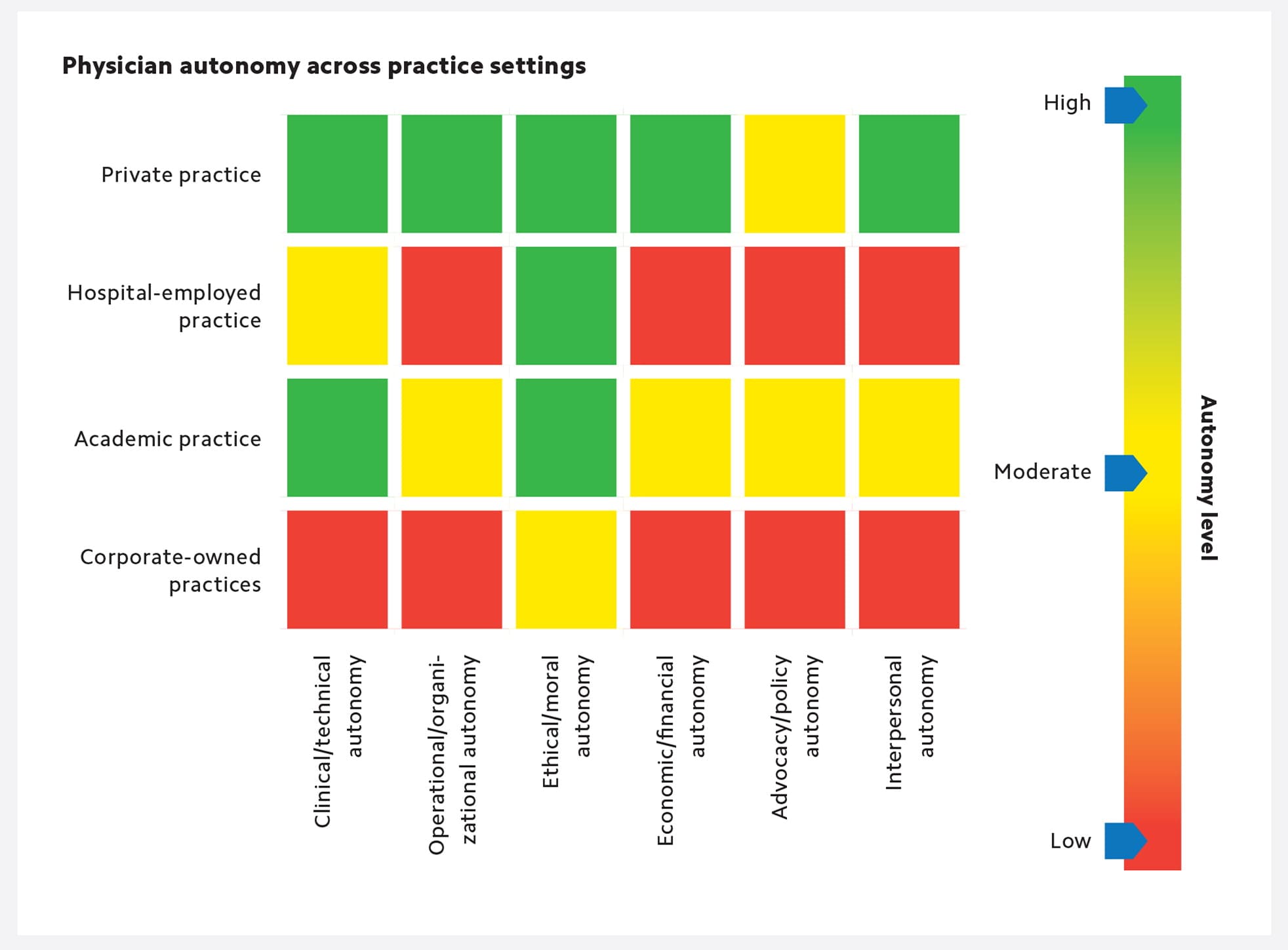
This heat map illustrates typical levels of physician autonomy across four practice settings in each of the six domains discussed in the article. Green indicates high levels of autonomy, yellow indicates moderate levels, and red indicates low levels.
AUTONOMY AND WELL-BEING: THE CHICKEN OR THE EGG?
We often think that how we feel about our autonomy affects our well-being, but conversely, our well-being can affect how we feel about our autonomy. When pushed beyond the limits of our natural resiliency and when burnout wells up inside us, we may need less autonomy. Giving ourselves a season of time to just focus on the basics of our work and see what bandwidth we have left at the end of the day may be the best way to recover our footing. With an adequate support system, these times may be brief, or we may need professional help to recover. Once we are well personally and professionally, we can regain the capacity for more autonomy and thrive. It is overly simplistic to assume that more autonomy will reliably get us out of burnout.
Your ideal level of autonomy is a dynamic tension informed by many professional and personal variables, which are in a perpetual state of flux. Because of that, a season-by-season recalibration of autonomy is healthy and desirable for most physicians. When you start to feel friction at work, consider where you might need a little more autonomy — and where you might benefit from a little less.
CAREER COACHING QUESTIONS
For physicians seriously contemplating whether they need a different work structure to achieve their desired level of autonomy, it may be helpful to engage a physician coach or mentor.6 Some additional coaching questions may help you find your “autonomy sweet spot.”
- Which autonomy domains are presently most important to you?
- Where do you feel most misaligned in your current work setting, and what is the impact of this on your personal and professional well-being?
- In which domains are you thriving, and why do you think that is?
- Where do autonomy, stability, community, and purpose rank in your professional values?
- What trade-offs are you willing to make for more or less autonomy at this stage of your career and life?
- What organizational barriers are preventing you from practicing the way you want to?
- What would your ideal practice look like if money, geography, or logistics weren’t barriers?
- What’s one small step you could take toward greater alignment today?
THE REAL GOAL
Ultimately, physicians aren’t just seeking greater autonomy; they’re seeking greater work satisfaction. The good news is that physicians can find meaning and feel a sense of ownership at any point along the autonomy continuum, depending on their individual needs. The key is to avoid the temptation to see autonomy as an all-or-nothing proposition. Then, regularly and honestly assess your current needs against your current practice situation. As articulated by Gail Gazelle, MD, a physician and leadership coach, “By developing a mindful approach, you can recover a sense of true autonomy even when much going on in healthcare is well beyond your individual control.”9 It will be time well spent and can help you find a place of dynamic sustainability, where you can thrive in practice and optimize your personal and professional satisfaction.
A STRANGE THING ABOUT AUTONOMY: THE LESS YOU SEEK IT, THE MORE IT FINDS YOU
For physicians looking to gain autonomy in the workplace, they often find it in the most unlikely places. One of the fastest ways to gain autonomy is by being a team player. When a physician collaborates effectively with others, completes work well and on time, maintains a good attitude, and constructively contributes suggestions for improvement, they are often rewarded with opportunities for greater autonomy and leadership. If you’re looking for resources on how to flex your teamwork muscles, FPM has an online archive of useful and relevant articles.7,8
SERIES OVERVIEW
- “The Paradox of Professional Autonomy” (FPM Sept/Oct 2025)
- “Better Together: What Physicians and Administrative Leaders Need From Each Other” (FPM Nov/Dec 2025)
- “Straddling Dual Roles: The Family Physician as Clinical and Administrative Leader” (FPM Jan/Feb 2026)