

For years, family physicians have been told that independent practice is disappearing. Headlines warning of health system consolidation, private equity investment, increasing administrative complexity, stagnant payment and rising operating costs have reinforced a common perception: the future of medicine belongs to large organizations, and physicians seeking stability should expect to become employees.1
While the headlines are accurate, the reality is more nuanced. Traditional small practices do face real challenges, but physician-led practice is evolving rather than vanishing. Family physicians are building successful careers in independent and physician-owned practices, direct primary care (DPC) models, hybrid arrangements, value-based care organizations and other innovative structures that offer varying degrees of autonomy and flexibility. These models do not always share a particular business design. Rather, they have common goals: allowing physicians to exert greater influence over how care is delivered, how practices are operated and how relationships are formed with patients.
The American Academy of Family Physicians (AAFP) does not advocate for a single practice model, but rather for an environment where family physicians thrive in the practice model that best aligns with their professional goals, personal values and community needs. Physicians and their patients deserve meaningful choices—whether those entail joining a health system, working in a large medical group, launching a DPC practice or participating in an independent physician network.
Evolving practice models can create new opportunities for family physicians, but they are not substitutes for addressing the underlying economics of delivering high-quality primary care. All family physicians, including those who choose to remain in traditional independent practice, should have an economically viable path to thrive. The AAFP vigorously advocates with public and private payers for better payment and fewer administrative barriers, and we will continue to do so.
Independent Practice Looks Different
For fans of 70s TV dramas, “Marcus Welby, M.D.” symbolized the trusted community physician. The title character was a dedicated, solo-practice family physician, committed to his patients inside and outside the clinic (or his house). Today’s television dramas are more likely to feature hospital-based surgeons or emergency physicians (Dr. Joel Fleischman of “Northern Exposure” and the practitioners of “Virgin River” are notable exceptions).
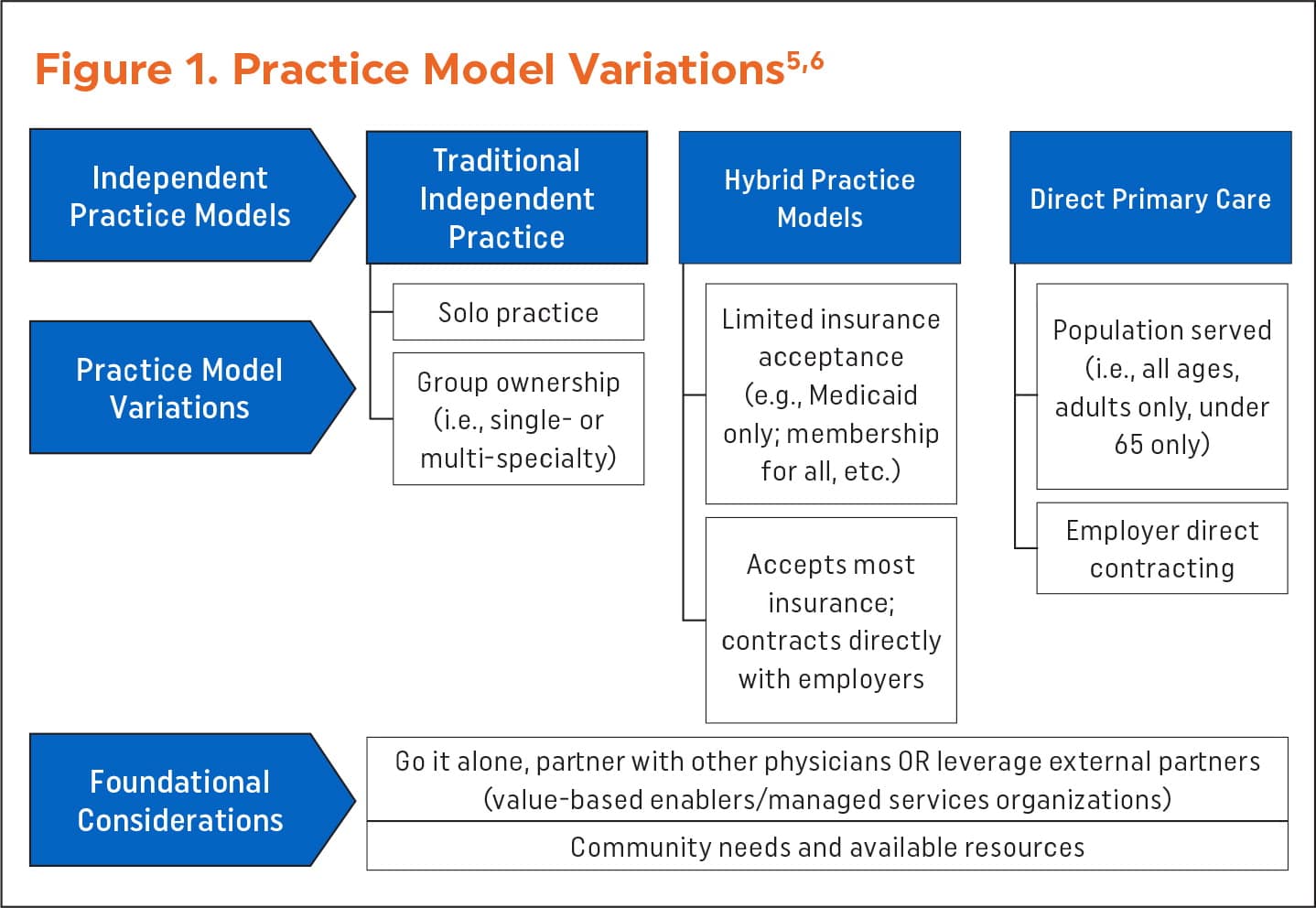
The cultural shift represented in entertainment mirrors a real-world trend away from independent community practice and toward physician employment. Despite this trend, independent practices have not disappeared. Many family physicians remain steadfast— even thriving—within traditional care models, while others are reinventing models in new and sustainable ways. Figure 1 highlights different practice models today and how they may differ from one another.
Figure 1. Practice Model Variations
Why Physicians Choose Independence
Discussions and research about the decision to choose independent practice often focuses on finances, regulation or market forces.2 However, for many family physicians, the decision is more complex and often deeply personal. Motivations leading physicians to explore and participate in independent practice are reflected in the priorities we outlined in the AAFP’s Principles to Optimize Family Physician Employment. Those priorities include professional autonomy, meaningful physician leadership, strong patient relationships and the ability to align practice decisions with what is best for patients and communities.3,4 Regardless of the practice model, physicians seek environments where they can influence how care is delivered and where values of family medicine can thrive.
“Having worked in both a hospital-owned group practice and a physician-owned group practice, I would choose the latter ten times over. Being an owner gives you far greater control over your schedule, how you want to practice and how much you want to earn versus how much free time you desire. Being in a larger physician-owned group allows us to have professional management and far fewer worries about the ‘business’ aspects than being in a solo practice.”
— Kenneth Adler, MD, practicing family physician, Arizona Community Physicians
Professional autonomy remains one of the primary motivations for pursuing independent practice. Family physicians who own or help govern their practices often cite several reasons related to autonomy for their preference for independent practice. They include making clinical decisions without competing organizational pressures, maintaining their desired scope of practice, influencing staffing/scheduling decisions and shaping the overall patient experience.3,7
Findings from the AAFP Career Benchmark Dashboard show that independent practice owners (in both traditional and DPC models) have among the highest levels of self-reported satisfaction when compared with physicians in many other practice and employment settings.8 For many physicians, independence is not simply about ownership—it is about creating a professional environment that better aligns with their vision of family medicine.
“I still loved practicing medicine, but I was spending too much of my time on EHR work and quality requirements that I did not believe improved care for my patients. I didn’t want to leave practice, so I explored direct primary care. After spending a day with DPC physicians, I knew I had to give it a try. It has been so good from the beginning, and I wish I had made the change 10 years earlier.”
— Steve Roskos, MD, owner, Red Cedar Direct Primary Care
Conclusion
The future of family medicine will not be defined by a single practice or employment model. Some physicians will achieve fulfillment in large health systems; others will find joy in independent practice. Many will land somewhere in between. What matters most is that many paths remain viable and family physicians can choose the path that best supports their patients and their professional and personal aspirations.
Independent practice today may look very different than it did a generation ago. Technological advancements, new payment arrangements, collaborative networks and evolving care models are creating opportunities that did not exist even a decade ago. At the same time, significant obstacles remain—from making technology meaningful to practices, administrative burdens and payer policies to workforce, regulatory and financial challenges. Overcoming them requires more than tech-savvy, entrepreneurial physicians. It requires a health care environment that recognizes the value of primary care and supports physician-led innovation.
The AAFP has embarked on a series of initiatives to prepare our members for an evolving technological and payment landscape. The Primary Care Innovation Network (PCIN) is the Academy’s flagship initiative to support responsible, physician-led innovation in digital health and AI. The PCIN will allow all AAFP members to engage with trusted education and peer-learning opportunities while staying current with technological advancements. Likewise, we will continue to actively and aggressively advocate for appropriately funded payment models of all types that benefit family physicians and we will keep members up to date on issues related to innovative payment and practice models.
As family physicians evaluate the practice model that best supports their personal and professional goals, the AAFP offers resources on career options in family medicine, guidance for those looking to start, sell or close a medical practice and information about the DPC model for physicians interested in membership-based approaches to care.
While these efforts are robust, the AAFP’s work extends beyond informing members of technological advancements and legislative and regulatory advocacy and education. Through engagement with health plans, employers, technology vendors, accreditation organizations and other private-sector stakeholders, we are always striving to improve the conditions in which family physicians practice every day. The goal is not to preserve a particular vision or perspective of independent practice. Rather, it is to ensure that family physicians continue to have meaningful choices and the support they need to succeed, wherever and however they choose to practice.