

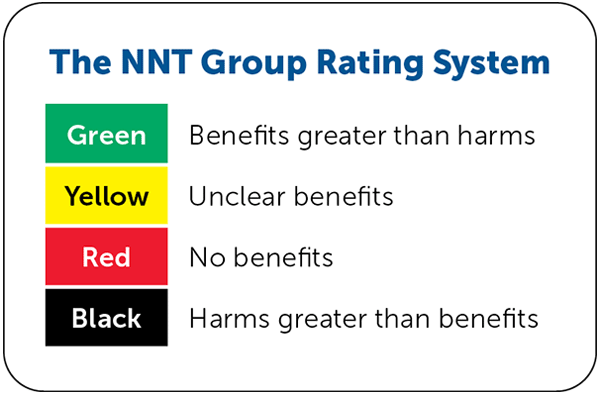
DETAILS FOR THIS REVIEW
Study Population: 107,698 adults who make decisions for themselves, for a child, or as a proxy
Efficacy End Points: Congruence between informed values and choice, knowledge, accurate risk perceptions, and participation in decision-making
Harm End Points: Decision regret
THE NUMBERS
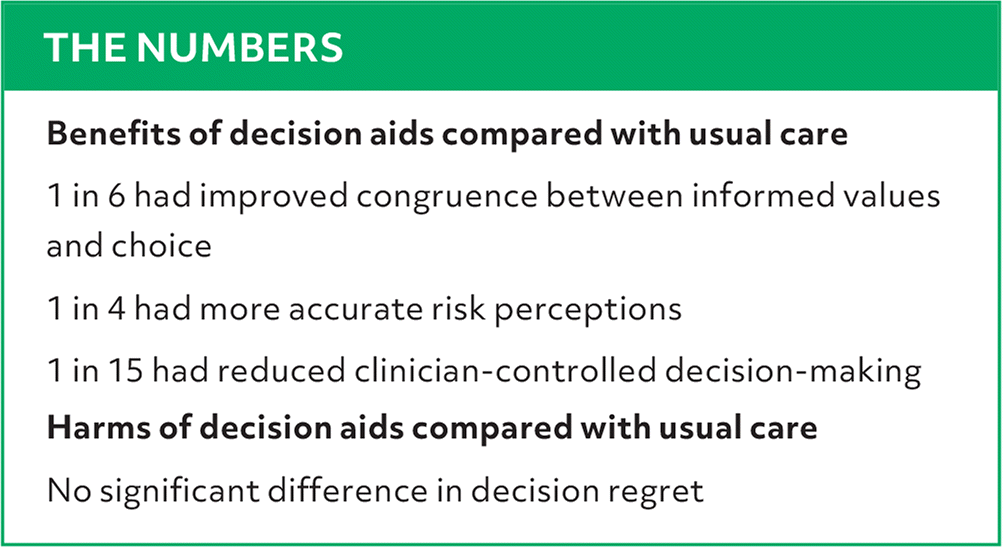
| Benefits of decision aids compared with usual care |
| 1 in 6 had improved congruence between informed values and choice |
| 1 in 4 had more accurate risk perceptions |
| 1 in 15 had reduced clinician-controlled decision-making |
| Harms of decision aids compared with usual care |
| No significant difference in decision regret |
Narrative: Medical advances often improve life expectancy but have also complicated medical decision-making due to increased screening and treatment options. The U.S. Preventive Services Task Force recommends shared decision-making for eight preventive services (e.g., prostate cancer screening).1 Major payors also have weighed in. The Centers for Medicare & Medicaid Services mandate the use of patient decision aids during discussions of several preventive services (e.g., lung cancer screening).2 Tailoring patient care to individual values plays an essential role in clinical practice, and decision aids can assist in navigating communication between physicians and patients.
A 2024 Cochrane review evaluated decision aids for adults who make decisions for themselves, for a child, or as a proxy for a significant other.3 This review included 209 randomized controlled trials (RCTs) with 107,698 participants in 19 countries (106 studies in the United States). A total of 71 different decisions were covered in this review, most commonly decisions regarding cardiovascular treatment (22 studies), cancer screening (colorectal, 17 studies; prostate, 15 studies; and breast, 12 studies), and cancer treatment (breast, 15 studies; prostate, 11 studies). The comparison was usual care, defined as general patient information, risk assessment, guideline summaries, placebo intervention, or no intervention.3
The primary outcomes in the review included congruence between a patient's informed values and the patient's choice (most often determined using the multidimensional measure of informed choice, which assesses a patient's knowledge, attitude, and uptake4), knowledge (scale from 0 [no knowledge] to 100 [perfect knowledge]), accurate risk perceptions, and participation in decision-making. All outcomes were assessed immediately after exposure to the decision aids. For an adverse event, decision regret was measured weeks to months after decision-making using the five-item Decision Regret Scale from 0 (no regret) to 100 (high regret).5
The review showed moderate-certainty evidence that compared with usual care, decision aids improved congruence between informed values and choice (risk ratio [RR] = 1.75; 95% CI, 1.44 to 2.13; absolute risk difference [ARD] = 18.6%; number needed to treat [NNT] = 6; RCTs = 21; n = 9,377). High-certainty evidence showed that compared with usual care, decision aids increased knowledge scores (11.9% higher mean knowledge score; 95% CI, 10.6 to 13.9; RCTs = 107; n = 25,492), increased accurate risk perceptions (RR = 1.94; 95% CI, 1.61 to 2.34; ARD = 25.1%; NNT = 4; RCTs = 25; n = 7,796), and decreased the rate of clinician-controlled decision-making (RR = 0.72; 95% CI, 0.59 to 0.88; ARD = 6.9%; NNT = 15; RCTs = 21; n = 4,348). High-certainty evidence demonstrated that use of decision aids did not increase decision regret compared with usual care.3
Read the full article
Get immediate access, anytime, anywhere.
Choose a single article, issue, or full-access subscription.
Earn up to 14 CME credits per issue.
