

CLINICAL QUESTION
How accurate is a novel multicancer early detection test in a large population of asymptomatic adults with no history of cancer?
BOTTOM LINE
The number needed to screen to detect a stage 1 or 2 cancer was 1,000 for the SPOT-MAS test in an average risk population. If its cost is similar to that of the Galleri test ($950), it would cost approximately $1 million to detect a single stage 1 or 2 cancer (not including the cost and potential harms of diagnostic evaluations). Large scale trials that are evaluating the impact on mortality and other important clinical outcomes are underway. Until then, these tests should not be recommended to patients. (Level of Evidence = 2b)
SYNOPSIS
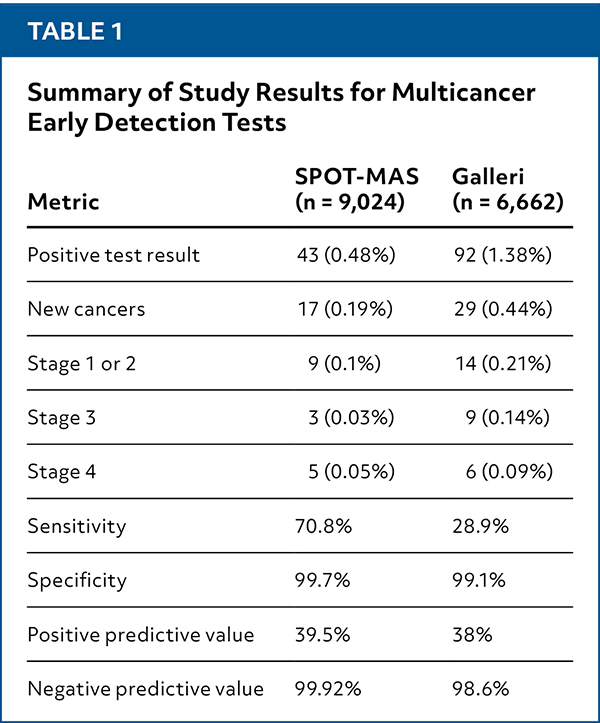
Multicancer early detection tests are being promoted as a “liquid biopsy” to simultaneously screen for dozens of different cancers. They combine detection of circulating fragments of tumor DNA with sophisticated artificial intelligence models. This study evaluated the SPOT-MAS test from a Singaporean company in a population of 9,057 asymptomatic Vietnamese adults 40 years and older without a history of cancer or known symptoms of cancer. The median age was 50 years and 55% were women. Positive test results were followed by an extensive diagnostic evaluation, whereas patients who tested negative were followed up for 1 year to identify subsequent cancer diagnoses unrelated to the multicancer early detection test during that period. This is similar to a study of the Galleri test published in 2023, although in that study patients were at higher risk, including 24% with a previous history of successfully treated cancer. The results of both studies are summarized in Table 1.
TABLE 1. Summary of Study Results for Multicancer Early Detection Tests
| Metric | SPOT-MAS (n = 9,024) | Galleri (n = 6,662) |
|---|---|---|
| Positive test result | 43 (0.48%) | 92 (1.38%) |
| New cancers | 17 (0.19%) | 29 (0.44%) |
| Stage 1 or 2 | 9 (0.1%) | 14 (0.21%) |
| Stage 3 | 3 (0.03%) | 9 (0.14%) |
| Stage 4 | 5 (0.05%) | 6 (0.09%) |
| Sensitivity | 70.8% | 28.9% |
| Specificity | 99.7% | 99.1% |
| Positive predictive value | 39.5% | 38% |
| Negative predictive value | 99.92% | 98.6% |
The tests were successfully designed to avoid a large number of false positive results, with specificities higher than 99% for both tests. Approximately one-third of patients in both studies with a positive test result had a cancer diagnosis confirmed. About one-half of patients with cancer in both studies had stage 1 or 2 cancer that was likely to be amenable to treatment; in the Galleri study, 7 of 14 stage 1 or 2 cancers were follicular lymphomas. Of the cancers detected by the SPOT-MAS test, 11 of 17 were cancers for which screening was recommended by the US Preventive Services Task Force. The sensitivity is probably overestimated because the patients with a negative SPOT-MAS test result did not undergo a systematic evaluation for cancer, with the researchers relying on self-report.
Read the full article
Get immediate access, anytime, anywhere.
Choose a single article, issue, or full-access subscription.
Earn up to 14 CME credits per issue.
