

Diagnosis and Management of Sodium Disorders: Hyponatremia and Hypernatremia

Nathaniel E. Miller, MD
David Rushlow, MD, MBOE
Stephen K. Stacey, DO

American Family Physician. 2023;108(5):476-486.

Author disclosure: No relevant financial relationships.

Hyponatremia and hypernatremia are electrolyte disorders that can be associated with poor outcomes. Hyponatremia is considered mild when the sodium concentration is 130 to 134 mEq per L, moderate when 125 to 129 mEq per L, and severe when less than 125 mEq per L. Mild symptoms include nausea, vomiting, weakness, headache, and mild neurocognitive deficits. Severe symptoms of hyponatremia include delirium, confusion, impaired consciousness, ataxia, seizures, and, rarely, brain herniation and death. Patients with a sodium concentration of less than 125 mEq per L and severe symptoms require emergency infusions with 3% hypertonic saline. Using calculators to guide fluid replacement helps avoid overly rapid correction of sodium concentration, which can cause osmotic demyelination syndrome. Physicians should identify the cause of a patient's hyponatremia, if possible; however, treatment should not be delayed while a diagnosis is pursued. Common causes include certain medications, excessive alcohol consumption, very low-salt diets, and excessive free water intake during exercise. Management to correct sodium concentration is based on whether the patient is hypovolemic, euvolemic, or hypervolemic. Hypovolemic hyponatremia is treated with normal saline infusions. Treating euvolemic hyponatremia includes restricting free water consumption or using salt tablets or intravenous vaptans. Hypervolemic hyponatremia is treated primarily by managing the underlying cause (e.g., heart failure, cirrhosis) and free water restriction. Hypernatremia is less common than hyponatremia. Mild hypernatremia is often caused by dehydration resulting from an impaired thirst mechanism or lack of access to water; however, other causes, such as diabetes insipidus, are possible. Treatment starts with addressing the underlying etiology and correcting the fluid deficit. When sodium is severely elevated, patients are symptomatic, or intravenous fluids are required, hypotonic fluid replacement is necessary.

Sodium abnormalities are common electrolyte disorders associated with significant morbidity and mortality. Abnormalities include hyponatremia (serum sodium concentration less than 135 mEq per L) and the less common hypernatremia (greater than 145 Eq per L). Understanding the pathophysiology of these conditions can be helpful in diagnosis and treatment.

SORT: KEY RECOMMENDATIONS FOR PRACTICE
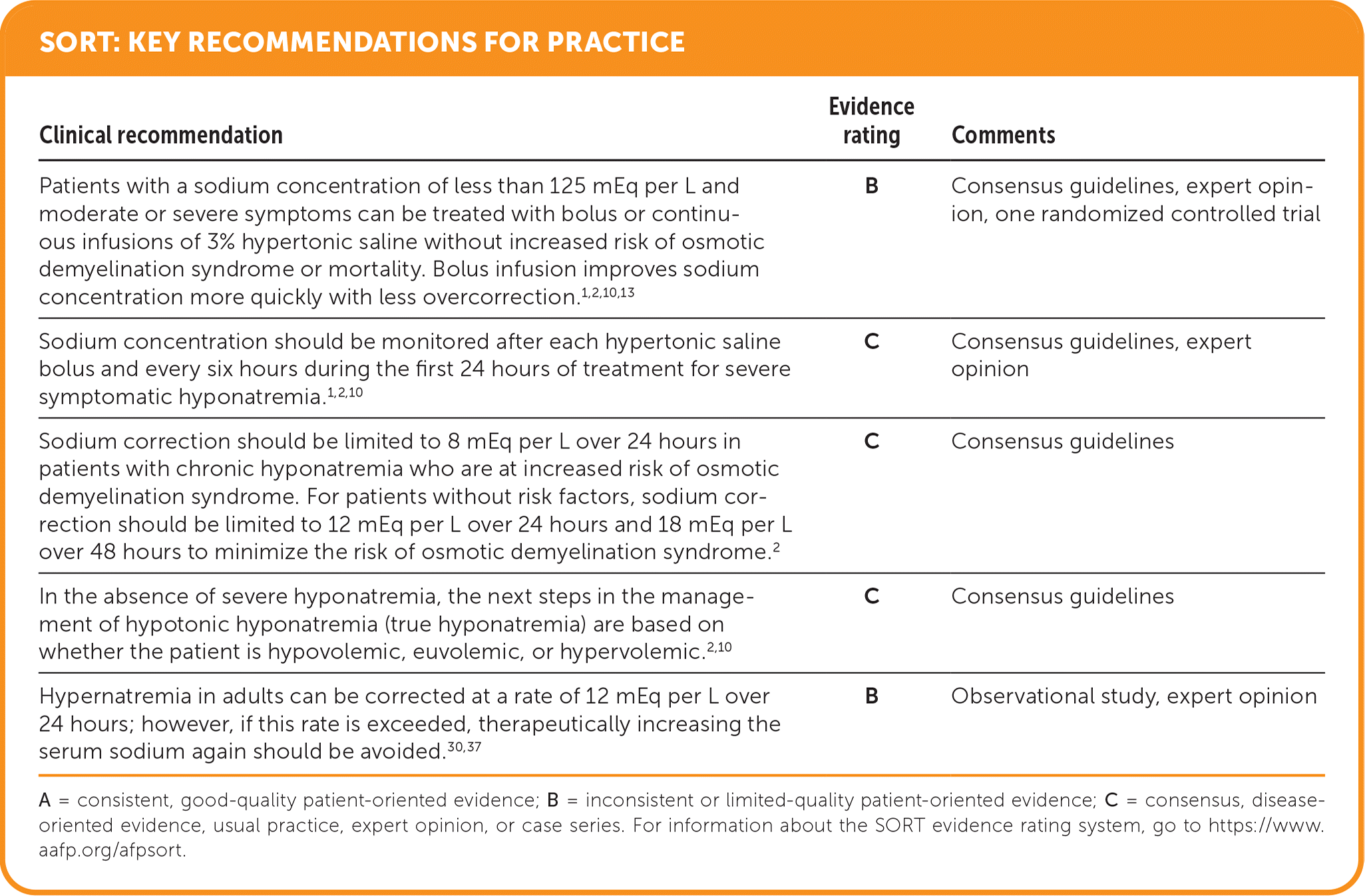
A = consistent, good-quality patient-oriented evidence; B = inconsistent or limited-quality patient-oriented evidence; C = consensus, disease-oriented evidence, usual practice, expert opinion, or case series. For information about the SORT evidence rating system, go to https://www.aafp.org/afpsort.

NATHANIEL E. MILLER, MD, is a family medicine residency core faculty member and an assistant professor in the Department of Family Medicine at Mayo Clinic, Rochester, Minn.

DAVID RUSHLOW, MD, MBOE, is an assistant professor in and chair of the Midwest Department of Family Medicine at Mayo Clinic.

STEPHEN K. STACEY, DO, is the director of osteopathic education and an assistant professor of family medicine at the La Crosse (Wis.)-Mayo Family Medicine Residency, Mayo Clinic Health System.

Address correspondence to Stephen K. Stacey, DO, Mayo Clinic, 815 10th St. S, La Crosse, WI 54601 (stacey.stephen@mayo.edu). Reprints are not available from the authors.

Author disclosure: No relevant financial relationships.

  1. 1.Seay NW, Lehrich RW, Greenberg A. Diagnosis and management of disorders of body tonicity—hyponatremia and hypernatremia: core curriculum 2020. Am J Kidney Dis. 2020;75(2):272-286.
  2. 2.Verbalis JG, Goldsmith SR, Greenberg A, et al. Diagnosis, evaluation, and treatment of hyponatremia: expert panel recommendations. Am J Med. 2013;126(10 suppl 1):S1-S42.
  3. 3.Hawkins RC. Age and gender as risk factors for hyponatremia and hypernatremia. Clin Chim Acta. 2003;337(1–2):169-172.
  4. 4.Selmer C, Madsen JC, Torp-Pedersen C, et al. Hyponatremia, all-cause mortality, and risk of cancer diagnoses in the primary care setting: a large population study. Eur J Intern Med. 2016;36:36-43.
  5. 5.Gankam-Kengne F, Ayers C, Khera A, et al. Mild hyponatremia is associated with an increased risk of death in an ambulatory setting. Kidney Int. 2013;83(4):700-706.
  6. 6.Corona G, Norello D, Parenti G, et al. Hyponatremia, falls and bone fractures: a systematic review and meta-analysis. Clin Endocrinol (Oxf). 2018;89(4):505-513.
  7. 7.Cumming K, Hoyle GE, Hutchison JD, et al. Prevalence, incidence and etiology of hyponatremia in elderly patients with fragility fractures. PLoS One. 2014;9(2):e88272.
  8. 8.Verbalis JG, Barsony J, Sugimura Y, et al. Hyponatremia-induced osteoporosis. J Bone Miner Res. 2010;25(3):554-563.
  9. 9.Corona G, Giuliani C, Parenti G, et al. Moderate hyponatremia is associated with increased risk of mortality: evidence from a meta-analysis. PLoS One. 2013;8(12):e80451.
  10. 10.Spasovski G, Vanholder R, Allolio B, et al.; Hyponatraemia Guideline Development Group. Clinical practice guideline on diagnosis and treatment of hyponatraemia [published correction appears in Nephrol Dial Transplant. 2014; 40(6): 924]. Nephrol Dial Transplant. 2014;29(suppl 2):i1-i39.
  11. 11.Braun MM, Barstow CH, Pyzocha NJ. Diagnosis and management of sodium disorders: hyponatremia and hypernatremia. Am Fam Physician. 2015;91(5):299-307.
  12. 12.Bennett BL, Hew-Butler T, Rosner MH, et al. Wilderness medical society clinical practice guidelines for the management of exercise-associated hyponatremia: 2019 update. Wilderness Environ Med. 2020;31(1):50-62.
  13. 13.Baek SH, Jo YH, Ahn S, et al. Risk of overcorrection in rapid intermittent bolus vs. slow continuous infusion therapies of hypertonic saline for patients with symptomatic hyponatremia: the SALSA randomized clinical trial. JAMA Intern Med. 2021;181(1):81-92.
  14. 14.Singh TD, Fugate JE, Rabinstein AA. Central pontine and extrapontine myelinolysis: a systematic review. Eur J Neurol. 2014;21(12):1443-1450.
  15. 15.Fenske W, Maier SKG, Blechschmidt A, et al. Utility and limitations of the traditional diagnostic approach to hyponatremia [published correction appears in Am J Med. 2011; 124(10): e9]. Am J Med. 2010;123(7):652-657.
  16. 16.Chung HM, Kluge R, Schrier RW, et al. Clinical assessment of extracellular fluid volume in hyponatremia. Am J Med. 1987;83(5):905-908.
  17. 17.McGee S, Abernethy WB, Simel DL. The rational clinical examination. Is this patient hypovolemic?. JAMA. 1999;281(11):1022-1029.
  18. 18.Bassi V, Fattoruso O. The role of fractional excretion of uric acid in the differential diagnosis of hypotonic hyponatraemia in patients with diuretic therapy. Cureus. 2020;12(4):e7762.
  19. 19.Chatterjee T, Koratala A. Point of care cardiac ultrasound in the management of hyponatremia. CEN Case Rep. 2022;11(1):6-10.
  20. 20.Samant S, Koratala A. Point-of-care Doppler ultrasound in the management of hyponatremia: another string to nephrologists' bow. Clin Case Rep. 2021;9(8):e04687.
  21. 21.Nagler EV, Haller MC, Van Biesen W, et al. Interventions for chronic non-hypovolaemic hypotonic hyponatraemia. Cochrane Database Syst Rev. 2018(6):CD010965.
  22. 22.Ganguli A, Mascarenhas RC, Jamshed N, et al. Hyponatremia: incidence, risk factors, and consequences in the elderly in a home-based primary care program. Clin Nephrol. 2015;84(2):75-85.
  23. 23.Garrahy A, Galloway I, Hannon AM, et al. Fluid restriction therapy for chronic SIAD. J Clin Endocrinol Metab. 2020;105(12):dgaa619.
  24. 24.Krisanapan P, Vongsanim S, Pin-On P, et al. Efficacy of furosemide, oral sodium chloride, and fluid restriction for treatment of syndrome of inappropriate antidiuresis (SIAD): an open-label randomized controlled study (The EFFUSE-FLUID Trial). Am J Kidney Dis. 2020;76(2):203-212.
  25. 25.Refardt J, Imber C, Sailer CO, et al. A randomized trial of empagliflozin to increase plasma sodium levels in patients with the syndrome of inappropriate antidiuresis. J Am Soc Nephrol. 2020;31(3):615-624.
  26. 26.Verbalis JG, Adler S, Schrier RW, et al.; SALT Investigators. Efficacy and safety of oral tolvaptan therapy in patients with the syndrome of inappropriate antidiuretic hormone secretion. Eur J Endocrinol. 2011;164(5):725-732.
  27. 27.Alshayeb HM, Showkat A, Babar F, et al. Severe hypernatremia correction rate and mortality in hospitalized patients. Am J Med Sci. 2011;341(5):356-360.
  28. 28.Imai N, Shibagaki Y. The prevalence of dysnatremia in the elderly patients without CKD. Am J Emerg Med. 2019;37(3):499-501.
  29. 29.Bischoff AR, Dornelles AD, Carvalho CG. Treatment of hypernatremia in breastfeeding neonates. Biomed Hub. 2017;2(1):1-10.
  30. 30.Chauhan K, Pattharanitima P, Patel N, et al. Rate of correction of hypernatremia and health outcomes in critically ill patients. Clin J Am Soc Nephrol. 2019;14(5):656-663.
  31. 31.Lindner G, Kneidinger N, Holzinger U, et al. Tonicity balance in patients with hypernatremia acquired in the intensive care unit. Am J Kidney Dis. 2009;54(4):674-679.
  32. 32.Metheny NA, Krieger MM. Salt toxicity: a systematic review and case reports. J Emerg Nurs. 2020;46(4):428-439.
  33. 33.Priya G, Kalra S, Dasgupta A, et al. Diabetes insipidus: a pragmatic approach to management. Cureus. 2021;13(1):e12498.
  34. 34.Grim CCA, Termorshuizen F, Bosman RJ, et al. Association between an increase in serum sodium and in-hospital mortality in critically ill patients. Crit Care Med. 2021;49(12):2070-2079.
  35. 35.Gubbi S, Hannah-Shmouni F, Koch CA, et al. Diagnostic testing for diabetes insipidus. Updated November 28, 2022. Accessed October 16, 2023. https://www.ncbi.nlm.nih.gov/books/NBK537591/?report=reader
  36. 36.Olsen MH, Møller M, Romano S, et al. Association between ICU-acquired hypernatremia and in-hospital mortality: data from the Medical Information Mart for Intensive Care III and the electronic ICU collaborative research database. Crit Care Explor. 2020;2(12):e0304.
  37. 37.Sterns RH. Evidence for managing hypernatremia: is it just hyponatremia in reverse? Clin J Am Soc Nephrol. 2019;14(5):645-647.

Copyright © 2026 by the American Academy of Family Physicians.

This content is owned by the AAFP. A person viewing it online may make one printout of the material and may use that printout only for his or her personal, non-commercial reference. This material may not otherwise be downloaded, copied, printed, stored, transmitted or reproduced in any medium, whether now known or later invented, except as authorized in writing by the AAFP. See permissions for copyright questions and/or permission requests.
