

Natasha Pyzocha, DO
Amanda Cuda, MD, MPH

American Family Physician. 2023;108(5):487-493.

Author disclosure: No relevant financial relationships.

Parasites are a source of significant illness worldwide. In the United States, giardiasis, cryptosporidiosis, cyclosporiasis, and trichinellosis are nationally notifiable conditions. Pinworm, the most common intestinal parasite in children, is not a locally notifiable infection. Intestinal parasites have a wide range of acute and chronic symptoms but should be suspected in those who present with diarrhea lasting more than seven days. Infections most often occur through a fecal-oral route. Symptoms tend to be worse for children, older adults, or immunocompromised individuals. To diagnose Giardia infection, stool microscopy with direct fluorescent antibody testing is recommended; metronidazole, nitazoxanide, or tinidazole is used for treatment. Microscopy with immunofluorescence is sensitive and specific for diagnosing Cryptosporidium infection. This infection is often self-resolving, but treatment with nitazoxanide is effective for symptoms lasting more than two weeks. Microscopy or polymerase chain reaction assays are recommended to diagnose Cyclospora infections, and sulfamethoxazole/trimethoprim may be used to treat patients with persistent diarrhea. Trichinella infection is diagnosed by serum antibody testing, and severe symptoms are treated with albendazole in patients older than one year. Pinworm infections are diagnosed visually or by a tape test or paddle test; albendazole and pyrantel pamoate are both effective treatments.

Intestinal parasites found in the United States include one-celled protozoa and soil-transmitted helminths. Examples of nationally notifiable one-celled protozoa infections include giardiasis, cryptosporidiosis, and cyclosporiasis.1,2 Soil-transmitted helminths are the most common intestinal parasites worldwide, causing an estimated 2.6 billion infections per year.3 The most common soil-transmitted helminth in the United States is Enterobius vermicularis (pinworm).4 Trichinella (roundworm) is another soil-transmitted helminth and is nationally notifiable in the United States.1,2 [corrected] Parasites generally spread through a fecal-oral route. Good hygiene, handwashing, and proper handling of food and water are key to preventing intestinal parasitic infections. Additional specific guidance for prevention is listed in Table 1.5–8

SORT: KEY RECOMMENDATIONS FOR PRACTICE
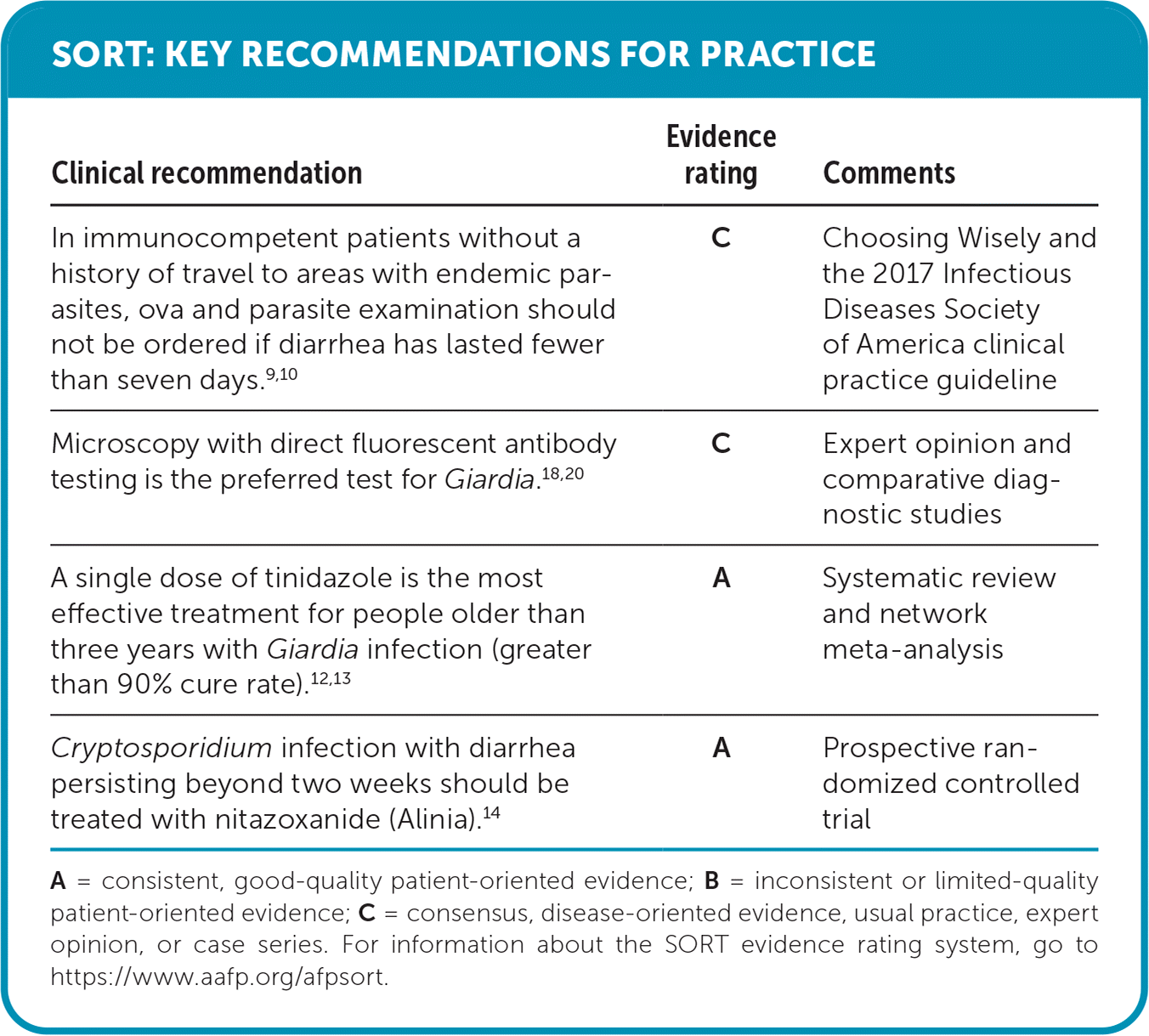
A = consistent, good-quality patient-oriented evidence; B = inconsistent or limited-quality patient-oriented evidence; C = consensus, disease-oriented evidence, usual practice, expert opinion, or case series. For information about the SORT evidence rating system, go to https://www.aafp.org/afpsort.

NATASHA PYZOCHA, DO, is an adjunct assistant professor in the Department of Family Medicine at the Uniformed Services University of the Health Sciences, Bethesda, Md.

AMANDA CUDA, MD, MPH, FAAFP, is an assistant professor in the Department of Family Medicine at the Uniformed Services University of the Health Sciences.

Address correspondence to Natasha Pyzocha, DO, 701 5th Ave., Suite 2300, Seattle, WA 98164 (natashapyzocha@gmail.com). Reprints are not available from the authors.

Author disclosure: No relevant financial relationships.

  1. 1.Cantey PT, Montgomery SP, Straily A. Neglected parasitic infections: what family physicians need to know—a CDC update. Am Fam Physician. 2021;104(3):277-287.
  2. 2.Centers for Disease Control and Prevention. Parasites, public health departments. Accessed February 27, 2023. https://www.cdc.gov/parasites/
  3. 3.World Health Organization. Soil-transmitted helminth infections. January 18, 2023. Accessed October 3, 2023. https://www.who.int/news-room/fact-sheets/detail/soil-transmitted-helminth-infections
  4. 4.Healthgrades. Intestinal parasites. Updated December 4, 2020. Accessed March 3, 2023. https://www.healthgrades.com/right-care/infections-and-contagious-diseases/intestinal-parasites
  5. 5.Huang DB, White AC. An updated review on Cryptosporidium and Giardia. Gastroenterol Clin North Am. 2006;35(2):291-314.
  6. 6.Giangaspero A, Gasser RB. Human cyclosporiasis. Lancet Infect Dis. 2019;19(7):e226-e236.
  7. 7.Noeckler K, Pozio E, van der Giessen J, et al. International Commission on trichinellosis. Food Waterborne Parasitol. 2019;14:e00041.
  8. 8.Centers for Disease Control and Prevention. Parasites—enterobiasis (also known as pinworm infection). Accessed March 4, 2023. https://www.cdc.gov/parasites/pinworm/index.html
  9. 9.Shane AL, Mody RK, Crump JA, et al. 2017 Infectious Diseases Society of America clinical practice guidelines for the diagnosis and management of infectious diarrhea. Clin Infect Dis. 2017;65(12):e45-e80.
  10. 10.American Society for Clinical Laboratory Science. ASCLS publishes Choosing Wisely recommendations. Accessed October 2, 2023. https://ascls.org/ascls-publishes-choosing-wisely-recommendations/
  11. 11.Ortiz JJ, Ayoub A, Gargala G, et al. Randomized clinical study of nitazoxanide compared to metronidazole in the treatment of symptomatic giardiasis in children from Northern Peru. Aliment Pharmacol Ther. 2001;15(9):1409-1415.
  12. 12.Zaat JO, Mank TG, Assendelft WJ. A systematic review on the treatment of giardiasis. Trop Med Int Health. 1997;2(1):63-82.
  13. 13.Ordóñez-Mena JM, McCarthy ND, Fanshawe TR. Comparative efficacy of drugs for treating giardiasis: a systematic update of the literature and network meta-analysis of randomized clinical trials. J Antimicrob Chemother. 2018;73(3):596-606.
  14. 14.Rossignol JF, Ayoub A, Ayers MS. Treatment of diarrhea caused by Cryptosporidium parvum. J Infect Dis. 2001;184(1):103-106.
  15. 15.Hoge CW, Shlim DR, Ghimire M, et al. Placebo-controlled trial of co-trimoxazole for Cyclospora infections among travellers and foreign residents in Nepal [published correction appears in Lancet. 1995;345(8956):1060]. Lancet. 1995;345(8951):691-693.
  16. 16.Wendt S, Trawinski H, Schubert S, et al. The diagnosis and treatment of pinworm infection. Dtsch Arztebl Int. 2019;116(13):213-219.
  17. 17.Centers for Disease Control and Prevention. Giardiasis NNDSS summary report for 2019. Accessed March 3, 2023. https://www.cdc.gov/healthywater/surveillance/giardiasis/giardiasis-2019.html
  18. 18.Centers for Disease Control and Prevention. Parasites— Giardia. Accessed March 3, 2023. https://www.cdc.gov/parasites/giardia/medical-professionals.html
  19. 19.Cantey PT, Roy S, Lee B, et al. Study of nonoutbreak giardiasis:novel findings and implications for research. Am J Med. 2011;124(12):1175.e1-1175.e8.
  20. 20.Aziz H, Beck CE, Lux MF, et al. A comparison study of different methods used in the detection of Giardia lamblia. Clin Lab Sci. 2001;14(3):150-154.
  21. 21.Gardner TB, Hill DR. Treatment of giardiasis. Clin Microbiol Rev. 2001;14(1):114-128.
  22. 22.Farthing MJ. Giardiasis. Gastroenterol Clin North Am. 1996;25(3):493-515.
  23. 23.Painter JE, Hlavsa MC, Collier SA, et al.; Centers for Disease Control and Prevention. Cryptosporidiosis surveillance—United States, 2011–2012. MMWR Suppl. 2015;64(3):1-14.
  24. 24.Centers for Disease Control and Prevention. Parasites—Cryptosporidium (also known as “Crypto”). Accessed February 27, 2023. https://www.cdc.gov/parasites/crypto/general.html
  25. 25.Adeyemo FE, Singh G, Reddy P, et al. Methods for the detection of Cryptosporidium and Giardia. Acta Trop. 2018;184:15-28.
  26. 26.Kansouzidou A, Charitidou C, Varnis T, et al. Cyclospora cayetanensis in a patient with travelers' diarrhea. J Travel Med. 2004;11(1):61-63.
  27. 27.Hadjilouka A, Tsaltas D. Cyclospora cayetanensis—major outbreaks from ready to eat fresh fruits and vegetables. Foods. 2020;9(11):1703.
  28. 28.Casillas SM, Hall RL, Herwaldt BL. Cyclosporiasis surveillance—United States, 2011–2015. MMWR Surveill Summ. 2019;68(3):1-16.
  29. 29.Centers for Disease Control and Prevention. Outbreak of Cyclospora infections linked to bagged salad mix. Updated September 24, 2020. Accessed March 3, 2023. https://www.cdc.gov/parasites/cyclosporiasis/outbreaks/2020/index.html
  30. 30.Bateman AC, Kim YJ, Guaracao AI, et al. Performance and impact of the BioFire FilmArray Gastrointestinal Panel on a large Cyclospora outbreak in Wisconsin, 2018. J Clin Microbiol. 2020;58(2):e01415-e01419.
  31. 31.Buss SN, Leber A, Chapin K, et al. Multicenter evaluation of the Bio-Fire FilmArray gastrointestinal panel for etiologic diagnosis of infectious gastroenteritis. J Clin Microbiol. 2015;53(3):915-925.
  32. 32.Centers for Disease Control and Prevention. Treatment for cyclosporiasis. Accessed March 3, 2023. https://www.cdc.gov/parasites/cyclosporiasis/health_professionals/tx.html
  33. 33.Wilson NO, Hall RL, Montgomery SP, et al. Trichinellosis surveillance—United States, 2008–2012. MMWR Surveill Summ. 2015;64(1):1-8.
  34. 34.Centers for Disease Control and Prevention. Parasites—parasitic infections in the United States. Accessed February 27, 2023. https://www.cdc.gov/parasites/npi/index.html
  35. 35.Hsiao Y-C, Wang J-H, Chu C-H, et al. Is pinworm infection still a public health concern among children in resource-rich regions? Trends in pinworm infection prevalence and associated factors among children in Hualien County, Taiwan: a retrospective cross-sectional study. BMC Public Health. 2022;22(1):2200.
  36. 36.Kucik CJ, Martin GL, Sortor BV. Common intestinal parasites. Am Fam Physician. 2004;69(5):1161-1168.

Copyright © 2026 by the American Academy of Family Physicians.

This content is owned by the AAFP. A person viewing it online may make one printout of the material and may use that printout only for his or her personal, non-commercial reference. This material may not otherwise be downloaded, copied, printed, stored, transmitted or reproduced in any medium, whether now known or later invented, except as authorized in writing by the AAFP. See permissions for copyright questions and/or permission requests.
