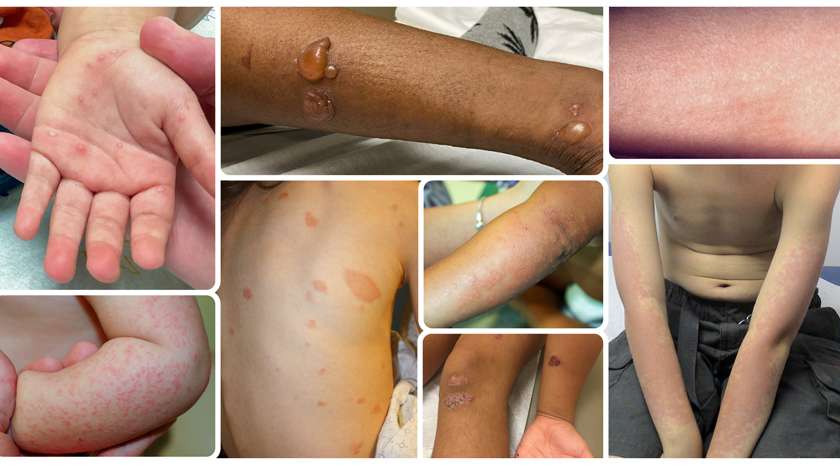

Childhood skin rashes are frequently evaluated by primary care physicians and are often diagnosed by recognition of distinguishing features. Atopic dermatitis affects 15% to 20% of children, usually with onset before the age of 2 years. Treatment is based on severity and begins with emollients and topical steroids. Erythema infectiosum presents with the slapped cheek rash that progresses to reticular lesions on the trunk and extremities. Hand-foot-and-mouth disease presents with painful oral ulcers and vesicular eruption of the hands, feet, buttocks, and genitals. Nonbullous impetigo is characterized by lesions with honey-colored crusting, whereas bullous impetigo presents with flaccid bullae; both are treated with antibiotics. Molluscum contagiosum is characterized by dome-shaped umbilicated papules that spontaneously resolve over months to years without intervention but may be treated with cryotherapy, curettage, or topical agents. Pityriasis rosea usually presents with a large herald patch on the trunk followed by the eruption of numerous smaller lesions aligned with Langer lines. Scarlet fever is a group A beta-hemolytic streptococcal infection with a sandpaper-like rash and should be treated with antibiotics to prevent rheumatic fever. Tinea capitis requires treatment with systemic antifungals, whereas tinea corporis is usually treatable with topical agents.
Skin concerns are common in children and adolescents. More than 70% of children with skin concerns—and 90% of those younger than 4 years—are evaluated by nondermatologists.1,2 Many childhood skin rashes have overlapping features but can often be differentiated clinically by their distinguishing features (Table 1).3–25 This article reviews infectious and non-infectious rashes that occur in children ages 1 to 12 years and are commonly encountered in primary care.
Return-to-school protocols for schools and childcare settings can help reduce transmission (Table 24–14,16–24). Several previously common childhood infectious rashes, such as measles, have become rare due to vaccines (Table 3).26–30 However, they may become more common as vaccination rates fall below herd immunity thresholds.31
SORT: KEY RECOMMENDATIONS FOR PRACTICE
| Clinical recommendation | Evidence rating | Comments |
|---|---|---|
| Topical steroids should be initiated in children with atopic dermatitis that cannot be controlled with moisturizers alone.37,38 | A | High certainty evidence from meta-analyses of randomized controlled trials |
| Hand-foot-and-mouth disease should be treated with supportive care. Topical analgesics should be avoided in the mouth due to lack of benefit and theoretical risk of toxicity.45 | C | Consensus opinion; single randomized controlled trial |
| Topical antibiotics are effective for limited impetigo (less than 2% of body surface area involved).9,25 | A | Multiple trials comparing topical and oral antibiotics for limited cases, and expert opinion |
| Oral antibiotics are indicated for impetigo when greater than 2% of body surface area is involved, there are complications, there is poor response to topical antibiotics, or there is recurrence. They should also be considered for infants and neonates.25 | C | Expert opinion |
| Molluscum contagiosum is self-limited, and most immunocompetent children can be managed with observation alone. Procedural or topical therapy may be offered for symptomatic or cosmetically concerning lesions.11,12 | B | Consistent observational data and a systematic review and network meta-analysis |
| Pityriasis rosea is self-limited, usually lasting 2 to 8 weeks. Symptoms of pruritus respond to oral steroids and oral antihistamines.53 | B | Limited quality studies in network meta-analysis |
| Scarlet fever should be treated with oral or intramuscular penicillin or amoxicillin within 9 days of onset to prevent acute rheumatic fever.22 | C | Consensus guideline |
| Tinea capitis should be treated with systemic antifungals: 4 to 6 weeks of oral terbinafine is as effective as 6 to 8 weeks of oral griseofulvin for most cases, although griseofulvin is more effective for Microsporum infection.24,56 | A | Consistent evidence from multiple comparative trials |
A = consistent, good-quality patient-oriented evidence; B = inconsistent or limited-quality patient-oriented evidence; C = consensus, disease-oriented evidence, usual practice, expert opinion, or case series. For information about the SORT evidence rating system, go to https://www.aafp.org/afpsort.
Read the full article
Get immediate access, anytime, anywhere.
Choose a single article, issue, or full-access subscription.
Earn up to 14 CME credits per issue.