

Preventing CVD in Women: Common Questions and Answers

Erin Westfall, DO
Anna B. Viere, DO
Joanne E. Genewick, DO

American Family Physician. 2023;108(6):595-604.

Author disclosure: No relevant financial relationships.

Cardiovascular disease (CVD) is the most common cause of mortality in the United States. Women have unique risk factors for CVD, including pregnancy, hormones, autoimmune disorders, and psychological stress. Most risk calculators underestimate the risk of CVD in women; therefore, it is essential that physicians have a heightened awareness of risk-enhancing factors. A thorough history of adverse pregnancy conditions, hormonal factors, autoimmune diseases, and psychological stress, including adverse social determinants of health, should be documented in the electronic health record. A risk assessment using the Atherosclerotic Cardiovascular Disease Risk Calculator should be routinely performed, and those with borderline (5% to less than 7.5%) and intermediate (7.5% to less than 20%) risk should undergo lifestyle modification counseling and shared decision-making regarding the initiation of a statin, aspirin, or antihypertensive therapy. Women with gestational diabetes mellitus should be screened at four to 12 weeks postpartum with a two-hour oral glucose tolerance test, and, if normal, the test should be repeated every one to three years. Women with hypertensive disorders of pregnancy should be assessed within three months of delivery, and CVD risk assessment should occur annually thereafter. Because women with a history of adverse pregnancy conditions have higher rates of traditional CVD risk factors that emerge at younger ages, earlier and more frequent monitoring should be considered. Optimizing management of mood disorders, traditional CVD risk factors, and autoimmune diseases and considering the effects of social determinants of health are essential. Lifestyle modification counseling should include guidance to adhere to a plant-based diet that is mostly vegetables, fruits, legumes, nuts, whole grains, and fish; 150 minutes of moderate-intensity or 75 minutes of vigorous-intensity exercise weekly; and tobacco cessation.

Although cardiovascular disease (CVD) remains the most common cause of death in the United States, CVD mortality rates have decreased over the past 40 years.1 The greatest gains were in men and women older than 65 years. However, women younger than 55 years experienced the smallest decline in mortality and an increase in hospitalizations for acute myocardial infarction from 2000 to 2009.2 Women are largely underrepresented in research studies, and data on prevention strategies are derived from studies in men, possibly explaining why the decline in the rate of CVD mortality in men is greater than that in women.1,3 Although terminology is not consistent and is used interchangeably, most studies refer to the term woman as sex assigned at birth and compared women with men.3 When counseling patients, physicians recognize traditional CVD risk factors but may be uncertain about how to account for the unique stages across a woman’s life span that can increase CVD risk, including factors related to pregnancy, hormones, autoimmune disorders, psychological stress, and social determinants of health. These risk factors are summarized in Table 1.4–23

WHAT’S NEW ON THIS TOPIC
Preventing Cardiovascular Disease in Women
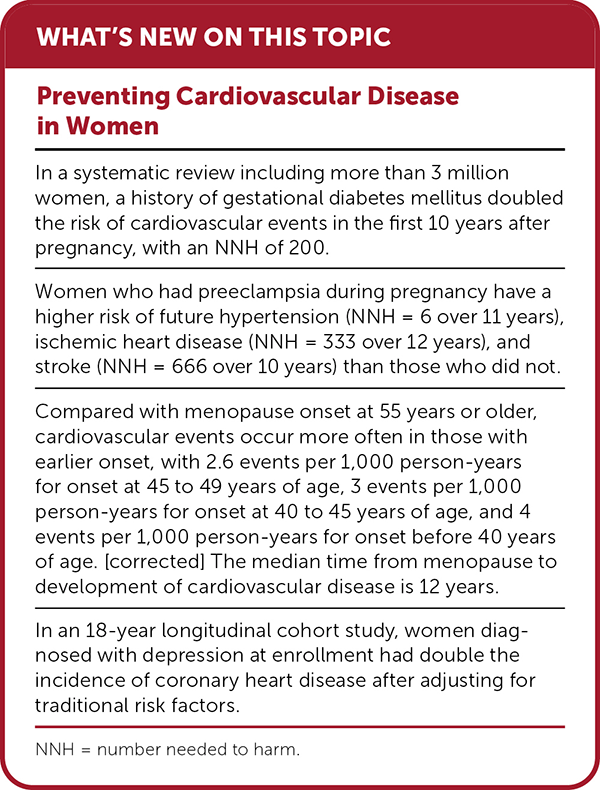
In a systematic review including more than 3 million women, a history of gestational diabetes mellitus doubled the risk of cardiovascular events in the first 10 years after pregnancy, with an NNH of 200.
Women who had preeclampsia during pregnancy have a higher risk of future hypertension (NNH = 6 over 11 years), ischemic heart disease (NNH = 333 over 12 years), and stroke (NNH = 666 over 10 years) than those who did not.
Compared with menopause onset at 55 years or older, cardiovascular events occur more often in those with earlier onset, with 2.6 events per 1,000 person-years for onset between 45 and 49 years of age, 3 events per 1,000 person-years for onset between 40 and 45 years of age, and 4 events per 1,000 person-years for onset before 40 years of age. [corrected] The median time from menopause to development of cardiovascular disease is 12 years.
In an 18-year longitudinal cohort study, women diagnosed with depression at enrollment had double the incidence of coronary heart disease after adjusting for traditional risk factors.

NNH = number needed to harm.

ERIN WESTFALL, DO, is an assistant professor in the Mayo Clinic Family Medicine Residency Program, Mankato, Minn.

ANNA B. VIERE, DO, is a resident in the Mayo Clinic Family Medicine Residency Program.

JOANNE E. GENEWICK, DO, is an assistant professor in the Mayo Clinic Family Medicine Residency Program.

Address correspondence to Erin Westfall, DO, 101 Martin Luther King Jr. Dr., Mankato, MN 56001 (westfall.erin@mayo.edu). Reprints are not available from the authors.

Author disclosure: No relevant financial relationships.

  1. 1.Sanchis-Gomar F, Perez-Quilis C, Leischik R, et al. Epidemiology of coronary heart disease and acute coronary syndrome. Ann Transl Med. 2016;4(13):256.
  2. 2.Wilmot KA, O’Flaherty M, Capewell S, et al. Coronary heart disease mortality declines in the United States from 1979 through 2011: evidence for stagnation in young adults, especially women. Circulation. 2015;132(11):997-1002.
  3. 3.Tsao CW, Aday AW, Almarzooq ZI, et al. Heart disease and stroke statistics-2022 update: a report from the American Heart Association [published correction appears in Circulation. 2022; 146(10): e141]. Circulation. 2022;145(8):e153-e639.
  4. 4.Kramer CK, Campbell S, Retnakaran R. Gestational diabetes and the risk of cardiovascular disease in women: a systematic review and meta-analysis. Diabetologia. 2019;62(6):905-914.
  5. 5.Bellamy L, Casas JP, Hingorani AD, et al. Pre-eclampsia and risk of cardiovascular disease and cancer in later life: systematic review and meta-analysis. BMJ. 2007;335(7627):974.
  6. 6.Oliver-Williams CT, Heydon EE, Smith GCS, et al. Miscarriage and future maternal cardiovascular disease: a systematic review and meta-analysis. Heart. 2013;99(22):1636-1644.
  7. 7.Schmiegelow MD, Andersson C, Køber L, et al. Prepregnancy obesity and associations with stroke and myocardial infarction in women in the years after childbirth: a nationwide cohort study. Circulation. 2014;129(3):330-337.
  8. 8.Liu L, Su G, Wang S, et al. The prevalence of obstructive sleep apnea and its association with pregnancy-related health outcomes: a systematic review and meta-analysis. Sleep Breath. 2019;23(2):399-412.
  9. 9.Grandi SM, Filion KB, Yoon S, et al. Cardiovascular disease-related morbidity and mortality in women with a history of pregnancy complications [published correction appears in Circulation. 2019; 140(9): e544]. Circulation. 2019;139(8):1069-1079.
  10. 10.Wu P, Gulati M, Kwok CS, et al. Preterm delivery and future risk of maternal cardiovascular disease: a systematic review and meta-analysis. J Am Heart Assoc. 2018;7(2):e007809.
  11. 11.Zhu D, Chung HF, Dobson AJ, et al. Age at natural menopause and risk of incident cardiovascular disease: a pooled analysis of individual patient data. Lancet Public Health. 2019;4(11):e553-e564.
  12. 12.de Groot PCM, Dekkers OM, Romijn JA, et al. PCOS, coronary heart disease, stroke and the influence of obesity: a systematic review and meta-analysis. Hum Reprod Update. 2011;17(4):495-500.
  13. 13.ACOG committee opinion no. 565: hormone therapy and heart disease. Obstet Gynecol. . 2013; 121(6): 1407–1410.
  14. 14.Oliver-Williams C, Glisic M, Shahzad S, et al. The route of administration, timing, duration and dose of postmenopausal hormone therapy and cardiovascular outcomes in women: a systematic review. Hum Reprod Update. 2019;25(2):257-271.
  15. 15.Moran CA, Collins LF, Beydoun N, et al. Cardiovascular implications of immune disorders in women. Circ Res. 2022;130(4):593-610.
  16. 16.Myasoedova E, Chandran A, Ilhan B, et al. The role of rheumatoid arthritis (RA) flare and cumulative burden of RA severity in the risk of cardiovascular disease. Ann Rheum Dis. 2016;75(3):560-565.
  17. 17.Aviña-Zubieta JA, Choi HK, Sadatsafavi M, et al. Risk of cardiovascular mortality in patients with rheumatoid arthritis: a meta-analysis of observational studies. Arthritis Rheum. 2008;59(12):1690-1697.
  18. 18.Kivimäki M, Steptoe A. Effects of stress on the development and progression of cardiovascular disease. Nat Rev Cardiol. 2018;15(4):215-229.
  19. 19.O’Neil A, Fisher AJ, Kibbey KJ, et al. Depression is a risk factor for incident coronary heart disease in women: an 18-year longitudinal study. J Affect Disord. 2016;196:117-124.
  20. 20.Vaccarino V, McClure C, Johnson BD, et al. Depression, the metabolic syndrome and cardiovascular risk. Psychosom Med. 2008;70(1):40-48.
  21. 21.Rutledge T, Reis SE, Olson MB, et al. Depression symptom severity and reported treatment history in the prediction of cardiac risk in women with suspected myocardial ischemia: the NHLBI-sponsored WISE study. Arch Gen Psychiatry. 2006;63(8):874-880.
  22. 22.Suglia SF, Koenen KC, Boynton-Jarrett R, et al.; American Heart Association Council on Epidemiology and Prevention; Council on Cardiovascular Disease in the Young; Council on Functional Genomics and Translational Biology; Council on Cardiovascular and Stroke Nursing; Council on Quality of Care and Outcomes Research. Childhood and adolescent adversity and cardiometabolic outcomes: a scientific statement from the American Heart Association. Circulation. 2018;137(5):e15-e28.
  23. 23.Manzi S, Meilahn EN, Rairie JE, et al. Age-specific incidence rates of myocardial infarction and angina in women with systemic lupus erythematosus: comparison with the Framingham Study. Am J Epidemiol. 1997;145(5):408-415.
  24. 24.Li J, Song C, Li C, et al. Increased risk of cardiovascular disease in women with prior gestational diabetes: a systematic review and meta-analysis. Diabetes Res Clin Pract. 2018;140:324-338.
  25. 25.Kautzky-Willer A, Leutner M, Harreiter J. Sex differences in type 2 diabetes [published correction appears in Diabetologia. 2023; 66(6): 1165]. Diabetologia. 2023;66(6):986-1002.
  26. 26.Ovesen P, Rasmussen S, Kesmodel U. Effect of prepregnancy maternal overweight and obesity on pregnancy outcome. Obstet Gynecol. 2011;118(2 pt 1):305-312.
  27. 27.Lee KK, Raja EA, Lee AJ, et al. Maternal obesity during pregnancy associates with premature mortality and major cardiovascular events in later life. Hypertension. 2015;66(5):938-944.
  28. 28.Schummers L, Hutcheon JA, Bodnar LM, et al. Risk of adverse pregnancy outcomes by prepregnancy body mass index: a population-based study to inform prepregnancy weight loss counseling. Obstet Gynecol. 2015;125(1):133-143.
  29. 29.Goldstein RF, Abell SK, Ranasinha S, et al. Association of gestational weight gain with maternal and infant outcomes: a systematic review and meta-analysis. JAMA. 2017;317(21):2207-2225.
  30. 30.Kew S, Ye C, Hanley AJ, et al. Cardiometabolic implications of postpartum weight changes in the first year after delivery. Diabetes Care. 2014;37(7):1998-2006.
  31. 31.Gartlehner G, Patel SV, Reddy S, et al. Hormone therapy for the primary prevention of chronic conditions in postmenopausal persons: updated evidence report and systematic review for the US Preventive Services Task Force [published correction appears in JAMA. 2023; 329(11): 943]. JAMA. 2022;328(17):1747-1765.
  32. 32.Stewart JC, Perkins AJ, Callahan CM. Effect of collaborative care for depression on risk of cardiovascular events: data from the IMPACT randomized controlled trial. Psychosom Med. 2014;76(1):29-37.
  33. 33.Soares ALG, Hammerton G, Howe LD, et al. Sex differences in the association between childhood maltreatment and cardiovascular disease in the UK Biobank. Heart. 2020;106(17):1310-1316.
  34. 34.Powell-Wiley TM, Baumer Y, Baah FO, et al. Social determinants of cardiovascular disease. Circ Res. 2022;130(5):782-799.
  35. 35.Groenhof TKJ, Zoet GA, Franx A, et al.; PREVEND Group. Trajectory of cardiovascular risk factors after hypertensive disorders of pregnancy. Hypertension. 2019;73(1):171-178.
  36. 36.American College of Obstetricians and Gynecologists’ Presidential Task Force on Pregnancy and Heart Disease and Committee on Practice Bulletins—Obstetrics. ACOG practice bulletin no. 212: pregnancy and heart disease. Obstet Gynecol. 2019;133(5):e320-e356.
  37. 37.Hypertension in pregnancy. Report of the American College of Obstetricians and Gynecologists’ Task Force on Hypertension in Pregnancy. Obstet Gynecol. 2013;122(5):1122-1131.
  38. 38.American Diabetes Association. 14. Management of diabetes in pregnancy: Standards of Medical Care in Diabetes-2020. Diabetes Care. 2020;43(suppl 1):S183-S192.
  39. 39.ACOG committee opinion no. 736: optimizing postpartum care. Obstet Gynecol. 2018;131(5):e140-e150.
  40. 40.Arnett DK, Blumenthal RS, Albert MA, et al. 2019 ACC/AHA guideline on the primary prevention of cardiovascular disease: executive summary: a report of the American College of Cardiology/American Heart Association Task Force on Clinical Practice Guidelines [published corrections appear in Circulation. 2019; 140(11): e647–e648, Circulation. 2020; 141(4): e59, and Circulation. 2020; 141(16): e773]. Circulation. 2019;140(11):e563-e595.
  41. 41.Mangione CM, Barry MJ, Nicholson WK, et al. Statin use for the primary prevention of cardiovascular disease in adults: US Preventive Services Task Force recommendation statement. JAMA. 2022;328(8):746-753.
  42. 42.O’Malley PG, Arnold MJ, Kelley C, et al. Management of dyslipidemia for cardiovascular disease risk reduction: synopsis of the 2020 updated U.S. Department of Veterans Affairs and U.S. Department of Defense clinical practice guideline. Ann Intern Med. 2020;173(10):822-829.
  43. 43.Grundy SM, Stone NJ, Bailey AL, et al. 2018 AHA/ACC/AACVPR/AAPA/ABC/ACPM/ADA/AGS/APhA/ASPC/NLA/PCNA guideline on the management of blood cholesterol: a report of the American College of Cardiology/American Heart Association Task Force on Clinical Practice Guidelines [published corrections appear in Circulation. 2019; 139(25): e1182–e1186 and Circulation. 2023; 148(7): e5]. Circulation. 2019;139(25):e1082-e1143.
  44. 44.Dehmer SP, O’Keefe LR, Evans CV, et al. Aspirin use to prevent cardiovascular disease and colorectal cancer: updated modeling study for the US Preventive Services Task Force. JAMA. 2022;327(16):1598-1607.
  45. 45.Curry SJ, Krist AH, Owens DK, et al. Risk assessment for cardiovascular disease with nontraditional risk factors: US Preventive Services Task Force recommendation statement. JAMA. 2018;320(3):272-280.
  46. 46.Sever P, Gouni-Berthold I, Keech A, et al. LDL-cholesterol lowering with evolocumab, and outcomes according to age and sex in patients in the FOURIER Trial. Eur J Prev Cardiol. 2021;28(8):805-812.
  47. 47.Zheng SL, Roddick AJ. Association of aspirin use for primary prevention with cardiovascular events and bleeding events: a systematic review and meta-analysis [published correction appears in JAMA. 2019; 321(22): 2245]. JAMA. 2019;321(3):277-287.
  48. 48.Cho L, Davis M, Elgendy I, et al.; ACC CVD Womens Committee Members. Summary of updated recommendations for primary prevention of cardiovascular disease in women: JACC state-of-the-art review. J Am Coll Cardiol. 2020;75(20):2602-2618.
  49. 49.George SM, Ballard-Barbash R, Manson JE, et al. Comparing indices of diet quality with chronic disease mortality risk in postmenopausal women in the Women’s Health Initiative Observational Study: evidence to inform national dietary guidance. Am J Epidemiol. 2014;180(6):616-625.
  50. 50.Fung TT, Malik V, Rexrode KM, et al. Sweetened beverage consumption and risk of coronary heart disease in women. Am J Clin Nutr. 2009;89(4):1037-1042.
  51. 51.Gao L, Faller J, Majmudar I, et al. Are interventions to improve cardiovascular disease risk factors in premenopausal women effective? A systematic review and meta-analysis. BMJ Open. 2021;11(7):e042103.
  52. 52.Piercy KL, Troiano RP, Ballard RM, et al. The physical activity guidelines for Americans. JAMA. 2018;320(19):2020-2028.
  53. 53.Hackshaw A, Morris JK, Boniface S, et al. Low cigarette consumption and risk of coronary heart disease and stroke: meta-analysis of 141 cohort studies in 55 study reports [published corrections appear in BMJ. 2018; 361: k1611 and BMJ. 2018; 363: k5035]. BMJ. 2018;360 : j5855.
  54. 54.Siu AL. Behavioral and pharmacotherapy interventions for tobacco smoking cessation in adults, including pregnant women: U.S. Preventive Services Task Force recommendation statement. Ann Intern Med. 2015;163(8):622-634.
  55. 55.Hayes SN. Preventing cardiovascular disease in women. Am Fam Physician. 2006;74(8):1331-1340.
  56. 56.Bedinghaus J, Leshan L, Diehr S. Coronary artery disease prevention: what’s different for women?. Am Fam Physician. 2001;63(7):1393-1401.

Copyright © 2026 by the American Academy of Family Physicians.

This content is owned by the AAFP. A person viewing it online may make one printout of the material and may use that printout only for his or her personal, non-commercial reference. This material may not otherwise be downloaded, copied, printed, stored, transmitted or reproduced in any medium, whether now known or later invented, except as authorized in writing by the AAFP. See permissions for copyright questions and/or permission requests.
