

High-Sensitivity Troponin in the Diagnosis of Acute Coronary Syndrome

Michael T. Partin, MD
Nathan J. Hemerly, DO
Karl T. Clebak, MD, MHA

American Family Physician. 2024;110(4):425-427.

Author disclosure: No relevant financial relationships.

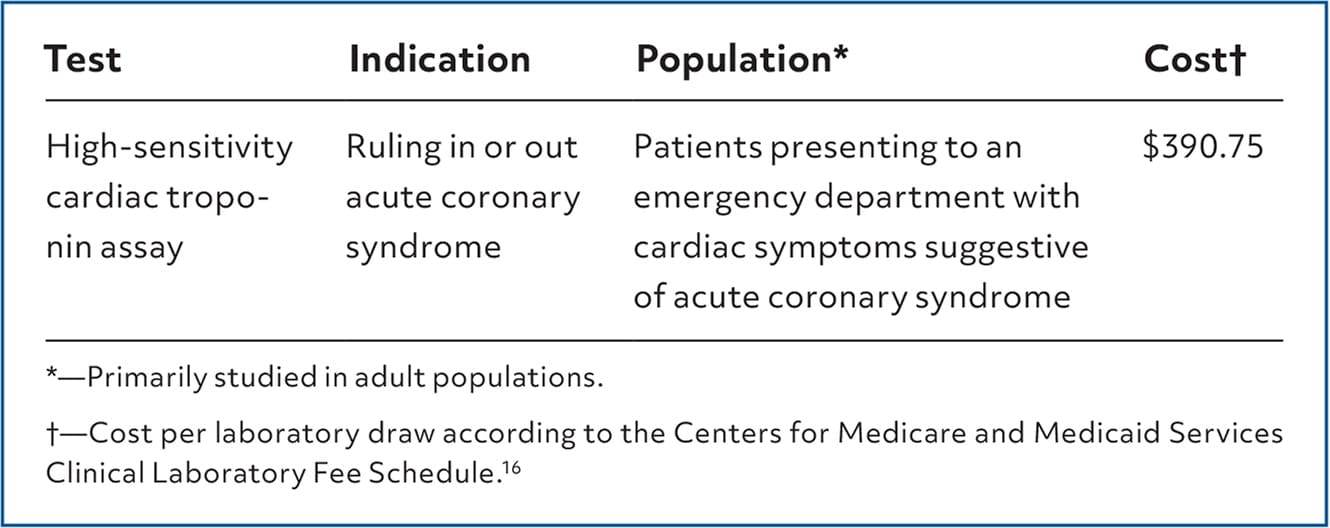
TestIndicationPopulation* Cost
High-sensitivity cardiac troponin assayRuling in or out acute coronary syndromePatients presenting to an emergency department with cardiac symptoms suggestive of acute coronary syndrome$390.75

*—Primarily studied in adult populations.

†—Cost per laboratory draw according to the Centers for Medicare and Medicaid Services Clinical Laboratory Fee Schedule.16

Numerous high-sensitivity cardiac troponin (hs-cTn) assays for acute myocardial infarction (MI) are available.1,2 These assays differ in their limits of detection, precision, and repeatability.3 The American College of Cardiology and American Heart Association guidelines endorse the 99th percentile upper reference limit for detecting myocardial injury to diagnose acute MI using hs-cTn.4 Evidence of myocardial injury with cardiac symptoms, new electrocardiogram changes, loss of viable myocardium per imaging, or evidence of coronary thrombus on angiography meets diagnostic criteria for acute MI.5 There is no standard cutoff value for hs-cTn. Abnormal values are based on a reference population for individual assays.

ACCURACY

There is little evidence comparing the diagnostic accuracy between conventional and hs-cTn assays. One study of 440 emergency department patients with chest pain found no statistically significant difference in acute MI diagnosis when comparing conventional troponin assay and hs-cTn testing.6

A prospective meta-analysis of 22,457 emergency department patients studied the use of hs-cTn assays for risk stratification with a primary outcome of acute MI or cardiac death at 30 days.7 In patients with hs-cTn I concentrations less than 5 ng per L (5 μg per L) on presentation, the negative predictive value was 99.5%.7 Similarly, a prospective, multicenter, observational study of 2,212 adult patients identified a negative predictive value of 99.6% (95% CI, 99.2% to 99.9%) for acute MI or death at 30 days if a single hs-cTn was less than 5 ng per L.8 A positive predictive value of at least 70% for acute MI was identified with hs-cTn of 120 ng per L (120 μg per L) or greater.8

A series of prospective studies of emergency department patients found that the positive predictive value of hs-cTn I and troponin assays for acute MI varies depending on timing and cutoff concentration.9 At presentation, lower hs-cTn concentrations and smaller absolute changes during serial sampling were associated with a lower likelihood of acute MI. From these data, risk calculator tools have been developed to determine negative predictive value, positive predictive value, sensitivity, specificity, and 30-day risk of death or MI.9

BENEFIT

The hs-cTn assay detects positive values at a much lower concentration than a conventional assay.1 Variables such as age, sex, time of day, and underlying medical conditions can lead to inaccurate diagnosis of myocardial damage in conventional troponin testing. The hs-cTn assays do not vary as much with these variables.1

The potential for early discharge from the emergency department without invasive testing is a benefit of hs-cTn testing (Figure 110). The American College of Emergency Physicians developed a clinical policy supported by a systematic review recommending that patients be eligible for early discharge with a non-ischemic electrocardiography finding and negative hs-cTn results tested serially over 2 hours.4,11 In a retrospective observational study involving 18,025 medical and surgical patients who underwent hs-cTn testing, there was a decrease in the number of patients diagnosed with MI, although there was no change in use of resources or in-hospital mortality.12

MICHAEL T. PARTIN, MD, FAAFP; NATHAN J. HEMERLY, DO; AND KARL T. CLEBAK, MD, MHA, FAAFP, Penn State Health Milton S. Hershey Medical Center, Hershey, Pennsylvania

Address correspondence to Michael T. Partin, MD, FAAFP, at mpartin@pennstatehealth.psu.edu.

Author disclosure: No relevant financial relationships.

  1. 1.Lazar DR, Lazar FL, Homorodean C, et al. High-sensitivity troponin: a review on characteristics, assessment, and clinical implications. Dis Markers. ;2022:9713326.
  2. 2.Yore M, Sharp A, Wu YL, et al. Emergency department cardiac risk stratification with high-sensitivity vs conventional troponin HEART pathway. JAMA Netw Open. 2023;6(12):e2348351.
  3. 3.Sherwood MW, Newby LK. High-sensitivity troponin assays: evidence, indications, and reasonable use. J Am Heart Assoc. 2014;3(1):e000403.
  4. 4.Sandoval Y, Apple FS, Mahler SA, et al.; International Federation of Clinical Chemistry and Laboratory Medicine Committee on the Clinical Application of Cardiac Biomarkers. High-sensitivity cardiac troponin and the 2021 AHA/ACC/ASE/CHEST/SAEM/SCCT/SCMR guidelines for the evaluation and diagnosis of acute chest pain. Circulation. 2022;146(7):569-581.
  5. 5.Domienik-Karłowicz J, Kupczyńska K, Michalski B, et al. Fourth universal definition of myocardial infarction. Selected messages from the European Society of Cardiology document and lessons learned from the new guidelines on ST-segment elevation myocardial infarction and non-ST-segment elevation-acute coronary syndrome. Cardiol J. 2021;28(2):195-201.
  6. 6.Hammerer-Lercher A, Ploner T, Neururer S, et al. High-sensitivity cardiac troponin T compared with standard troponin T testing on emergency department admission: how much does it add in everyday clinical practice?. J Am Heart Assoc. 2013;2(3):e000204.
  7. 7.Chapman AR, Lee KK, McAllister DA, et al. Association of high-sensitivity cardiac troponin I concentration with cardiac outcomes in patients with suspected acute coronary syndrome [published correction appears in JAMA. 2018; 319(11): 1168]. JAMA. 2017;318(19):1913-1924.
  8. 8.Sandoval Y, Nowak R, deFilippi CR, et al. Myocardial infarction risk stratification with a single measurement of high-sensitivity troponin I. J Am Coll Cardiol. 2019;74(3):271-282.
  9. 9.Neumann JT, Twerenbold R, Ojeda F, et al.; COMPASS-MI Study Group. Application of high-sensitivity troponin in suspected myocardial infarction. [published correction appears in N Engl J Med. 2022; 387(18): 1724]. N Engl J Med. 2019;380(26):2529-2540.
  10. 10.McCord J, Hana A, Cook B, et al. The role of cardiac testing with the 0/1-hour high-sensitivity cardiac troponin algorithm evaluating for acute myocardial infarction. Am Heart J. 2021;233:68-77.
  11. 11.Tomaszewski CA, Nestler D, Shah KH, et al.; American College of Emergency Physicians Clinical Policies Subcommittee (Writing Committee) on Suspected Non–ST-Elevation Acute Coronary Syndromes. Clinical policy: critical issues in the evaluation and management of emergency department patients with suspected non-ST-elevation acute coronary syndromes. Ann Emerg Med. 2018;72(5):e65-e106.
  12. 12.Zachoval CF, Dolscheid-Pommerich R, Graeff I, et al. High-sensitivity troponin T testing: consequences on daily clinical practice and effects on diagnosis of myocardial infarction. J Clin Med. 2020;9(3):775.
  13. 13.Lipinski MJ, Baker NC, Escárcega RO, et al. Comparison of conventional and high-sensitivity troponin in patients with chest pain: a collaborative meta-analysis. Am Heart J. 2015;169(1):6-16.e6.
  14. 14.Ganguli I, Cui J, Thakore N, et al. Downstream cascades of care following high-sensitivity troponin test implementation. J Am Coll Cardiol. 2021;77(25):3171-3179.
  15. 15.Twerenbold R, Jaeger C, Rubini Gimenez M, et al. Impact of high-sensitivity cardiac troponin on use of coronary angiography, cardiac stress testing, and time to discharge in suspected acute myocardial infarction. Eur Heart J. 2016;37(44):3324-3332.
  16. 16.Centers for Medicare and Medicaid Services. 23CLABQ4. Accessed November 17, 2023. https://www.cms.gov/medicare/medicare-fee-service-payment/clinicallabfeesched/clinical-laboratory-fee-schedule-files/23clabq3
  17. 17.Chuang MA, Gnanamanickam ES, Karnon J, et al. Cost effectiveness of a 1-hour high-sensitivity troponin-T protocol: an analysis of the RAPID-TnT trial. Int J Cardiol Heart Vasc. 2021;38:100933.

This series is coordinated by Natasha Pyzocha, DO, contributing editor.

A collection of Diagnostic Tests published in AFP is available at https://www.aafp.org/afp/diagnostic.

Copyright © 2026 by the American Academy of Family Physicians.

This content is owned by the AAFP. A person viewing it online may make one printout of the material and may use that printout only for his or her personal, non-commercial reference. This material may not otherwise be downloaded, copied, printed, stored, transmitted or reproduced in any medium, whether now known or later invented, except as authorized in writing by the AAFP. See permissions for copyright questions and/or permission requests.
