

Rotational and angular variations of the lower extremities in children are common conditions seen in primary care. These visits are often due to parental concerns about the appearance of their child's lower extremities. Common variations include intoeing (metatarsus adductus, internal tibial torsion, and femoral anteversion); out-toeing (external tibial torsion, femoral retroversion, and pes planus); and angular variations (genu varum and genu valgum). History, particularly age of onset; duration; progression; appearance and impact; prenatal and birth history; nutritional deficiencies; growth and development; medical and family history of related disorders, including rheumatologic, autoimmune, or neurologic conditions, can help differentiate normal variations from true deformities. In addition to a routine physical examination, a focused examination measuring a variety of parameters, such as foot progression angle, internal and external hip rotation, thigh-foot angle, joint laxity, and other condition-specific tests should be performed. If an underlying cause is identified, it should be treated; however, these conditions typically do not require further evaluation or treatment if measurements are within age-related normal ranges and patients are asymptomatic, and parents can be reassured that they are benign. There is minimal evidence to support the use of orthotics or braces. Referral to a pediatric orthopedist should be considered when measurements are more than 2 standard deviations outside of normal values, children have pain, or function is affected.
Musculoskeletal-related issues account for up to one-third of presenting concerns in children in primary care.1 This article discusses three common types of nontraumatic lower extremity conditions: intoeing, out-toeing, and angular variations and how to distinguish normal variations from pathologic deformities that require referral.
SORT: KEY RECOMMENDATIONS FOR PRACTICE
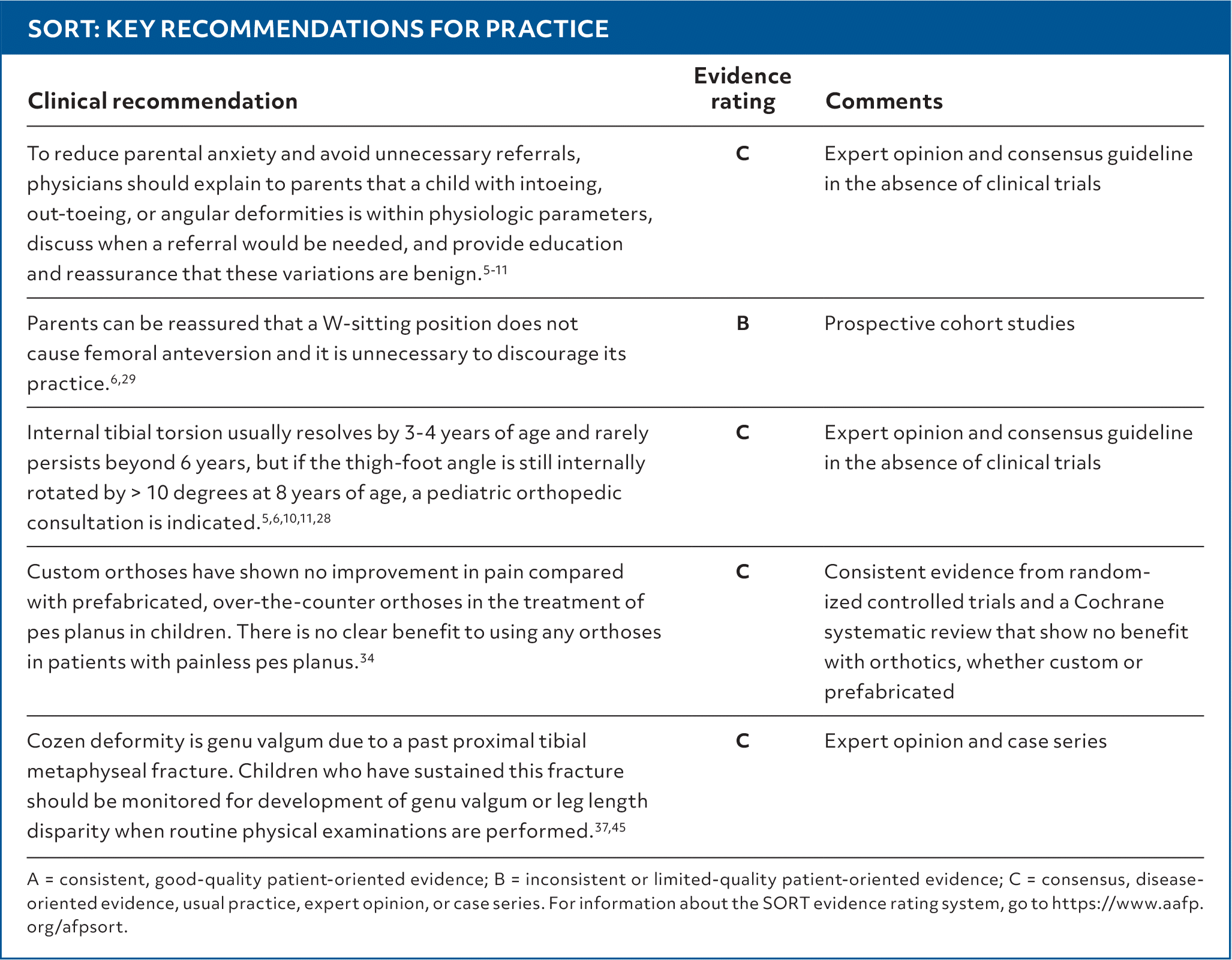
| Clinical recommendation | Evidence rating | Comments |
|---|---|---|
| To reduce parental anxiety and avoid unnecessary referrals, physicians should explain to parents that a child with intoeing, out-toeing, or angular deformities is within physiologic parameters, discuss when a referral would be needed, and provide education and reassurance that these variations are benign.5–11 | C | Expert opinion and consensus guideline in the absence of clinical trials |
| Parents can be reassured that a W-sitting position does not cause femoral anteversion and it is unnecessary to discourage its practice.6,29 | B | Prospective cohort studies |
| Internal tibial torsion usually resolves by 3–4 years of age and rarely persists beyond 6 years, but if the thigh-foot angle is still internally rotated by > 10 degrees at 8 years of age, a pediatric orthopedic consultation is indicated.5,6,10,11,28 | C | Expert opinion and consensus guideline in the absence of clinical trials |
| Custom orthoses have shown no improvement in pain compared with prefabricated, over-the-counter orthoses in the treatment of pes planus in children. There is no clear benefit to using any orthoses in patients with painless pes planus.34 | C | Consistent evidence from randomized controlled trials and a Cochrane systematic review that show no benefit with orthotics, whether custom or prefabricated |
| Cozen deformity is genu valgum due to a past proximal tibial metaphyseal fracture. Children who have sustained this fracture should be monitored for development of genu valgum or leg length disparity when routine physical examinations are performed.37,45 | C | Expert opinion and case series |
A = consistent, good-quality patient-oriented evidence; B = inconsistent or limited-quality patient-oriented evidence; C = consensus, disease-oriented evidence, usual practice, expert opinion, or case series. For information about the SORT evidence rating system, go to https://www.aafp.org/afpsort.
Read the full article
Get immediate access, anytime, anywhere.
Choose a single article, issue, or full-access subscription.
Earn up to 14 CME credits per issue.
