Gastric Cancer: Rapid Evidence Review

Timothy Mott, MD
Carrie Gray, DO

American Family Physician. 2025;111(2):140-145.

Author disclosure: No relevant financial relationships.

This clinical content conforms to AAFP criteria for CME.

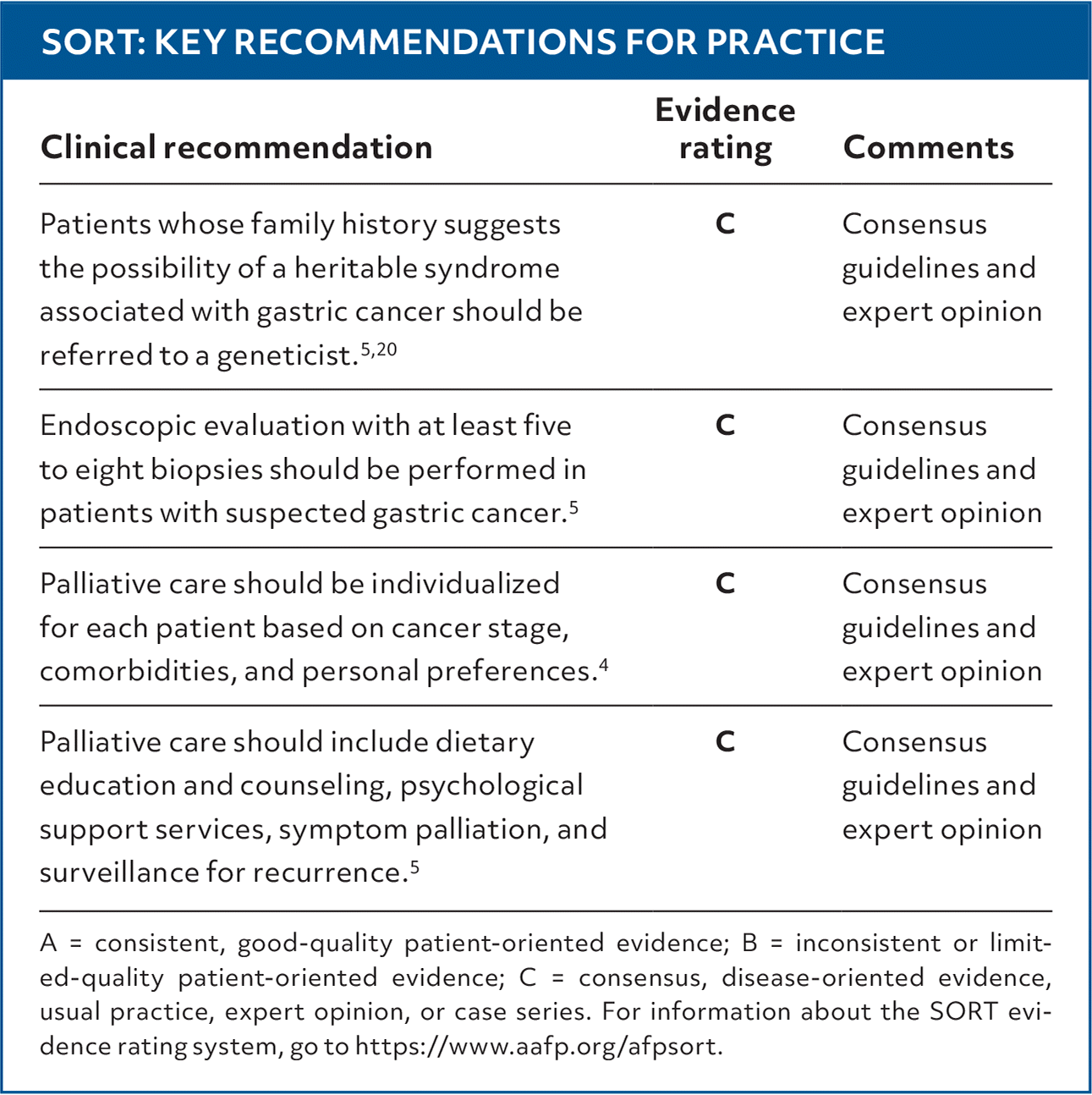
Gastric cancer is one of the deadliest and most diagnosed cancers, although the annual incidence has been steadily decreasing. Gastric cancer risk is multifactorial with a clear association with Helicobacter pylori infection. In the United States, the age-adjusted annual incidence is 4.1 per 100,000 people with a mortality rate of 1.6; the global adjusted annual incidence is roughly twice as much with a mortality rate four times higher. No randomized controlled trials have demonstrated the benefit of endoscopy or serum pepsinogen measurement in screening for gastric cancer. Patients are often asymptomatic or have general symptoms such as weight loss, abdominal pain, nausea, and anorexia, which can preclude an early diagnosis. When gastric cancer is suspected, the recommended initial test is upper gastrointestinal endoscopy with multiple tissue biopsies. A multidisciplinary treatment team should be assembled, and shared decision-making should occur with consideration of cancer staging, comorbidities, and available treatments. Treatment is guided by extent of disease, histopathology, and tumor biomarkers. Chemotherapy and radiation, in addition to various targeted therapies, may be treatment options for tumors regardless of resectability. Prognosis is directly related to the extent of disease at diagnosis; the 5-year survival rate of treated localized disease is more than 70% vs less than 10% for distant metastatic disease.

TIMOTHY MOTT, MD, FAAFP, is the program director at the Baldwin Health Family Medicine Residency, Foley, Alabama. At the time this article was written, he was an associate professor in the Department of Family Medicine at the Uniformed Services University of the Health Sciences, Bethesda, Maryland.

CARRIE GRAY, DO, FAAFP, is an assistant program director at Doctors Hospital Family Medicine Residency, Columbus, Ohio. At the time this article was written, she was associate program director of the Baldwin Health Family Medicine Residency.

Address correspondence to Timothy Mott, MD, at timothy_mott@baldwinhealth.com.

Author disclosure: No relevant financial relationships.

  1. 1.Kocarnik JM, Compton K, Dean FE, et al.; Global Burden of Disease 2019 Cancer Collaboration. Cancer incidence, mortality, years of life lost, years lived with disability, and disability-adjusted life years for 29 cancer groups from 2010 to 2019: a systematic analysis for the global burden of disease study 2019. JAMA Oncol. 2022;8(3):420-444.
  2. 2.Ferlay J, Colombet M, Soerjomataram I, et al. Cancer statistics for the year 2020: an overview. Int J Cancer. 2021;149:778-789.
  3. 3.Colquhoun A, Arnold M, Ferlay J, et al. Global patterns of cardia and non-cardia gastric cancer incidence in 2012. Gut. 2015;64(12):1881-1888.
  4. 4.Ajani JA, D’Amico TA, Bentrem DJ, et al. Gastric cancer, version 2.2022, NCCN clinical practice guidelines in oncology. J Natl Compr Canc Netw. 2022;20(2):167-192.
  5. 5.Lordick F, Carneiro F, Cascinu S, et al.; ESMO Guidelines Committee. Gastric cancer: ESMO clinical practice guideline for diagnosis, treatment and follow-up. Ann Oncol. 2022;33(10):1005-1020.
  6. 6.World Health Organization. Global cancer observatory: cancer today. Accessed December 31, 2024. https://gco.iarc.fr/today
  7. 7.Sung H, Ferlay J, Siegel RL, et al. Global cancer statistics 2020: GLOBOCAN estimates of incidence and mortality worldwide for 36 cancers in 185 countries. CA Cancer J Clin. 2021;71(3):209-249.
  8. 8.National Institutes of Health. National Cancer Institute. Surveillance, epidemiology, and end results program. Updated November 5, 2024. Accessed December 31, 2024. https://seer.cancer.gov/statistics-network/explorer/
  9. 9.GBD 2017 Stomach Cancer Collaborators. The global, regional, and national burden of stomach cancer in 195 countries, 1990–2017: a systematic analysis for the global burden of disease study 2017. Lancet Gastroenterol Hepatol. 2020;5(1):42-54.
  10. 10.Hooi JKY, Lai WY, Ng WK, et al. Global prevalence of Helicobacter pylori infection: systematic review and meta-analysis. Gastroenterology. 2017;153(2):420-429.
  11. 11.Graham DY. History of Helicobacter pylori, duodenal ulcer, gastric ulcer and gastric cancer. World J Gastroenterol. 2014;20(18):5191-5204.
  12. 12.Yaghoobi M, McNabb-Baltar J, Bijarchi R, et al. What is the quantitative risk of gastric cancer in the first-degree relatives of patients? A meta-analysis. World J Gastroenterol. 2017;23(13):2435-2442.
  13. 13.Poorolajal J, Moradi L, Mohammadi Y, et al. Risk factors for stomach cancer: a systematic review and meta-analysis. Epidemiol Health. 2020;42:e2020004.
  14. 14.Murphy G, Dawsey SM, Engels EA, et al. Cancer risk after pernicious anemia in the US elderly population. Clin Gastroenterol Hepatol. Dec 2015;13(13):2282-9.e1-4.
  15. 15.Turati F, Tramacere I, La Vecchia C, et al. A meta-analysis of body mass index and esophageal and gastric cardia adenocarcinoma. Ann Oncol. 2013;24(3):609-617.
  16. 16.Wu X, Chen L, Cheng J, et al. Effect of dietary salt intake on risk of gastric cancer: a systematic review and meta-analysis of case-control studies. Nutrients. 2022;14(20):4260.
  17. 17.Deng W, Jin L, Zhuo H, et al. Alcohol consumption and risk of stomach cancer: a meta-analysis. Chem Biol Interact. 2021;336:109365.
  18. 18.Bai X, Li X, Ding S, et al. Adherence to the Mediterranean diet and risk of gastric cancer: a systematic review and meta-analysis. Nutrients. 2023;15(17):3826.
  19. 19.Wu AH, Tseng CC, Bernstein L. Hiatal hernia, reflux symptoms, body size, and risk of esophageal and gastric adenocarcinoma. Cancer. 2003;98(5):940-948.
  20. 20.Oliveira C, Pinheiro H, Figueiredo J, et al. Familial gastric cancer: genetic susceptibility, pathology, and implications for management. Lancet Oncol. 2015;16(2):e60-e70.
  21. 21.National Institutes of Health. National Cancer Institute. Stomach (gastric) cancer screening (PDQ®)–health professional version. Updated March 19, 2024. Accessed December 31, 2024. https://www.cancer.gov/types/stomach/hp/stomach-screening-pdq
  22. 22.Dong E, Duan L, Wu BU. Racial and ethnic minorities at increased risk for gastric cancer in a regional US population study. Clin Gastroenterol Hepatol. 2017;15(4):511-517.
  23. 23.Jun JK, Choi KS, Lee HY, et al. Effectiveness of the Korean National Cancer screening program in reducing gastric cancer mortality. Gastroenterology. 2017;152(6):1319-1328.e7.
  24. 24.Hamashima C; Systematic Review Group and Guideline Development Group for Gastric Cancer Screening Guidelines. Update version of the Japanese guidelines for gastric cancer screening. Jpn J Clin Oncol. 2018;48(7):673-683.
  25. 25.Zhang X, Li M, Chen S, et al. Endoscopic screening in Asian countries is associated with reduced gastric cancer mortality: a meta-analysis and systematic review. Gastroenterology. 2018;155(2):347-354.e9.
  26. 26.Ford AC, Yuan Y, Forman D, et al. Helicobacter pylori eradication for the prevention of gastric neoplasia. Cochrane Database Syst Rev. 2020(7):CD005583.
  27. 27.US Preventive Services Task Force. Helicobacter pylori infection: screening. Accessed December 31, 2024. https://www.uspreventiveservicestaskforce.org/uspstf/recommendation/heliobacter-pylori-infection-screening
  28. 28.Layke JC, Lopez PP. Gastric cancer: diagnosis and treatment options. Am Fam Physician. 2004;69(5):1133-1140.
  29. 29.Banks M, Graham D, Jansen M, et al. British Society of Gastroenterology guidelines on the diagnosis and management of patients at risk of gastric adenocarcinoma. Gut. 2019;68(9):1545-1575.
  30. 30.National Institute for Health and Care Excellence. Oesophago-gastric cancer: assessment and management in adults. Updated July 4, 2023. Accessed December 31, 2024. https://www.ncbi.nlm.nih.gov/books/NBK594295/.
  31. 31.Wanebo HJ, Kennedy BJ, Chmiel J, et al. Cancer of the stomach. A patient care study by the American College of Surgeons. Ann Surg. 1993;218(5):583-592.
  32. 32.Black CJ, Paine PA, Agrawal A, et al. British Society of Gastroenterology guidelines on the management of functional dyspepsia. Gut. 2022;71(9):1697-1723.
  33. 33.Rasmussen S, Haastrup PF, Balasubramaniam K, et al. Predictive values of upper gastrointestinal cancer alarm symptoms in the general population: a nationwide cohort study. BMC Cancer. 2018;18(1):440.
  34. 34.Heikkinen M, Pikkarainen P, Eskelinen M, et al. GPs’ ability to diagnose dyspepsia based only on physical examination and patient history. Scand J Prim Health Care. 2000;18(2):99-104.
  35. 35.Xia JY, Aadam AA. Advances in screening and detection of gastric cancer. J Surg Oncol. 2022;125(7):1104-1109.
  36. 36.Toh Yoon EW, Nishihara K. Virchow’s node together with an Irish node. Clin Case Rep. 2017;5(6):1046-1047.
  37. 37.Dourmishev LA, Draganov PV. Paraneoplastic dermatological manifestation of gastrointestinal malignancies. World J Gastroenterol. 2009;15(35):4372-4379.
  38. 38.Mocellin S, Pasquali S. Diagnostic accuracy of endoscopic ultrasonography (EUS) for the preoperative locoregional staging of primary gastric cancer. Cochrane Database Syst Rev. 2015;2015(2):CD009944.
  39. 39.Chey WD, Leontiadis GI, Howden CW, et al. ACG clinical guideline: treatment of Helicobacter pylori infection. Am J Gastroenterol. 2017;112(2):212-239.
  40. 40.Lee YC, Chiang TH, Chou CK, et al. Association between Helicobacter pylori eradication and gastric cancer incidence: a systematic review and meta-analysis. Gastroenterology. 2016;150(5):1113-1124.e5.
  41. 41.Ajani JA, In H, Sano T, et al. Stomach. In: Amin MB, et al., eds. AJCC Cancer Staging Manual. 8th ed. Springer; 2017: 203.
  42. 42.PDQ® Adult Treatment Editorial Board. PDQ Gastric Cancer Treatment. Bethesda, MD: National Cancer Institute. Updated January 26, 2024. Accessed August 26, 2024. https://www.cancer.gov/types/stomach/hp/stomach-treatment-pdq
  43. 43.Suzuki H, Ono H, Hirasawa T, et al.; J-WEB/EGC group. Long-term survival after endoscopic resection for gastric cancer: real-world evidence from a multicenter prospective cohort. Clin Gastroenterol Hepatol. 2023;21(2):307-318.e2.
  44. 44.Songun I, Putter H, Kranenbarg EM, et al. Surgical treatment of gastric cancer: 15-year follow-up results of the randomised nationwide Dutch D1D2 trial. Lancet Oncol. 2010;11(5):439-449.
  45. 45.Wagner AD, Syn NL, Moehler M, et al. Chemotherapy for advanced gastric cancer. Cochrane Database Syst Rev. 2017(8):CD004064.
  46. 46.Ychou M, Boige V, Pignon JP, et al. Perioperative chemotherapy compared with surgery alone for resectable gastroesophageal adenocarcinoma: an FNCLCC and FFCD multicenter phase III trial. J Clin Oncol. 2011;29(13):1715-1721.
  47. 47.Schuhmacher C, Gretschel S, Lordick F, et al. Neoadjuvant chemotherapy compared with surgery alone for locally advanced cancer of the stomach and cardia: European Organisation for Research and Treatment of Cancer randomized trial 40954. J Clin Oncol. 2010;28(35):5210-5218.
  48. 48.Ly J, O’Grady G, Mittal A, et al. A systematic review of methods to palliate malignant gastric outlet obstruction. Surg Endosc. 2010;24(2):290-297.
  49. 49.Berger JM, Preusser M, Berghoff AS, et al. Malignant ascites: current therapy options and treatment prospects. Cancer Treat Rev. 2023;121:102646.
  50. 50.Markar SR, Mackenzie H, Jemal S, et al. Emergency presentation of esophagogastric cancer: predictors and long-term prognosis. Ann Surg. 2018;267(4):711-715.
  51. 51.Lv L, Liang X, Wu D, et al. Is cardia cancer a special type of gastric cancer? A differential analysis of early cardia cancer and non-cardia cancer. J Cancer. 2021;12(8):2385-2394.
  52. 52.National Cancer Institute Center for Cancer Research. Diet and nutrition after gastrectomy: what you should know. Accessed August 26, 2024. https://ccr.cancer.gov/surgical-oncology-program/clinical-team/diet-and-nutrition-after-gastrectomy-what-you-should-know

Copyright © 2026 by the American Academy of Family Physicians.

This content is owned by the AAFP. A person viewing it online may make one printout of the material and may use that printout only for his or her personal, non-commercial reference. This material may not otherwise be downloaded, copied, printed, stored, transmitted or reproduced in any medium, whether now known or later invented, except as authorized in writing by the AAFP. See permissions for copyright questions and/or permission requests.