

A 21-year-old woman presented to urgent care with a fever and worsening facial rash that both began 2 days prior.
The rash started as a small red spot on her right cheek. She was prescribed trimethoprim-sulfamethoxazole. One day later, she went to the emergency department with no improvement. She was given a dose of intravenous ceftriaxone and discharged with a prescription for oral cephalexin. The next day, the rash had become more extensive and tender.
The patient had no recent travel, contact with people who were sick, or trauma to the area. She had no other significant symptoms. Her vital signs were normal, and she was afebrile.
Physical examination revealed a large erythematous area on her right cheek that was tender but not fluctuant (Figure 1). Her right upper eyelid was swollen, but she had no pain with eye movements. Her oral cavity was normal with no visible lesions. Computed tomography did not show an abscess or abnormality of the orofacial tissues or retropharyngeal space.
FIGURE 1
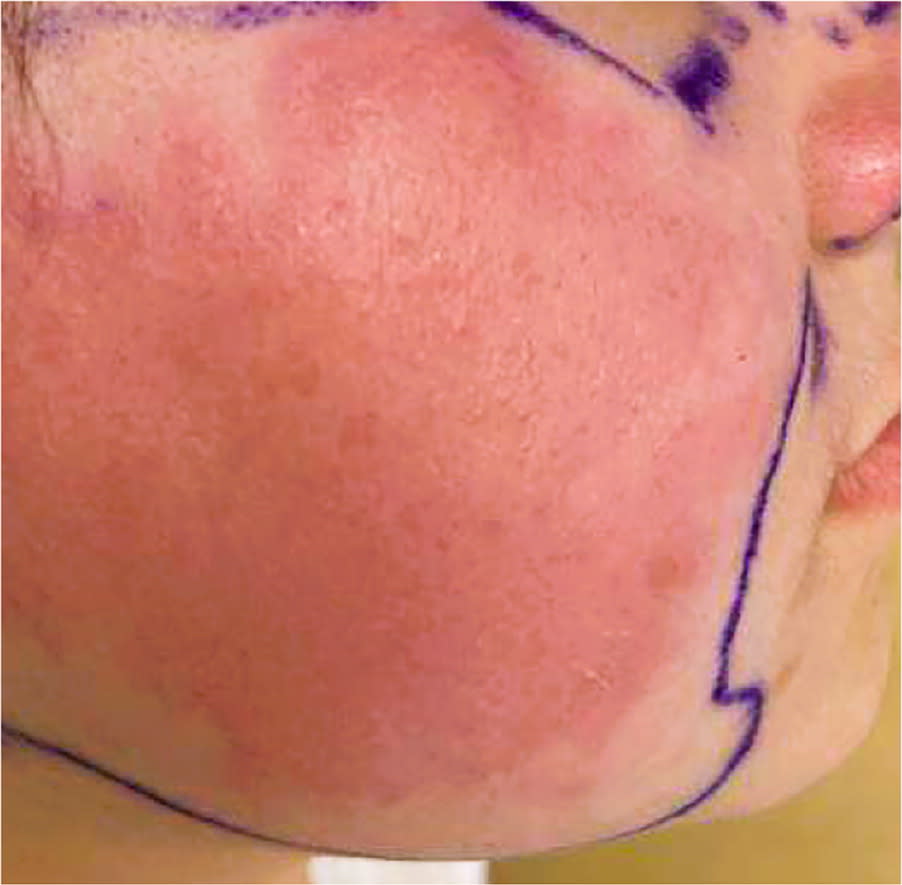
QUESTION
Based on the patient’s history and physical examination, which one of the following is the most likely diagnosis?
- A. Cellulitis.
- B. Erysipelas.
- C. Erythema infectiosum.
- D. Rosacea.
- E. Systemic lupus erythematosus.
DISCUSSION
The answer is B: erysipelas, an infection of the upper dermis and superficial lymphatics typically caused by group A beta-hemolytic streptococci. It often originates at the site of bacterial inoculation following a breach in the epithelial barrier. Less commonly, erysipelas is caused by group B, C, or G beta-hemolytic streptococci, Staphylococcus aureus, Streptococcus pneumoniae, and Haemophilus influenzae.1
Erysipelas is diagnosed clinically. The rash has an acute onset and features rapidly advancing erythema in a tender, raised, sharply demarcated area. The most commonly affected sites are the lower extremities and face, usually involving one or both cheeks and the periorbital area.1 Erysipelas is more common in older patients, younger children, and those who are immunocompromised.2 It is typically associated with systemic symptoms such as fever, chills, and regional lymphadenopathy.
Cellulitis is an infection of the deeper dermis and subcutaneous fat. The erythematous skin is warm to the touch but usually not tender. The area is not as well demarcated as erysipelas. Fever and malaise can occur in severe cases, but these symptoms are more commonly associated with erysipelas.1
Erythema infectiosum is a viral exanthem caused by human parvovirus B19. It can affect people of all ages but is most common in children. The condition presents with a short prodrome of fever, malaise, headache, and coryza followed by a characteristic bright red malar rash that resembles slapped cheeks. The rash is usually self-limiting and fades over 1 to 4 days, but it may recur with exercise, emotional stress, bathing, or exposure to sunlight.3
Rosacea is a chronic, relapsing inflammatory skin disorder that mainly affects the central face. It occurs most commonly in people with lighter skin tones who are middle-aged or older. Rosacea manifests as erythema, papules, pustules, and telangiectasia. Facial flushing associated with rosacea can be triggered by emotional stress, spicy food, alcohol, menopause, and certain medications.4
Read the full article
Get immediate access, anytime, anywhere.
Choose a single article, issue, or full-access subscription.
Earn up to 14 CME credits per issue.
