

DETAILS FOR THIS REVIEW
Study Population: 20,346 adolescents, young adults, and adults using various types of smokeless tobacco products enrolled in 43 trials
Efficacy End Points: Abstinence from all tobacco or from smokeless tobacco at 6 months or longer after treatment
Harm End Points: Adverse events
THE NUMBERS
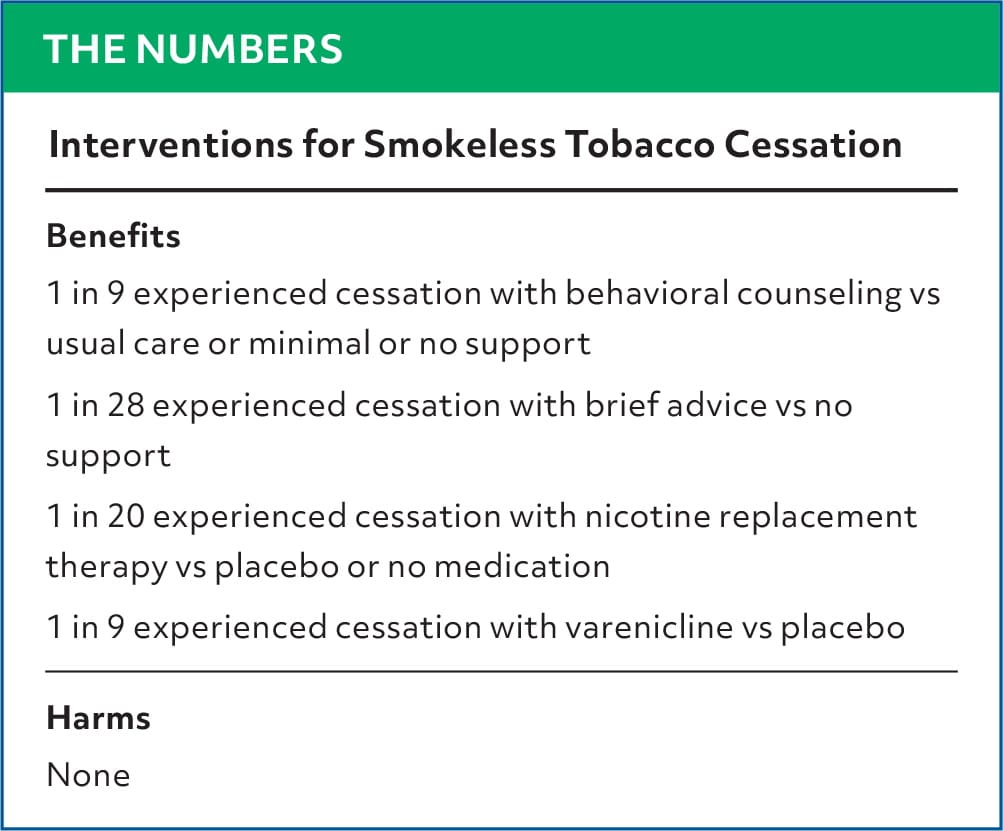
| Benefits |
| 1 in 9 experienced cessation with behavioral counseling vs usual care or minimal or no support |
| 1 in 28 experienced cessation with brief advice vs no support |
| 1 in 20 experienced cessation with nicotine replacement therapy vs placebo or no medication |
| 1 in 9 experienced cessation with varenicline vs placebo |
| Harms |
| None |
Narrative: Compared with combustible tobacco (eg, cigarettes), smokeless tobacco is ingested by chewing, sniffing, or holding it in the mouth. More than 300 million individuals worldwide use smokeless tobacco, with the highest prevalence in South and Southeast Asia.1 Use of smokeless tobacco increases the risk of head and neck cancer, cardiovascular disease, and adverse pregnancy outcomes (eg, low birth weight, stillbirth).1,2 Counseling interventions for tobacco cessation aim to improve motivation to quit, increase ability to cope with urges to use, identify and mitigate triggers, and reinforce continued tobacco abstinence. Pharmacotherapy for smokeless tobacco cessation has generally included similar options to what has been effective for combustible tobacco.
The 2025 Cochrane review discussed here included 43 studies with 20,346 individuals.3 Thirty-two trials included only adults, and 11 trials included adolescents and young adults. Thirty-three studies were based in North America; the remainder were conducted in Europe and Asia. Participants used various types of smokeless tobacco. Trials were conducted in a mix of community, health, and educational settings using counseling and treatment from mental health professionals, physicians, nurses, clinical pharmacists, or dental professionals.
The review examined behavioral and pharmacotherapy options for smokeless tobacco cessation, examining the rates of all tobacco cessation or smokeless tobacco cessation at 6 months or longer after the intervention.
Moderate-certainty evidence demonstrated that counseling improved the rate of tobacco cessation at 6 months or later compared with usual care or minimal or no cessation support (risk ratio [RR] = 1.76; 95% CI, 1.44 to 2.16; absolute risk difference [ARD] = 12%; number needed to treat [NNT] = 9; 21 randomized controlled trials [RCTs]; n = 7,414). Moderate-certainty evidence also showed that compared with no support, brief advice increased the rate of tobacco cessation at 6 months or later (RR = 1.24; 95% CI, 1.03–1.48; ARD = 3.6%; NNT = 28; seven RCTs; n = 6,271).
Low-certainty evidence demonstrated that nicotine replacement therapy improved tobacco cessation rates compared with placebo or no medication at 6 months or later (RR = 1.18; 95% CI, 1.05–1.33; ARD = 5%; NNT = 20; 11 RCTs; n = 2,826). Moderate-certainty evidence demonstrated that varenicline improved tobacco cessation rates at 6 months or later compared with placebo (RR = 1.35; 95% CI, 1.08–1.68; ARD = 11.6%; NNT = 9; two RCTs; n = 508). Bupropion did not appear to affect tobacco cessation rates at 6 months or later compared with placebo.
Read the full article
Get immediate access, anytime, anywhere.
Choose a single article, issue, or full-access subscription.
Earn up to 14 CME credits per issue.
