

to the editor: Male dyspareunia in the uncircumcised patient often results from balanitis xerotica obliterans (BXO), also known as lichen sclerosus et atrophicus.1
Our patient was a 40-year-old Jewish immigrant from Russia who requested a ritual circumcision on an outpatient basis. He maintained good personal hygiene but had developed dyspareunia. Examination revealed balanitis xerotica obliterans. The glans and mucosa were white, smooth and atrophic, and the meatus showed erosion. Varicose veins were present on the dorsal mucosa of the prepuce. In addition, a very tight frenulum caused a frenular chordee2 (Figure 1).
FIGURE 1.
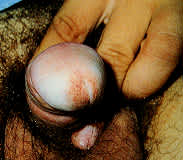
Genital balanitis xerotica obliterans that caused male dyspareunia. The glans was white, smooth and atrophic, and erosion was apparent on the meatus. In addition, the very tight frenulum caused a frenular chordee.
BXO is an inflammatory deteriorative condition. The scarring or sclerosis that may result can trigger, among other conditions, phimosis, meatal stenosis, pain on erection1 and male dyspareunia.
BXO is not limited to adults. Children may also have BXO1 and its related condition, posthitis xerotica obliterans3; however, these conditions are often missed.1,2 Circumcision is the treatment of choice.4 Drs. Ledwig and Weigand reported that “we were unable to find a case of lichen sclerosus et atrophicus of the glans or prepuce in a male circumcised in infancy.”1
The Mohel (ritual circumciser) performed the circumcision on the patient in the usual sterile fashion on an outpatient basis (Figure 2). Post-circumcision care consisted of sitz baths, an astringent wet dressing two times per day and applications of A + D ointment six to eight times per day. Treatment was discontinued after one month. The patient's condition improved, and he was able to resume normal marital relations (Figure 3).
FIGURE 2.
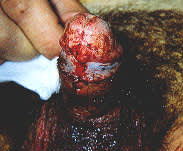
Immediately after the circumcision. Notice that the mucosa too was white, smooth and atrophic. The frenular chordee was resolved with lysis of the frenulum.
FIGURE 3.
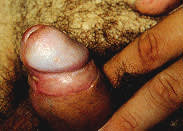
One month after circumcision. The condition greatly improved, and the patient resumed normal marital relations.
