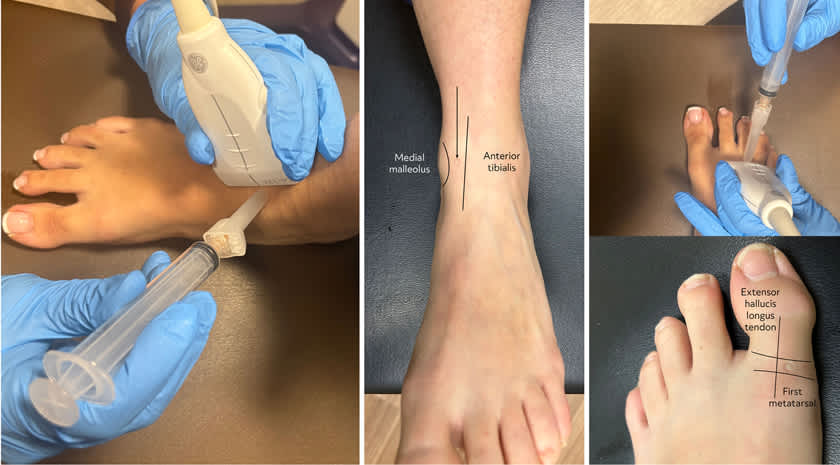
Foot and ankle injections are commonly performed by family physicians for the management of musculoskeletal conditions such as plantar fasciitis, osteoarthritis, interdigital neuromas, tarsal tunnel syndrome, and pathology of the first metatarsophalangeal joint. If symptoms persist despite conservative measures, injections may improve function and reduce pain. Before an injection, the clinician should discuss procedural risks, including pain, swelling, redness, stiffness, infection, and damage to surrounding tissues, and obtain informed consent. Corticosteroid injections can provide short-term pain relief for plantar fasciitis and first metatarsophalangeal joint arthritis, but they increase the risk of fascia rupture, fat pad atrophy, and cartilage damage. Platelet-rich plasma injections are supported by evidence that they may be beneficial in those with plantar fasciitis. Corticosteroid injections placed directly into weight-bearing tendons is not recommended because of the increased risk of rupture. Ultrasound guidance improves accuracy and reduces procedural risks such as neurovascular injury.
The estimated prevalence of foot and ankle pain in adults seen in primary care is 24% and 15%, respectively.1 The most common foot and ankle pathologies seen in primary care are infection and injury, followed by musculoskeletal disorders, such as ankle or foot arthritis and plantar fasciitis.2 Injections can help improve pain, ultimately increasing activity in patients with foot and ankle pain.3 Common needle, corticosteroid, and anesthetic combinations for foot and ankle injections are listed in Table 1.4–6
SORT: KEY RECOMMENDATIONS FOR PRACTICE
| Clinical recommendation | Evidence rating | Comments |
|---|---|---|
| Intratendinous corticosteroid injection into weight-bearing tendons (eg, Achilles) is not recommended due to increased risk of tendon rupture.17 | C | Expert consensus and safety studies |
| Ultrasound-guided injections improve accuracy and may reduce the risk of neurovascular injury and inadvertent intratendinous injection.18–20 | B | Multiple observational studies and randomized trial |
| Corticosteroid injections into the plantar fascia provide short-term relief but increase the risk of plantar fascia rupture and heel pad atrophy.23,24 | B | Retrospective studies and expert opinion |
A = consistent, good-quality patient-oriented evidence; B = inconsistent or limited-quality patient-oriented evidence; C = consensus, disease-oriented evidence, usual practice, expert opinion, or case series. For information about the SORT evidence rating system, go to https://www.aafp.org/afpsort.
TABLE 1. Common Needle, Corticosteroid, and Anesthetic Combinations for Foot and Ankle Injections
| Site | Type of needle | Corticosteroids* | Anesthetic |
|---|---|---|---|
| Plantar fascia | 25 gauge, 1.5 inches | 40 mg methylprednisolone 40 mg triamcinolone |
2-mL lidocaine 1%, ropivacaine 0.5%, or bupivacaine 0.5% |
| Ankle (tibiotalar) joint | 22–25 gauge, 1.5 inches | 40 mg methylprednisolone 40 mg triamcinolone |
2–4 mL lidocaine 1%, ropivacaine 0.5%, or bupivacaine 0.5% |
| Tarsal tunnel | 25 gauge, 1 or 1.5 inches | 20 mg methylprednisolone 20 mg triamcinolone |
2-mL lidocaine 1%, ropivacaine 0.5%, or bupivacaine 0.5% |
| Interdigital neuroma | 25 gauge, 1 or 1.5 inches | 20 mg methylprednisolone 20 mg triamcinolone |
1-mL lidocaine 1%, ropivacaine 0.5%, or bupivacaine 0.5% |
| First metatarsophalangeal joint | 25 gauge, 1 or 1.5 inches | 20 mg methylprednisolone 20 mg triamcinolone |
1-mL lidocaine 1%, ropivacaine 0.5%, or bupivacaine 0.5% |
*—Methylprednisolone and triamcinolone are the most commonly used corticosteroids.
Read the full article
Get immediate access, anytime, anywhere.
Choose a single article, issue, or full-access subscription.
Earn up to 14 CME credits per issue.