

FIGURE 1.
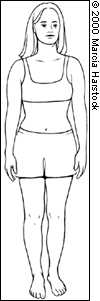
Patient stands straight with arms at sides, facing examiner. Normal findings: symmetry of upper and lower extremities and trunk. Common abnormalities include enlarged acromioclavicular joint, enlarged sternoclavicular joint, asymmetric waist (leg-length difference or scoliosis), swollen knee and swollen ankle.
FIGURE 2.
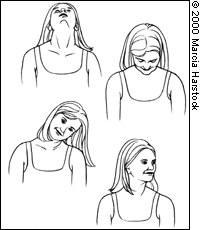
Patient looks at the ceiling, looks at the floor, touches right (and left) ear to shoulder and looks over right (and left) shoulder. Normal findings: patients should be able to touch chin to chest, ears to shoulders and look equally over the shoulders. Common abnormalities, which include loss of flexion, loss of lateral bending and loss of rotation, may indicate previous neck injury.
FIGURE 3.
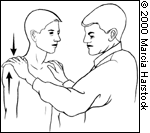
Patient stands in front of examiner with arms at side. Examiner tries to hold shoulder down while patient tries to shrug. Common abnormalities include atrophy or weakness of muscles indicating shoulder, neck or trapezius nerve abnormalities.
FIGURE 4.
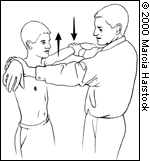
Patient holds arms out from sides horizontally and tries to lift them (while examiner holds arms down). Normal findings: strength should be equal in both arms, and deltoid muscles should be equal in size. Common abnormalities include loss of strength and wasting of the deltoid muscle.
FIGURE 5.
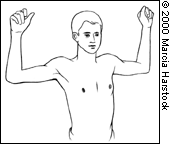
Patient holds arms out from sides with elbows bent at 90 degrees; patient raises hands vertically as far as they will go. Normal findings: Hands go back equally and at least to upright vertical position. Common abnormalities: loss of external rotation, which may indicate shoulder problem or old dislocation.
FIGURE 6.
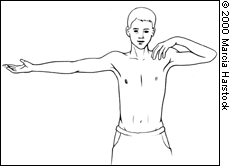
Patient holds arms out from sides, palms up, and completely straightens and bends elbows. Normal findings: motion should be equal on left and right sides. Common abnormalities, which include loss of extension and loss of flexion, may indicate old elbow injury, dislocation, fractures, etc.
FIGURE 7.
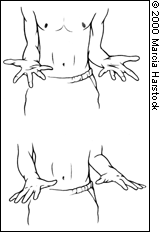
Patient holds arms down at sides with elbows bent at 90 degrees, then twists palms up and down. Normal findings: palms should go from facing the ceiling to facing the floor. Common abnormalities, which include lack of full supination and full pronation, may indicate an old injury of the forearm, wrist or elbow.
FIGURE 8.
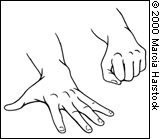
Patient makes a fist, opens the hand and spreads the fingers. Normal findings: fist should be tight and fingers straight when spread. Common abnormalities, which include a knuckle protruding from the fist and a swollen or crooked finger, may indicate old finger fractures or sprains.
FIGURE 9.
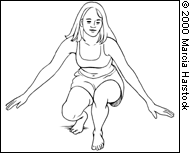
Patient squats on heels, duck-walks four steps and stands up. Normal findings: maneuver is painless, heel-to-buttock distance is equal on left and right sides and knee flexion is equal during the walk. Common abnormalities include inability to fully flex one knee and inability to stand up without twisting or bending to one side.
FIGURE 10.
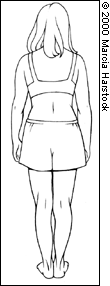
Patient stands up straight with arms at sides (with back to the examiner). Normal findings: symmetry of shoulders, waist, thighs and calves. Common abnormalities include high shoulder (scoliosis) or low shoulder (muscle loss), prominent rib cage (scoliosis), high hip or asymmetric waist (leg-length difference or scoliosis), and small calf or thigh (weakness from an old injury).
FIGURE 11.
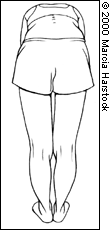
Patient bends forward slowly with knees straight and touches the toes. Normal findings: patient bends forward straightly and smoothly. Common abnormalities include patient twisting to one side (low back pain) and asymmetric back (scoliosis).
FIGURE 12.
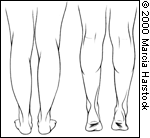
Patient stands on the heels and then rises up on the toes. Normal findings: equal elevation on right and left sides, symmetry of calf muscles. Common abnormalities include wasting of calf muscles (Achilles injury or old ankle injury).
