

Clinical Question
What is the probability of group A beta-hemolytic streptococcal (GABHS) pharyngitis (strep throat) in a patient who presents with sore throat?
Applying the Evidence: Justin is a 13-year-old boy who has had sore throat, fever, and swollen glands for two days. On examination, he has exudative tonsillitis and tender anterior cervical nodes, but no posterior cervical adenopathy. What is his probability of having strep throat?
Answer: Justin has a strep score of 5, which indicates a 52 percent risk of GABHS pharyngitis. It would be reasonable to treat him empirically. As another option, the physician could obtain a specimen for throat culture and call the patient in two days to discontinue the antibiotics if the culture is negative; however, the physician should consider the possibility of false-negative culture results when the pretest probability of strep throat is sufficiently high. A third option is to base treatment on a rapid step test for high-risk patients, although the physician should keep in mind that this test has the same risk of false-negative results as the throat culture.
Evidence Summary
The probability of GABHS pharyngitis as the cause of sore throat is greatest in children younger than 15 years, especially those younger than 10. In a typical outpatient setting, 30 percent of children five to nine years of age with sore throat have GABHS pharyngitis; the probability declines to 15 to 20 percent in preadolescents and adolescents (ages 10 to 19 years). Only 5 to 10 percent of adults with sore throat have GABHS pharyngitis.1–3
Sore Throat Encounter Form
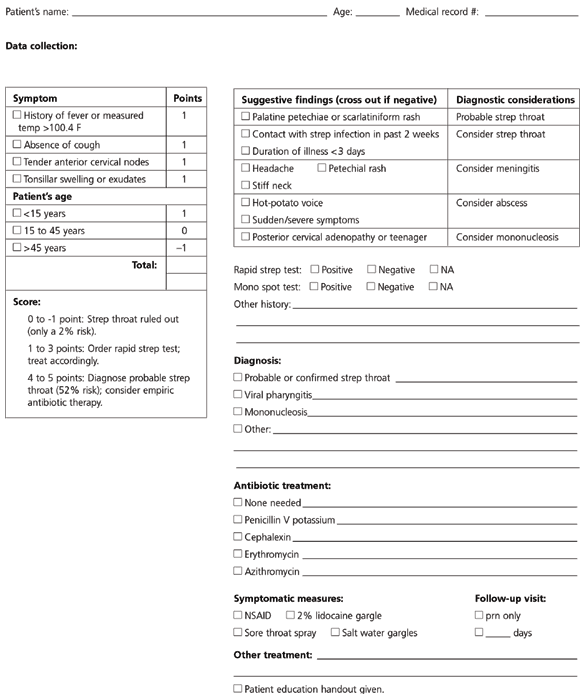
Developed by Mark H. Ebell, M.D., M.S., Michigan State University College of Human Medicine, East Lansing. Copyright© 2003 Amer \can Academy of Family Physicians. Physicians may photocopy or adapt for use in their own practices; all other rights reserved. “Point-of-Care Guides.” Ebell MH. American Family Physician. September 1, 2003;68:937–8,https://www.aafp.org/afp/2003/0901/p937.html.
Signs and symptoms that help rule in GABHS pharyngitis include tonsillar exudates (positive likelihood ratio [LR+]: 3.4), pharyngeal exudates (LR+: 2.1), and exposure to strep throat in the previous two weeks (LR+: 1.9). The absence of tender anterior cervical nodes (negative likelihood ratio [LR-]: 0.6), the absence of tonsillar enlargement (LR-: 0.6), and the absence of exudate (LR-: 0.7) are the most helpful findings for ruling out GABHS pharyngitis.4 The presence of a scarlatiniform rash or palatine petechiae is uncommon but very specific for the diagnosis of GABHS pharyngitis.4
A number of clinical decision rules have been developed and validated to help physicians more accurately estimate the probability of GABHS pharyngitis. Some have been tested only in adults, some only in children, some only in primary care settings, and some only in emergency departments or college health centers. The spectrum of disease may differ in each setting. The best clinical decision rule, created by McIsaac and colleagues,3 is included in the accompanying evidence-based patient encounter form for the management of sore throat. This tool is simple to use and takes the patient's age, tonsillar exudates, absence of cough, cervical adenopathy, and fever into account. It has been found to be clinically accurate in a group of more than 600 adults and children who presented to family physicians with sore throat.3
