

Letters to the Editor

Milk-Like Serum Suggests Markedly Elevated Triglycerides

TERESA M. ALLEN, LT, MC, USNR,
ANTHONY J. VIERA, LCDR, MC, USNR,
Naval Hospital Jacksonville, 2080 Child St., Jacksonville, FL 32214

American Family Physician. 2004;70(5):821.

to the editor: Occasionally, clinicians encounter a finding that is rarely seen, and thus is worth sharing. The accompanying figure is a serum sample from a 60-year-old woman with diabetes who presented for evaluation of severe abdominal pain, nausea, and vomiting that had been worsening over a 24-hour period. She denied any chest pain, shortness of breath, fever, or chills. A nonfasting lipid panel revealed a triglyceride level of 8,535 mg per dL (96.3 mmol per L; normal range: 40 to 150 mg per dL [0.45 to 1.69 mmol per L]). Her lipase level was elevated at 1,476 U per L (normal range: 23 to 300 U per L).

Figure.
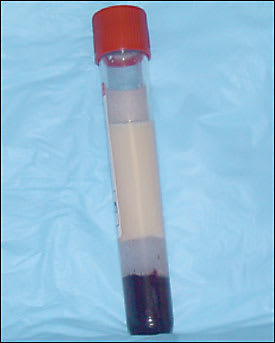
Serum sample from a 60-year-old woman with diabetes. Lactescent (milk-like) appearance suggests markedly elevated triglyceride level.

Approximately 1.3 to 3.8 percent of cases of acute pancreatitis may be secondary to hypertriglyceridemia.1 Serum triglyceride levels of about 1,000 mg per dL (11.29 mmol per L) can precipitate such attacks, although the exact mechanism is unknown. When the triglyceride level is above 4,500 mg per dL (50.81 mmol per L), as in this patient, the serum is described as lactescent (milk-like). Such appearance should prompt the physician to get an immediate lipid level.1

TERESA M. ALLEN LT, MC, USNR

ANTHONY J. VIERA LCDR, MC, USNR

Naval Hospital Jacksonville

2080 Child St.

Jacksonville, FL 32214

  1. 1.Fortson MR, Freedman SN, Webster PD. Clinical assessment of hyperlipidemic pancreatitis.. Am J Gastroenterol. 1995;90:2134-9.

Email letter submissions to afplet@aafp.org. Letters should be fewer than 400 words and limited to six references, one table or figure, and three authors. Letters submitted for publication in AFP must not be submitted to any other publication. Letters may be edited to meet style and space requirements.

This series is coordinated by Kenny Lin, MD, MPH, deputy editor.

Copyright © 2026 by the American Academy of Family Physicians.

This content is owned by the AAFP. A person viewing it online may make one printout of the material and may use that printout only for his or her personal, non-commercial reference. This material may not otherwise be downloaded, copied, printed, stored, transmitted or reproduced in any medium, whether now known or later invented, except as authorized in writing by the AAFP. See permissions for copyright questions and/or permission requests.