

to the editor: A healthy 43-year-old man underwent Holter monitoring to evaluate palpitations. Electrocardiograms obtained at rest and after three minutes of step-test were normal, with heart rates of 58 and 102 beats per minute, respectively. Physical examination was unremarkable. The Holter monitor (see accompanying figure) showed an underlying sinus rhythm interrupted briefly by what appears to be wide-complex tachycardia. However, within the “ventricular tachycardia,” QRS complexes were visible at intervals that coincided with the cycle length of the baseline rhythm. The rest of the Holter monitoring was normal. When asked what he had been doing during the event, the patient denied symptoms and explained that he had been brushing his teeth. Repeated Holter monitoring and an echocardiogram were unremarkable.
Figure.
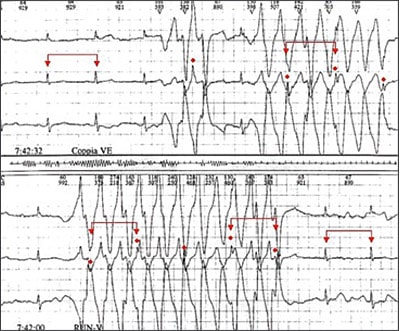
Toothbrushing mimicking wide-complex tachycardia. Portions of the QRS complexes are visible within the artifact (solid circles) at the sinus-cycle length (arrows).
This case demonstrates characteristics that may be helpful in differentiating artifact from true ventricular tachycardia: the absence of symptoms during the event, normal QRS complexes within the arrhythmia, and an association with body movement.1
