

The ecology of medical care changes for older people, with increases in usage of residential and institutional care, emergency departments, and home care. Care integrated across multiple settings, as is proposed for new models of primary care, is essential for the care of older patients.
The prevalence of multiple chronic conditions and the transitions of care between settings distinguish the health care of older adults and complicate the integration of their care. For most people in the United States, the office of a physician is the major platform of health care delivery and a natural location from which agreed-upon goals and management plans can be sustained in a continuous healing relationship with a trusted clinician. Increasing age is associated with greater use of a variety of other care settings, requiring a more sophisticated role for primary care (see accompanying table and figure).1,2
Estimated Number of Persons per 1,000 per Month Who Receive Care in Each Setting
| 65 to 74 years of age | 75 to 84 years of age | 85 years of age and older | 65 years of age and older† | |
|---|---|---|---|---|
| Office | 364 | 417 | 384 | 384 |
| HOC | 53 | 54 | 25 | 51 |
| Hospital | 15 | 26 | 29 | 20 |
| ED | 12 | 15 | 26 | 14 |
| Any home care services | 33 | 99 | 245 | 74 |
| Formal home care | 37 | 87 | 133 | 65 |
| SNF | 7 | 27 | 104 | 25 |
| ICF | 5 | 23 | 102 | 22 |
| Hospice | 1 | 2 | 5 | 2 |
HOC = hospital outpatient clinic; ED = emergency department; SNF = skilled nursing facility; ICF = immediate-care facility.
*—The same person may receive care in more than one setting.
†—This column, based upon a sample of 1,000 patients in the 65 and older group, represents the experience of the Medicare population.
note: The period from 1996 to 1997 was analyzed to allow direct comparison to similar analyses for the entire population of the United States.2 Figures are rounded to the nearest integer.
Figure.
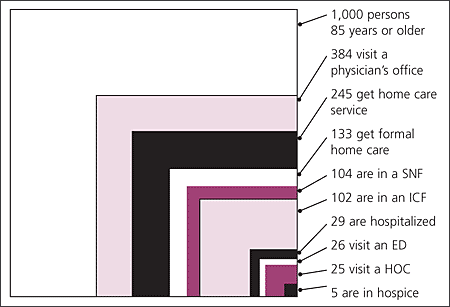
Monthly ecology of medical care for persons 85 years or older.* (SNF = skilled nursing facility; ICF = immediate-care facility; ED = emergency department; HOC = hospital outpatient clinic.)
The same person may receive care in more than one setting.
Information from references 1 and 2.
This extension of the ecology model of health care2 to include institutionalized older patients demonstrates a dramatic shift of care to long-term care facilities, emergency departments, and in-home services. As new models of primary care are elaborated3 they must incorporate systems that integrate the care of older patients, many of whom will not be seen in the office setting. Older people and their families need a physician who sticks with them and whom they can trust to ensure safe health care transitions that are faithful to their needs and goals.
