

Hematospermia can be a distressing symptom for patients, but most cases are effectively managed by a primary care physician. Although the condition is usually benign, significant underlying pathology must be excluded by history, physical examination, laboratory evaluation, and, in select cases, other diagnostic modalities. In men younger than 40 years without risk factors (e.g., history of cancer, known urogenital malformation, bleeding disorders) and in men with no associated symptoms, hematospermia is often self-limited and requires no further evaluation or treatment other than patient reassurance. Many cases are attributable to sexually transmitted infections or other urogenital infections in men younger than 40 years who present with hematospermia associated with lower urinary tract symptoms. Workup in these patients can be limited to urinalysis and testing for sexually transmitted infections, with treatment as indicated. In men 40 years and older, iatrogenic hematospermia from urogenital instrumentation or prostate biopsy is the most common cause of blood in the semen. However, recurrent or persistent hematospermia or associated symptoms (e.g., fever, chills, weight loss, bone pain) should prompt further investigation, starting with a prostate examination and prostate-specific antigen testing to evaluate for prostate cancer. Other etiologies to consider in those 40 years and older include genitourinary infections, inflammations, vascular malformations, stones, tumors, and systemic disorders that increase bleeding risk.
Presence of blood in the semen, known as hematospermia or hemospermia, is often a frightening finding for patients. The incidence of hematospermia is difficult to quantify because most men do not observe their semen.1,2 Prevalence in clinical settings is highest in men younger than 40 years.3 Most cases of hematospermia can be appropriately managed by primary care physicians. Hematospermia is commonly benign and self-limited, especially in men younger than 40 years without risk factors and in men with no associated symptoms. These patients need minimal investigation, and they can be reassured if workup findings are negative, or treated if indicated. Patients with risk factors or associated symptoms, patients 40 years and older, and patients with persistent or recurrent hematospermia need more extensive evaluation and may need to be referred to a urologist.
SORT: KEY RECOMMENDATIONS FOR PRACTICE
| Clinical recommendation | Evidence rating | References |
|---|---|---|
| Men younger than 40 years with limited episodes of hematospermia and no risk factors or associated symptoms can be evaluated for common genitourinary diseases, treated if indicated, and reassured. | C | 1 |
| Men with hematospermia who are 40 years and older, have associated symptoms, or have persistent hematospermia need more extensive evaluation, including assessment for underlying prostate cancer. | C | 4 |
| Low-volume hematospermia associated with iatrogenic etiologies is often self-limiting; therefore, observation is the most appropriate management strategy. | C | 4 |
A = consistent, good-quality patient-oriented evidence; B = inconsistent or limited-quality patient-oriented evidence; C = consensus, disease-oriented evidence, usual practice, expert opinion, or case series. For information about the SORT evidence rating system, go to https://www.aafp.org/afpsort.xml.
Etiology
Until recent decades, hematospermia was not considered clinically significant, and it was mostly attributed to prolonged sexual abstinence or intense sexual experiences because a precise etiology could not be determined in as many as 70 percent of patients who presented with it.3–5 Although prolonged sexual abstinence, excessive masturbation, and rigorous sexual intercourse are still considered causes of hematospermia,1 advancements in medical imaging and laboratory techniques have allowed physicians to determine a more precise cause in up to 85 percent of hematospermia cases, many of which are benign.6 Of specific etiologies, infectious conditions are the most common, accounting for approximately 40 percent of hematospermia cases.3,4 Other etiologies include inflammatory, neoplastic (e.g., prostate cancer, testicular cancer),7,8 iatrogenic (e.g., prostate biopsy [most common], prostate surgery, urologic instrumentation, radiation therapy, hemorrhoid injections),9 structural, systemic, and vascular causes (Table 17–21).
Table 1. Etiologies of Hematospermia and Their Typical Presentations
| Etiology | Typical presentation |
|---|---|
| Behavioral* | |
| Excessive sex or masturbation | Isolated hematospermia episode triggered by particular sexual behavior |
| Interrupted sex | |
| Prolonged sexual abstinence | |
| Infectious* | |
| Echinococcus (rare) | Irritative genitourinary symptoms; urinalysis positive for inflammation; positive microbiology findings |
| Gram-positive and gram-negative uropathogens | |
| Mycobacterium tuberculosis (rare) | |
| Schistosoma (rare) | |
| Sexually transmitted infections: Chlamydia trachomatis; Neisseria gonorrhoeae; herpes simplex virus types 1 and 2 urethritis; urethral human papillomavirus | |
| Inflammatory | |
| Chemical epididymitis | Irritative genitourinary symptoms; urinalysis positive for inflammation; negative microbiology findings |
| Interstitial, eosinophilic, proliferative cystitis | |
| Prostatitis | |
| Seminal vesiculitis | |
| Neoplastic | |
| Benign and malignant tumors of the bladder, urethra, prostate, seminal vesicles, spermatic cord, epididymis, and testes | Abnormal findings on examination or imaging |
| Structural | |
| Ectopic prostatic tissue or prostatic polyps | Voiding problems |
| Intraprostatic Müllerian duct remnants | |
| Prostatic stones, cysts, benign prostatic hyperplasia | |
| Urethral stricture, fistula, diverticula | |
| Systemic | |
| Amyloidosis | Hematospermia associated with systemic disease without other explanations |
| Bleeding disorders | |
| Chronic liver disease | |
| Severe uncontrolled hypertension | |
| Trauma (iatrogenic)* | |
| Hemorrhoid injections | Temporary hematospermia related to trauma |
| Penile injections | |
| Prostate biopsy, radiation therapy, brachytherapy, microwave therapy, transurethral resection of the prostate | |
| Urethral instrumentation | |
| Urethral stent migration | |
| Vascular | |
| Arteriovenous malformations | Isolated hematospermia episode, or hematospermia associated with hematuria |
| Bladder neck and prostatic varices, submucosal bleeding, hemangiomas, telangiectasias | |
*— Most common causes of hematospermia.
Evaluation
The goal of clinical assessment is to identify significant or treatable underlying causes of hematospermia.1 The foundation for a comprehensive evaluation includes a thorough patient history and physical examination. Figure 1 presents an algorithm for the evaluation of hematospermia.7,8
Figure 1. Hematospermia Evaluation
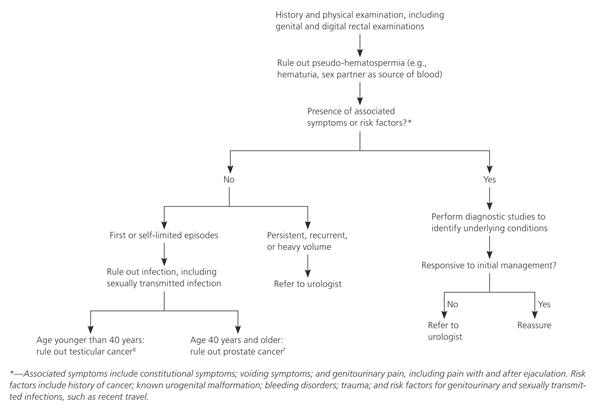
Algorithm for the evaluation of hematospermia.
Information from references 7 and 8.
HISTORY
The first step of the history is to rule out pseudo-hematospermia (Table 2) by determining if hematuria is being misinterpreted as hematospermia or if the blood may have been from the patient's sexual partner (e.g., ask about his partner's possible menstruation or genitourinary infection, and about intense sexual behavior).1,4
Table 2. Possible Causes of Pseudo-Hematospermia
| Cause | Diagnostic studies | Initial management |
|---|---|---|
| Hematuria | Urinalysis, computed tomography–intravenous pyelogram | Treat if indicated versus urology or nephrology referral |
| Sexual partner source | Condom test or sperm sample from self-stimulation, if needed | Patient reassurance, if negative |
| Melanospermia (melanoma metastasis to prostate; very rare) | Skin examination; semen analysis with or without chromatography, if suspected | Oncology referral |
Once true hematospermia has been confirmed, three key factors help guide further evaluation: age of the patient, duration of symptoms, and presence of associated symptoms or risk factors (Tables 3 and 4). In men younger than 40 years, risk factors of behavior-related hematospermia or infectious etiologies should be assessed. In men 40 years and older, neoplasia or structural abnormalities should be more strongly considered. Hematospermia that is limited to a few episodes usually has an identifiable etiology (e.g., infection, intense sexual experiences) and is less concerning than persistent or recurring hematospermia, which can indicate a pathologic condition.
Table 3. Evaluation and Initial Management of Isolated Hematospermia
| Differential diagnosis | Diagnostic studies | Initial management |
|---|---|---|
| First episode of hematospermia* | ||
| Excessive sex or masturbation; interrupted sex; prolonged sexual abstinence | Urinalysis | Patient reassurance, education |
| STI | STI testing based on risk stratification | Treat as indicated, patient education |
| Urinary tract infection | Urinalysis and culture | Treat as indicated, patient education |
| Benign prostate hyperplasia† | American Urological Association symptom index, postvoid residual | Monitoring versus pharmacologic treatment |
| Prostate cancer† | Prostate-specific antigen | Urology referral for prostate biopsy |
| Persistent, recurrent, or high-volume hematospermia | ||
| Vascular (prostate or urethral varices, hemangioma) | Urinalysis | Urology referral for fulguration |
| Tumors (bladder, urethra, prostate, seminal vesicles, spermatic cord, epididymis, testes) | Urinalysis, urine cytology | Urology referral |
| Bleeding diathesis | Prothrombin time, partial thromboplastin time, complete blood count | Treat as indicated |
note:Isolated hematospermia is hematospermia with no associated symptoms or obvious etiology.
STI = sexually transmitted infection.
*— Blood in fewer than 10 consecutive ejaculations or for less than 12 weeks.
†— In patients 40 years and older.
Relevant associated symptoms include genitourinary pain or voiding symptoms. Pain with urination may suggest urethritis, cystitis, or prostatitis, whereas pain with bladder distention usually indicates cystitis. Pain with ejaculation may be associated with prostatitis or obstruction of an ejaculatory duct. Voiding symptoms may indicate primary or secondary involvement of the bladder or bladder outlet, such as dysfunctional conditions or morphologic abnormalities. Ascertaining the patient's sexual history and history of iatrogenic injury is important because sexually transmitted infections (STIs) and instrumentation, biopsy, or other procedures are leading causes of hematospermia.
Systemic diseases that may be associated with hematospermia include bleeding disorders; liver disease, which can affect clotting factor production; and severe uncontrolled hypertension (demonstrated in a limited case-control study22), which is attributed to interference with clotting.22,23 Constitutional symptoms (e.g., weight loss, night sweats, fever, chills, bone pain) may indicate a neoplastic or infectious source. Travel and medication history also may point to a source (e.g., tuberculosis exposure, Schistosoma infection, warfarin [Coumadin] use).13
Table 4. Evaluation and Initial Management of Hematospermia with Associated Conditions or Symptoms
| Associated condition or symptom | Differential diagnosis | Diagnostic studies | Initial management | |
|---|---|---|---|---|
| Trauma | ||||
| Self-inflicted | Abrasion | Urinalysis | Monitor | |
| Foreign body | Urinalysis; urine culture, if indicated | Urology referral for endoscopy | ||
| Arteriovenous fistula (e.g., secondary to penile injections) | — | Urology referral for penile Doppler study | ||
| Iatrogenic* | Trauma, inflammation, or infection | Urinalysis; urine culture, if indicated | Monitor, anti-inflammatories or antibiotics if indicated, consider urology referral | |
| Genitourinary infection or inflammation | Urinary tract infection or STI | Urinalysis, STI testing | Treat as indicated, consider urology referral | |
| Prostatitis | Localization studies† with or without sperm culture | |||
| Epididymitis | Urinalysis, urine culture with or without scrotal Doppler ultrasonography | |||
| Voiding symptoms | Benign prostate hyperplasia | American Urological Association symptom index, post-void residual | Alpha blocker with or without 5-alpha reductase inhibitor | |
| Bladder neck dysfunction | Urinalysis | Alpha blocker | ||
| Prostate cancer | Prostate-specific antigen | Urology referral | ||
| Urethral stricture | Urinalysis, post-void residual | Urology referral | ||
| Cystitis (interstitial or eosinophilic) | Urinalysis | Urology referral | ||
| Pain with ejaculation | Prostatitis | Localization studies† with or without sperm culture | Treat as indicated | |
| Obstruction of ejaculatory duct by stones, strictures, polyps, tumors, cysts | Transrectal ultrasonography or prostate magnetic resonance imaging | Urology referral | ||
| Systemic disorders | Hypertension | Blood pressure, serum creatinine, urinalysis with protein quantification | Treat underlying disorder | |
| Bleeding disorder | Prothrombin time, partial thromboplastin time, CBC | |||
| Malignancy (leukemia, lymphoma) | CBC with differential | |||
| HIV, immunosuppression | HIV screening, purified protein derivative | |||
| Liver disease | Complete metabolic panel, hepatitis panel | |||
| Travel or exposure history | Tuberculosis | Purified protein derivative testing, urine acid-fast bacillus, chest radiography | Treat as indicated, or infectious disease referral | |
| Schistosomiasis | Computed tomography–intravenous pyelogram; urine, semen, and stool analysis for Schistosoma | |||
CBC = complete blood count; HIV = human immunodeficiency virus; STI = sexually transmitted infection.
*— Includes prostate biopsy (most common), prostate surgery, urologic instrumentation, radiation therapy, or hemorrhoid injections.
†— Localization of the site of infection requires four fluid samples: first void, midstream void, expelled prostatic secretions, and post-prostatic massage void.
PHYSICAL EXAMINATION
Elevated blood pressure, fever, and tachycardia may indicate a systemic cause, such as severe uncontrolled hypertension, infection, or malignancy. Detailed abdominal and genitourinary examinations should be performed to assess for trauma, inflammation, discharge, and lymphadenopathy. Full scrotal examination is important to evaluate for inflammation; infection; and masses of the testes, epididymis, and spermatic cords.14 Rectal examination is needed to check the prostate for size, tenderness, fluctuation, symmetry, firmness, and nodularity.1,3
FURTHER TESTING
Usually, hematospermia has resolved by the time a patient sees his physician. If the patient has no risk factors or associated symptoms, he should be reassured that such self-limited hematospermia needs no further evaluation or treatment. However, in most patients with ongoing lower urinary tract symptoms, urinalysis should be performed and testing for genitourinary infections, including STIs, should be considered (Table 3).
Minimal, directed laboratory evaluation usually leads to a diagnosis, and patients often have quick resolution with treatment. However, certain associated symptoms and laboratory findings require prompt subspecialty referral and intervention (Table 5). For example, if results of the prostate examination are abnormal or if the prostate-specific antigen level is elevated, a prostate biopsy is indicated to evaluate for malignancy. Urology referral should also be considered for a patient whose history, physical examination, and initial laboratory workup do not lead to a diagnosis, yet hematospermia persists or recurs. Urologists use several additional tools to evaluate patients with hematospermia, including urethrocystoscopy, transrectal ultrasonography with or without Doppler vascular evaluation, scrotal ultrasonography, magnetic resonance imaging, and computed tomography.1,3,19,24
Table 5. Indications for Hematospermia Urology Referral
| Based on symptoms: |
| Hematospermia associated with genitourinary pain |
| Hematospermia associated with unexplained voiding symptoms |
| Recurrent, persistent, high-volume hematospermia |
| Based on evaluation: |
| Abnormal examination findings suggestive of tumor or structural problems |
| Abnormal prostate-specific antigen findings |
| Abnormal urinalysis findings (hematuria, sterile pyuria) |
| Suspected foreign body, stent migration |
| Suspected vascular malformation |
| Based on lack of response to initial management: |
| Symptoms or abnormal findings persist |
Treatment
If treatment is necessary, it should be directed at the diagnosed etiology. Appropriate antibiotics are indicated in patients with genitourinary infection. If infection is suspected, yet none is found, empiric two-week treatment with an antibiotic that penetrates the prostate-blood barrier (e.g., fluoroquinolones, doxycycline, trimethoprim, trimethoprim/sulfamethoxazole [Bactrim, Septra]) may be beneficial, with follow-up if symptoms recur or persist.1 Iatrogenic causes of hematospermia usually resolve spontaneously within a few weeks or approximately 10 ejaculations.4,9,25–27 Other treatments for hematospermia are usually initiated under the direction of a urologist, and include transurethral endoscopic resection, incision, fulguration, or marsupialization.1,16,18,19,21
Monitoring and Referral
Most men with an easily treatable cause of hematospermia do not need follow-up. Men with recurrent or persistent isolated hematospermia or symptomatic men in whom an etiology is not elucidated require follow-up within three to six months to reassess symptoms and potential etiologic factors. Poor response to treatment or troublesome associated symptoms or findings should prompt referral to a urologist (Table 5).
