

A 44-year-old man presented with a focal patch of hair loss in his beard that had been present for about two months. It was not itchy or painful. His history findings were unremarkable.
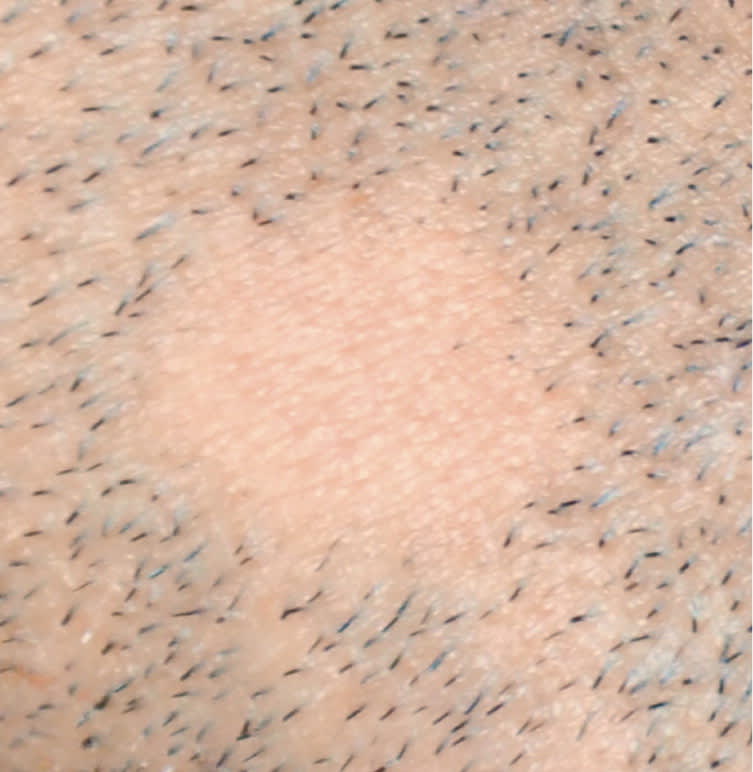
Physical examination revealed a well-circumscribed, hairless patch on the right jawline (Figures 1 and 2). The patch was 1 × 1 cm and smooth. There was no surrounding erythema or scale, and no cervical lymphadenopathy. There were no other lesions.
Figure 1.
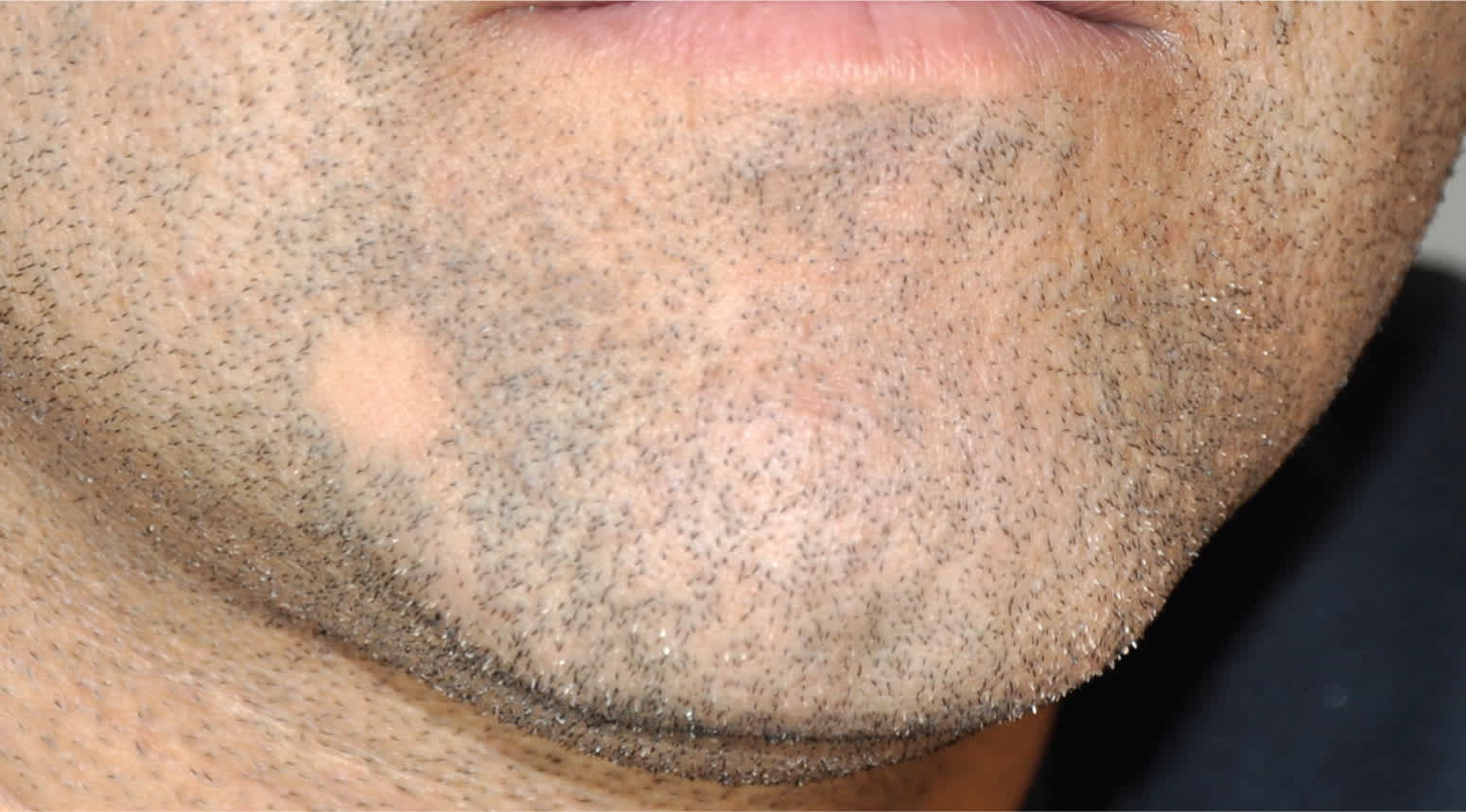
Figure 2.
Question
Based on the patient's history and physical examination findings, which one of the following is the most likely diagnosis?
A. Alopecia areata.
B. Cicatricial alopecia.
C. Tinea barbae.
D. Traction alopecia.
E. Trichotillomania.
Discussion
The answer is A: alopecia areata. This T cell–mediated autoimmune disease has a lifetime prevalence of about 2%.1 It is characterized by a localized area of complete hair loss with normal skin pattern. Alopecia areata has a sudden onset and may involve the entire scalp (alopecia totalis) or the entire body (alopecia universalis).2 Alopecia areata increases the risk of other autoimmune disorders.3
The diagnosis is usually made clinically; however, a skin biopsy may be performed if the diagnosis is unclear.1,4,5 Spontaneous remission is common and usually occurs within six to 12 months.1,2 Topical, intralesional injection and, occasionally, systemic glucocorticoids are used for treatment.1,2,5 Immunomodulating agents (e.g., irritant dithranol, diphenylcyclopropenone) and topical minoxidil have been used with variable results.1,4,5
Cicatricial alopecia is permanent hair loss caused by destruction of the hair follicles by inflammatory or autoimmune diseases, commonly discoid lupus erythematosus.2,5 The condition causes folliculitis and eventually leads to scarring and skin atrophy.
Tinea barbae is an uncommon fungal infection that most often occurs in farm workers.6 It usually causes pruritic, erythematous, and scaling patches with fragile, broken hairs.2,5 Pulling infected hairs is usually painless.6
Traction alopecia is unintentional hair loss due to high-tension grooming style.2,5Although it can occur in the beard, it is more common on the scalp. In rare cases, chronic traction alopecia results in folliculitis and scar formation.5
Trichotillomania is a compulsive disorder that involves repetitive hair pulling.2,5 The most common location is the scalp.2 Scar formation occurs in rare cases.2,5
Summary Table
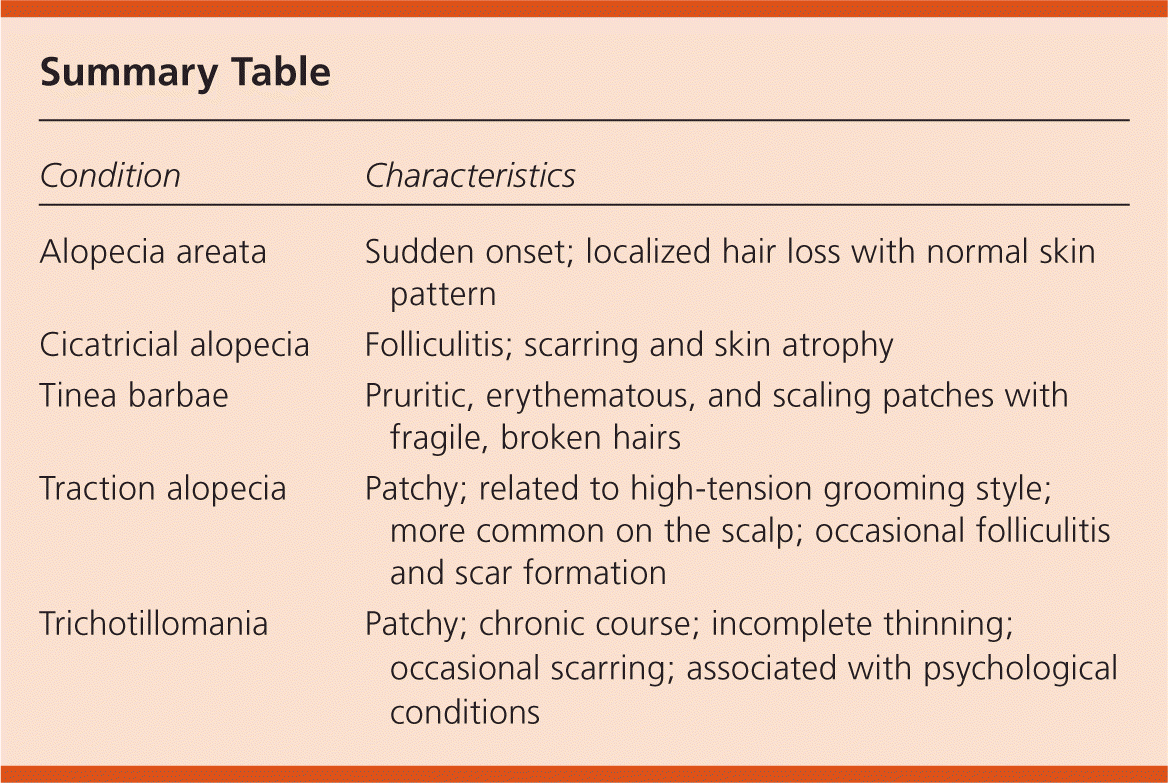
| Condition | Characteristics |
|---|---|
| Alopecia areata | Sudden onset; localized hair loss with normal skin pattern |
| Cicatricial alopecia | Folliculitis; scarring and skin atrophy |
| Tinea barbae | Pruritic, erythematous, and scaling patches with fragile, broken hairs |
| Traction alopecia | Patchy; related to high-tension grooming style; more common on the scalp; occasional folliculitis and scar formation |
| Trichotillomania | Patchy; chronic course; incomplete thinning; occasional scarring; associated with psychological conditions |
