


HYPERPRONATION METHOD FOR REDUCTION OF NURSEMAID'S ELBOW
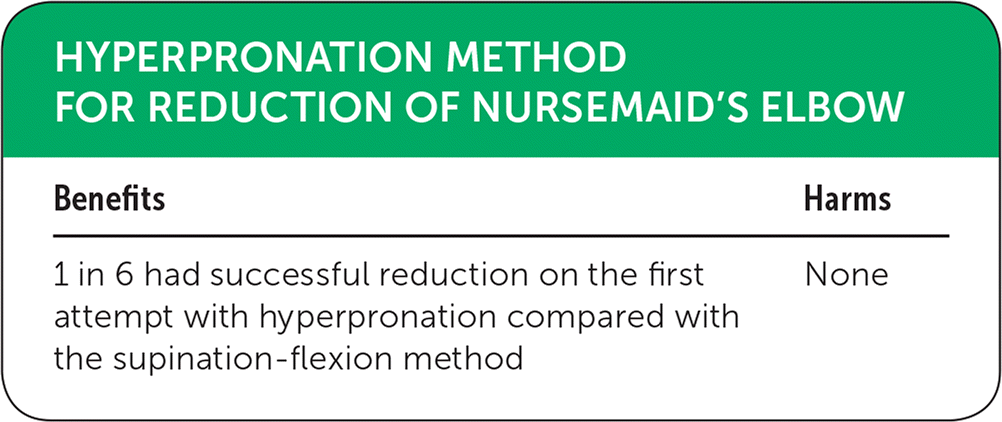
| Benefits | Harms |
|---|---|
| 1 in 6 had successful reduction on the first attempt with hyperpronation compared with the supination-flexion method | None |
Details for This Review
Study Population: Children younger than seven years with nursemaid's elbow
Efficacy End Points: Successful first attempt at reduction of radial head subluxation (nursemaid's elbow).
Harm End Points: Failure of reduction of nursemaid's elbow
Narrative: Radial head subluxation, also known as nursemaid's elbow, is a common injury in children younger than seven years, with peak incidence occurring between two and three years of age.1–3 It typically arises from a sudden upward pull of the arm. As axial traction is placed on the forearm, the radius is pulled through the annular ligament, resulting in subluxation of the radial head, which can cause acute onset of pain and limited mobility of the arm.2 This injury is treated with manual reduction of the subluxed radial head.1,2 Historically, various reduction maneuvers have been described, but the two most common are supination with flexion and the hyperpronation method.4,5 Supination-flexion is the traditional method taught in most textbooks; however, it is unclear whether either maneuver offers a higher rate of success while limiting potential adverse effects.
A 2017 Cochrane review included nine trials, eight of which specifically compared supinationflexion with the hyper-pronation method. A total of 811 children younger than seven years were recruited. Data from those trials suggested that hyperpronation resulted in a higher rate of first attempt success than supination-flexion (90.8% vs. 73.6%, respectively). This translates to a 17.2% absolute increase in the rate of first attempt success favoring hyperpronation (95% confidence interval [CI], 13.4% to 20.1%); six patients would need to be treated with the hyperpronation method to have one additional episode of treatment success (95% CI, 5 to 9).6
Although data are limited, the results have consistently shown a higher rate of success with first attempt reduction when the hyperpronation method was used. For other outcomes, including pain and adverse effects such as bruising, no conclusions could be drawn because the quality of evidence was poor.6
Caveats: Given the small number of studies, all of which had selection bias and lacked blinding, the quality of the evidence remains low. In addition, although a few of the studies reported on pain, there were no studies that reported on adverse effects of the maneuvers. Despite these limitations, until larger more methodologically robust randomized controlled trials are conducted, a strategy using hyperpronation as the initial method in reducing nursemaid's elbow seems reasonable.6
